Why Are There 60 Minutes in an Hour?
The 60-minute hour comes from ancient sexagesimal, or base-60, mathematics. Egypt’s division of day and night into 12 parts each helped shape the 24-hour day, while equal-length hours came later.
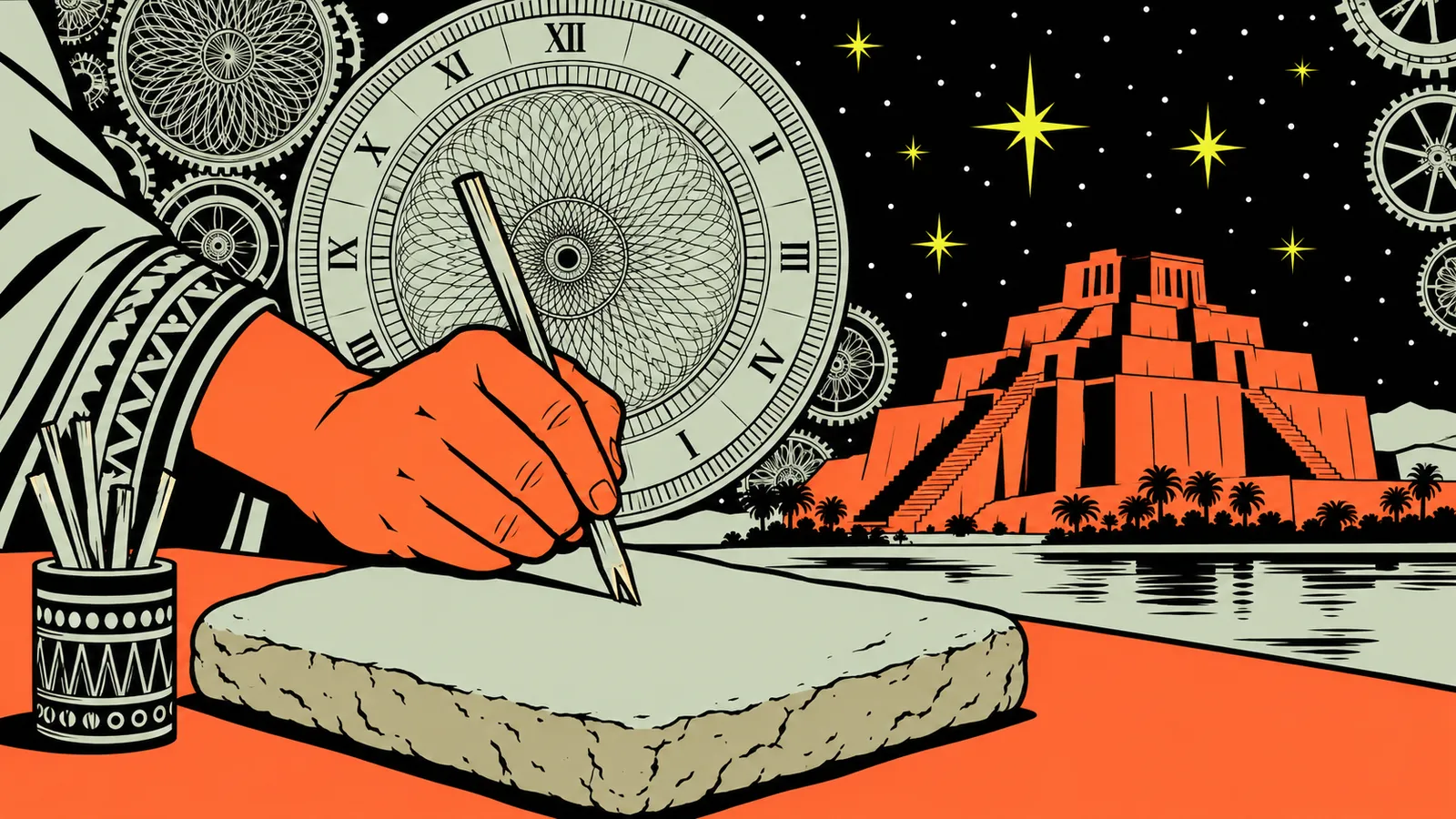
An hour has 60 minutes because ancient astronomers used a base-60 number system to divide quantities, and that convention eventually became part of timekeeping. The 24-hour day has a separate historical strand: ancient Egyptians divided daytime and nighttime into 12 parts each, though those early hours varied in length with the seasons. NIST explains how these older divisions led to the hours, minutes, and seconds used today.
- IBase 60 is also called the sexagesimal system.
- IIEgyptians divided day and night into 12 parts each.
- IIIEarly seasonal hours were not always equal in length.
- IVPtolemy described minutes and seconds in astronomy around 150 CE.
- VToday, an hour contains 60 minutes and 3,600 seconds.
The short answer: an hour inherited base 60
The number 60 is a legacy of ancient mathematics, not a measurement that nature requires. In a sexagesimal system, quantities are organized around 60, just as the decimal system organizes many everyday quantities around 10. Ancient Babylonian astronomers used sexagesimal calculations, and the convention became especially influential in astronomy, where people worked with angles and the apparent motions of celestial bodies.
The number is practical because it divides evenly by many small whole numbers. You can split 60 into halves, thirds, quarters, fifths, sixths, tenths, or twelfths without needing a fraction of a minute. That flexibility matters when you want to describe portions of an hour in familiar whole numbers. Royal Museums Greenwich notes 60’s many useful divisors, while NIST describes Babylonian astronomical calculations using base 60.
| Share of an hour | Minutes | Why it is useful |
|---|---|---|
| One-half | 30 | Half an hour |
| One-third | 20 | Three equal parts |
| One-quarter | 15 | Four equal parts |
| One-fifth | 12 | Five equal parts |
| One-sixth | 10 | Six equal parts |
| One-tenth | 6 | Ten equal parts |
The same base-60 pattern appears one level down: each minute contains 60 seconds. If you need to total elapsed time in a schedule, an hours calculator can handle the arithmetic while the familiar 60-part structure makes estimates easy.
How Egypt’s 12-part day helped create 24 hours
The 60-minute hour and the 24-hour day are related in modern clocks, but they did not come from one single invention. Ancient Egyptians divided the daylight period into 12 parts and the night into 12 parts. Put together, those two groups give 24 parts across a full day-and-night cycle. NIST describes this Egyptian division as an early foundation for the 24-hour day.
Those first hours were not necessarily the same duration as the hours on your clock. Daylight changes length through the seasons, so dividing daylight into 12 equal portions makes each portion longer in summer and shorter in winter. Nighttime hours varied too. NIST’s history of early timekeeping describes an Egyptian shadow clock that divided a sunlit day into 10 parts plus two twilight hours, illustrating that early systems could divide the day in ways unlike today’s fixed clock hours.
That difference is easy to miss: “12 hours of daylight” in an ancient seasonal system did not always mean the same elapsed duration as “12 hours” on a modern clock. The modern 24-hour day is a consistent framework, not a promise that daylight itself lasts 12 hours. For planning around daylight, use a sunrise and sunset tool; for a specific interval, a time-duration calculator can show the elapsed clock time.
NIST’s history of the second describes the Egyptian 12-and-12 division and the later development of equal hours. The NIST account of early clocks gives examples of shadow clocks and other ways people tracked time.
Why modern hours are equal in length
For a clock to support schedules and precise timing, its hours need to be consistent. But equal-length hours were not always the everyday standard. According to NIST, ancient Greeks proposed dividing the day into 24 equal hours, while people continued using hours of uneven length until late medieval Europe. Hellenistic astronomers also introduced equinoctial hours, which had equal lengths rather than changing with the season.
Mechanical clocks helped make fixed hours useful for ordinary life. NIST notes that, in the late medieval period, monks developed mechanical clocks to establish regular periods for prayer and work. Once a clock could count repeating intervals, it could mark equal portions of time without relying on the changing length of daylight. A clock needs a regular process and a way to count and display its increments, as NIST’s early-clock overview explains.
That shift also changed the meaning of an hour. A modern hour is always 60 minutes, whether it is summer or winter. The Sun’s position still matters for sunrise, sunset, and local solar time, but it does not change the length of the hour on your wall clock. For a worked schedule, you can add or subtract clock times with an add-time calculator, or total a shift with a time-card calculator.
For more on the devices behind that change, see our guide to timekeeping from sundials to atomic clocks.
Minutes and seconds started as astronomical subdivisions
Minutes and seconds did not begin as tiny marks on a wristwatch. Their history is tied to dividing measurements in astronomy. NIST explains that the Sumerians divided a circle into 360 degrees, and that Babylonian astronomers and Greeks later applied that division to the sky. Around 150 CE, the astronomer Ptolemy described dividing each degree into 60 minutes and each minute into 60 seconds in his Almagest.
The names preserve the idea of successive subdivisions. NIST notes that “minute” comes from the first fractional sexagesimal place and “second” from the second. In other words, the terminology reflects an old way of splitting a unit into smaller and smaller parts. Those subdivisions began in astronomy and later entered mechanical timekeeping in medieval Europe.
That history helps explain why the hour has 60 minutes, but it does not mean ancient clocks were already showing the precise minute-by-minute time you see now. Early devices such as sundials and water clocks had practical limits, and a sundial depended on the Sun. A water clock could measure time without sunlight, though water flow could be difficult to control accurately. If you want to explore a fixed short interval, use a timer; modern tools can count subdivisions consistently in a way early devices could not.
For a longer explanation of how the second’s definition changed, NIST traces the path from astronomical divisions to modern time measurement.
Why 60 is convenient for everyday calculations
Base 60 is useful because it offers many clean divisions. You can divide an hour into two, three, four, five, six, or ten equal portions and still get a whole number of minutes. That makes mental arithmetic straightforward: a quarter hour is 15 minutes, a third of an hour is 20 minutes, and one-tenth is 6 minutes. The number 60 does not make time more accurate by itself; it makes common subdivisions easier to express.
Compare that with a number that has fewer divisors. If an hour contained 100 smaller units, thirds would not come out to a whole number of those units. With 60, a person can describe an appointment as half an hour, a 20-minute segment, or a 15-minute quarter without converting to decimals. That is handy for timetables, work shifts, and everyday estimates.
Here is the basic arithmetic behind a familiar conversion: 60 minutes per hour multiplied by 60 seconds per minute gives 3,600 seconds in an hour. To calculate a time span that crosses an hour boundary, keep the minutes separate from the hours rather than treating the clock as a decimal number. For instance, 1 hour 30 minutes means 90 minutes, not 1.30 hours. An elapsed-time calculator can help check the result when a duration crosses midnight or includes several intervals.
Royal Museums Greenwich summarizes the convenience of 60; the arithmetic above follows directly from 60 minutes per hour and 60 seconds per minute.
What would change in a decimal-time system?
It is possible to imagine time divided using base 10, but the arithmetic depends on what you choose to keep fixed. For example, if you kept the 24-hour day but divided each existing hour into 100 smaller units, each unit would equal 36 seconds: 3,600 seconds divided by 100. Those units would be decimal fractions of an hour, not today’s conventional minutes.
A more complete redesign could divide the full day into 10 large units, then divide each of those into 100 smaller units and each smaller unit into 100 parts. The numbers would look tidy in base 10, but the units would not match the current hour, minute, or second. Converting appointments, work records, scientific measurements, and everyday routines would require a shared change in notation and practice.
The practical point is that decimal arithmetic is not automatically better for every measurement. The current system combines a 24-part day with 60-minute hours and 60-second minutes. Its divisions are convenient for halves, thirds, quarters, and other common fractions, while decimal units are convenient for powers of 10. The two systems optimize different kinds of calculation.
The verified historical sources for this guide document the origins and use of sexagesimal divisions, but do not establish a particular historical decimal-time reform, so this comparison is a mathematical illustration rather than a claim about a specific attempt. For everyday scheduling, use standard clock time and convert only when a task specifically requires a decimal duration.
How the modern second is defined
The hour and minute are familiar units, but the modern second is defined with extraordinary precision. NIST says the SI second is based on a particular transition in the cesium-133 atom: one second corresponds to 9,192,631,770 cycles of radiation associated with that transition. This atomic definition gives timekeeping a stable reference that does not depend on the length of a shadow or the flow of water.
A modern clock still works by counting repeating events. A quartz watch counts crystal vibrations, while atomic clocks count a frequency associated with atoms. NIST describes clocks generally as devices that count a periodic event with a known frequency. The second is defined at the atomic level; minutes and hours are then built from those seconds through the familiar 60-to-1 relationships.
| Clock unit | Equivalent in minutes | Equivalent in seconds |
|---|---|---|
| 1 minute | 1 | 60 |
| 1 hour | 60 | 3,600 |
| 24 hours | 1,440 | 86,400 |
The last row follows by simple arithmetic: 24 multiplied by 60 is 1,440 minutes, and 1,440 multiplied by 60 is 86,400 seconds. If you need to compare a stated time across places, use a time zone converter; changing time zones changes the displayed clock time, not the length of the hour.
NIST’s clock FAQ covers periodic events and atomic standards, and its SI-second guide gives the formal definition.
Common mistakes when converting hours and minutes
The most common error is treating minutes as if they were hundredths of an hour. Clock notation is not decimal notation: 1:30 means 1 hour and 30 minutes, or 1.5 hours. It does not mean 1.30 hours. To convert minutes to a decimal part of an hour, divide the minutes by 60. For example, 30 divided by 60 is 0.5, so 1 hour 30 minutes equals 1.5 hours.
A second source of confusion is mixing duration with time of day. “Two hours” is an elapsed interval; “2:00 p.m.” is a position on the clock. A third issue is forgetting that a calculation can pass midnight. If a shift begins before midnight and ends after it, the date changes even though the elapsed time is still calculated from the start and end.
For work records, enter the actual start and end times and account for unpaid breaks according to your recordkeeping needs. A time-card calculator can total work intervals, while a hours calculator can help convert hours and minutes. For a countdown to a particular event, use a countdown tool.
Remember the main distinction: the 60-minute hour is a historical convention, but the arithmetic is exact once you are using modern clock time. There are 60 minutes in an hour and 60 seconds in a minute, so multiplying or dividing by 60 is the reliable way to convert between those units.
Questions people ask
Who decided that an hour has 60 minutes?
There was no single modern decision-maker. The system grew from ancient sexagesimal mathematics used in astronomy. NIST traces the divisions of degrees, minutes, and seconds through Babylonian and Greek astronomical work and notes that they later became part of mechanical timekeeping.
Did the ancient Egyptians invent the 24-hour day?
Egyptians divided daytime and nighttime into 12 parts each, making 24 parts across the full cycle. Those early hours could vary in length with the season, unlike the equal-length hours on modern clocks. NIST summarizes this history.
Why is an hour 60 minutes instead of 100?
Sixty divides evenly into many useful whole-number portions, including halves, thirds, quarters, fifths, and sixths. That makes common fractions of an hour easy to express as whole minutes. A 100-part hour would suit decimal arithmetic, but thirds would not divide into a whole number of those units.
Did ancient people’s hours last the same amount of time as ours?
Not always. Seasonal hours divided daylight or darkness into equal portions of that changing period, so their duration varied with the season. Equal-length hours were proposed by Greek thinkers, but NIST notes that unequal hours continued in use until late medieval Europe.
How many seconds are in an hour?
There are 3,600 seconds in an hour: 60 minutes multiplied by 60 seconds per minute. The modern SI second is defined using 9,192,631,770 cycles of radiation associated with a cesium-133 atomic transition, according to NIST.
Is 1 hour and 30 minutes the same as 1.30 hours?
No. Clock minutes are not hundredths of an hour. One hour and 30 minutes is 1.5 hours because 30 minutes is half of 60 minutes. The notation 1.30 hours, read as a decimal, means 1 hour plus 0.30 of an hour, which is 18 minutes.
Sources
- Second: Introduction, NIST
- Timekeeping and clocks FAQs, NIST
- Why 12 months in a year, seven days in a week or 60 minutes in an hour?, Royal Museums Greenwich
- A Walk Through Time - Early Clocks, NIST
Edited by Leo, editor of WhatTimeIsIt.blog
Calculations on this page run in your browser using the IANA time zone database and standard calendar rules. Facts are checked against the government agency, standards body or official source linked in the text. Last reviewed November 10, 2026. See the editorial policy or report an error to hello@whattimeisit.blog.