Water Clocks: How Clepsydras Measured Time
A water clock, or clepsydra, measures time by tracking water as it flows into or out of a vessel. Its simple principle supported increasingly elaborate devices, but changing flow rates made precision difficult.
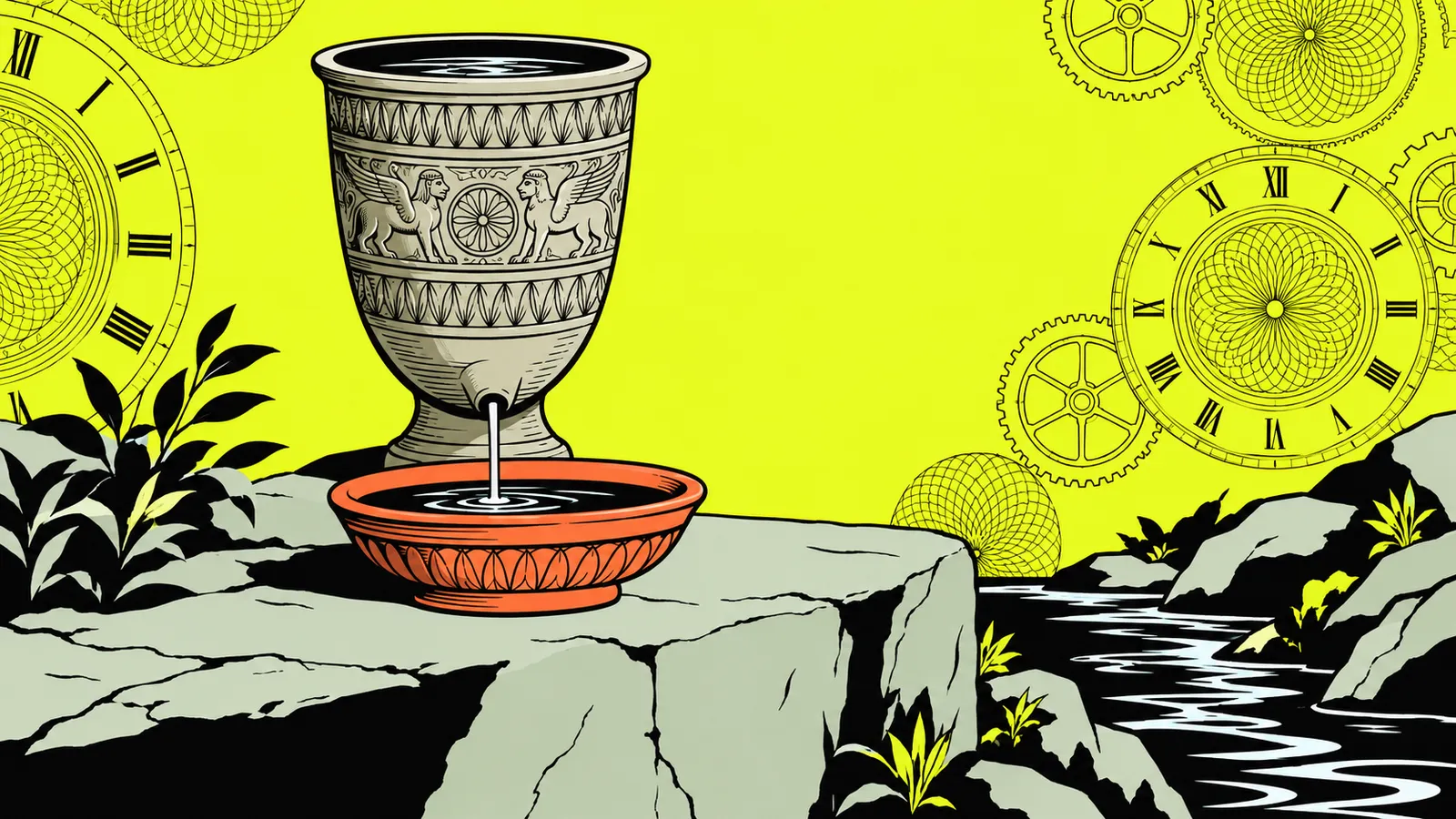
A water clock measures time by tracking a steady flow of water: some designs mark water draining from a vessel, while others measure water filling one. Egyptians, Greeks and Chinese developed distinct forms, from marked vessels to elaborate mechanical towers. Because flow changes with water level and other conditions, clepsydras were useful timekeepers but not perfectly accurate ones. Encyclopaedia Britannica describes their types and accuracy challenges.
- IClepsydra means “water thief” in Greek.
- IIEgyptian water clocks measured time at night.
- IIIGreeks used clepsydras by about 325 BCE.
- IVSu Sung’s Chinese clock tower was built in 1088 CE.
- VChanging water flow limited accuracy.
What Is a Water Clock?
A water clock is a device that measures time by tracking water as it flows. It is also called a clepsydra, from Greek words meaning “to steal” and “water.” Unlike a sundial, it does not need sunlight to show the passage of time, so it could be useful indoors, at night, or under overcast skies. Encyclopaedia Britannica notes that clepsydras often offered a more consistent measure than sundials, though their accuracy had limits.
The central idea is straightforward: use the amount of water that has moved to represent elapsed time. A user might read marks on a vessel as the water level changes, or watch a float rise as a container fills. In more complex clocks, water could power moving parts that displayed time or triggered a signal.
Water clocks belong to the history of timekeeping because they made elapsed time measurable without directly observing the sky. They were not clocks in the modern sense of a device that keeps a continuously standardized time, but they could answer practical questions: how long has passed, or when should an activity end? For a broad timeline from early devices to modern clocks, see our guide to the history of timekeeping.
Elapsed time, not always equal hours
A clepsydra could mark a duration, but its markings did not automatically correspond to equal modern hours. In ancient Egypt, hours varied with the seasons because daylight and nighttime were divided into set portions even as their lengths changed. A water clock could help track those hours, but the meaning of an “hour” depended on the timekeeping system in use.
Early Water Clocks in Egypt
Water clocks are among the earliest known ways to measure time without watching celestial bodies. The National Institute of Standards and Technology (NIST) says one of the oldest known examples was found in the tomb of Egyptian pharaoh Amenhotep I, buried around 1500 BCE. NIST’s history of early clocks describes water clocks as a practical complement to sun-based timekeeping.
Egyptian devices could be used to track nighttime hours, when a sundial could not help. A later example, an alabaster clock from Karnak associated with Amenhotep III’s reign, used carved hour markings and the water level inside the vessel. The water gradually escaped, and a reader compared the remaining level with the marks. The shape of some vessels narrowed toward the bottom to help compensate for the slowing flow as the water level fell.
This was useful because the clock did not depend on a clear sky. But the scale had to be designed for the vessel and its behavior: equal drops in water level did not necessarily represent equal periods of time. In an everyday demonstration, you could start a marked vessel at 9:00 a.m. in Cairo and compare its reading after a chosen interval, such as 15 minutes. That would illustrate elapsed time, not establish that an ancient clock used modern minute markings.
Water clocks did not replace every other method. A sundial used the Sun’s position and shadow, while a clepsydra could work when sunlight was unavailable. The two methods answered related questions in different conditions.
What the water level could tell you
Some Egyptian examples were designed to show the hour of the night through the level of water remaining. The markings translated a changing physical quantity into a time reading. That basic idea—calibrate a scale against a process—remains familiar, even though modern clocks use very different regulators.
How Inflow and Outflow Water Clocks Work
Water clocks generally work in one of two directions. In an outflow design, water leaves a marked container, and the falling level indicates how much time has passed. In an inflow design, water enters a vessel; its rising level or the movement of a float serves as the indicator. Some inflow designs used a small floating vessel that eventually sank as it filled, marking an interval.
Both approaches depend on a relationship between water movement and time. If water moves at a uniform rate, a measured volume corresponds to a repeatable duration. The challenge is making that rate uniform. In a simple outflow vessel, the water pressure pushing through the opening decreases as the water level falls. The stream can slow, so equal intervals do not always correspond to equal changes in level.
Designers tried different ways to improve the reading. Narrower vessel shapes could partly compensate for declining flow. Siphons and related mechanisms could help make flow more uniform. Chinese stair-step clocks arranged bowls so water passed from one to another, helping maintain a more regular flow. These solutions did not remove every source of variation, but they show that water-clock makers understood the need to control the process as well as mark it.
| Design | What moves | How time is read |
|---|---|---|
| Outflow vessel | Water drains out | Read the falling level against marks |
| Inflow vessel | Water fills a container | Read the rising level or a float |
| Float indicator | Water raises a float | Follow the float against a scale |
| Stair-step bowls | Water passes between vessels | Use the staged flow as a time measure |
To get a feel for a fixed interval today, use a timer or duration calculator. Those tools rely on modern time standards, but the basic question—how much time has elapsed?—is the same.
Why Water Clocks Were Not Perfectly Accurate
The main difficulty was controlling the flow. In a basic draining clock, water escapes faster when the vessel is fuller and more slowly as the level drops. A scale that assumes a constant rate will therefore become misleading over the course of a run. Inflow clocks have related challenges: variations in the supply or the vessel can change how quickly the level rises.
Water clocks also depend on physical conditions and construction. The opening must stay clear, the vessel must be positioned consistently, and the flow must be repeatable from one use to the next. A clock that works well for measuring a broad interval might still be unsuitable for dividing that interval into many precise subdivisions. The historical source does not give a single accuracy figure that applies to all clepsydras; designs differed widely.
Accuracy also depends on what the clock is meant to do. A device used to allocate time to a speech can be useful even if it does not match a modern standard second. A scientific experiment that compares small differences needs a more consistent regulator. The same instrument may be adequate for one task and too imprecise for another.
Water clocks could be more dependable than a sundial in darkness or cloud, but “works without the Sun” does not mean “keeps perfectly even time.” A sundial’s reading depends on sunlight and the Sun’s apparent position; a clepsydra’s reading depends on the behavior of water. To understand why timekeeping improved over time, compare these early methods with the hourglass, which also measures a duration through a flowing material.
Repeatability matters
For a water clock to be useful, the starting level, vessel, and flow needed to be consistent. If the rate changed, the same mark could correspond to a different elapsed time. This is why the shape of the vessel and the way water was supplied or diverted mattered as much as the scale itself.
Clepsydras in Greece: From Simple Timing to Mechanisms
Greeks were using water clocks by about 325 BCE and called them clepsydras. The devices were useful because they could measure time indoors and in conditions where a sundial could not provide a reading. Ancient Roman practice later included using clepsydras to limit or time orators’ speeches, a task that called for measuring an interval rather than displaying a modern clock time.
Greek and Roman makers also developed more elaborate water-powered clocks. From about 100 BCE to 500 CE, some devices used water to drive mechanisms that rang bells or gongs, moved pointers and dials, or operated displays. These clocks combined a timekeeping process with a way to make the result visible or audible. A water clock could therefore be more than a vessel with graduations: it could be part of a public or astronomical display.
The Tower of the Winds in Athens is a notable example of this broader approach. The structure included a mechanized water clock alongside sundials and indicators for the winds. Its design brought together different ways to relate time to the natural world: water flow inside, shadows from the Sun, and signs associated with wind and the seasons. The NIST history of early clocks describes the tower’s water clock as a 24-hour mechanism.
Water clocks were also adaptable. They could be used to time speeches, and the Britannica account notes that medieval doctors used them to determine patients’ pulse rates. Later, astronomers including Galileo used clepsydras in scientific investigations. For a modern interval task, a stopwatch or classroom timer gives a clearer readout, but the purpose is still to set or track a bounded period.
More than a container
Mechanization made the clock’s result easier to notice. A pointer could indicate a reading; a bell could announce a moment. Those additions did not make water flow inherently perfect, but they expanded what the clock could do and who could use it.
Chinese Water Clocks and Su Sung’s Tower
Chinese water-clock makers developed designs that used a sequence of vessels rather than relying on one container alone. Stair-step water clocks, described as appearing around 200 BCE, arranged bowls so that water flowed between them. The arrangement helped maintain a more nearly constant rate and produced a more uniform measure of time than a simple vessel whose flow slowed as it emptied. Encyclopaedia Britannica describes this principle in its account of clepsydras.
Over time, Chinese makers built increasingly elaborate mechanisms that used water to drive astronomical displays. A major example is the clock tower constructed by Su Sung and his associates in 1088 CE. According to NIST, its mechanism used a water-driven escapement invented about 725 CE. The tower included an automatically rotating celestial globe, while figures indicated hours or other special times of day with bells or gongs.
An escapement is a mechanism that regulates a moving system by releasing motion in controlled steps. In this clock, water supplied the driving force, while the mechanism helped organize that motion into a display. The result was not simply a water level with marks; it was a coordinated machine connecting a water supply, mechanical parts, and visible or audible indications.
| Approximate date | Development |
|---|---|
| Around 1500 BCE | One of the oldest known examples is associated with an Egyptian tomb |
| Around 325 BCE | Greeks used water clocks called clepsydras |
| Around 200 BCE | Chinese stair-step water clocks used a sequence of bowls |
| About 725 CE | A water-driven escapement was invented |
| 1088 CE | Su Sung and associates built an elaborate clock tower |
Su Sung’s tower illustrates how a basic timing principle could support complex engineering. The water-driven mechanism powered a display that combined the passage of time with a model of the heavens. It is a significant chapter in the history of timekeeping, not evidence that all later clocks descended directly from this one design.
How Water Clocks Were Used—and What They Left Behind
Clepsydras served different needs across time and place. They could measure nighttime hours, time a speech, support medical observations, or drive a display. Some water clocks were designed for a limited task, while elaborate models connected flow to moving figures, dials, bells, or astronomical imagery. The variety matters: “water clock” describes a family of devices, not one standard design.
One lasting contribution was the idea of turning a regular physical process into a time signal. Water flow was not perfectly constant, but clockmakers learned to shape vessels, route water, use floats, and add mechanisms to make the reading more useful. The history of clocks is partly a history of finding and controlling processes that can represent equal intervals. NIST explains that modern clocks likewise count a periodic event, though today’s standards use electronic oscillations and atomic transitions rather than flowing water. NIST’s explanation of the second describes the modern definition based on cesium atoms.
The difference in precision is substantial. A water clock depends on a flow that can vary; an atomic clock counts a defined frequency. NIST states that one second is defined using 9,192,631,770 cycles of radiation associated with a transition in cesium-133. That modern standard is not a direct continuation of the clepsydra’s mechanism, but both devices answer the same basic need: to measure intervals in a repeatable way.
Water clocks also remind us that telling time and measuring time are not identical tasks. A vessel might show how long an interval has lasted without establishing a time of day that can be compared across locations. Today, if you need to compare a start and end time, use an hours calculator; for current time in different places, use the world clock. Modern tools use shared standards, while a clepsydra’s reading depended on its design and calibration.
A useful historical comparison
Think of a marked vessel as a simple analog timer: water changes, and the markings translate that change into an interval. It can be a helpful demonstration, but a digital timer is more practical when you need a consistent modern countdown. The old principle remains easy to recognize even though the technology has changed.
Questions people ask
What does clepsydra mean?
Clepsydra comes from Greek words meaning “to steal” and “water,” and is commonly translated as “water thief.” It is another name for a water clock, a device that measures time through the gradual movement of water. Encyclopaedia Britannica explains the term and the device’s main designs.
How does an outflow water clock work?
In an outflow clock, water drains from a vessel. A reader checks the falling water level against markings to estimate how much time has passed. Because water may flow more slowly as its level drops, the marks and vessel shape need to account for a changing rate. Some Egyptian vessels were shaped to help compensate for that problem. Encyclopaedia Britannica describes these designs.
How does an inflow water clock work?
An inflow clock measures water entering a vessel. The rising water level can be read against a scale, or a float can move as the vessel fills. In one type of design, water filled a small floating vessel until it sank, marking an interval. As with outflow clocks, the usefulness of the reading depends on keeping the flow and setup consistent.
Were water clocks accurate?
They could be useful and, in some settings, more consistent than a sundial, but they were not perfectly accurate. Water flow can change as the level in a vessel rises or falls, and the vessel’s shape and opening affect the rate. Makers developed designs to improve consistency, including siphons and sequences of bowls, but no single accuracy figure applies to every clepsydra. Encyclopaedia Britannica summarizes these limits.
What was special about Su Sung’s water clock?
Su Sung and his associates built an elaborate clock tower in 1088 CE. It used a water-driven escapement and included an automatically rotating celestial globe. Figures indicated hours or other special times of day using bells or gongs. The design shows how water could power a complex time display, not just mark a changing level in a container. NIST’s early-clocks history describes the tower.
What is the difference between a water clock and a sundial?
A sundial reads time from the position of a shadow cast by the Sun, so it needs sunlight and a suitable setup. A water clock tracks water moving into or out of a vessel and can operate indoors or at night. Both had limitations: sundials depended on the Sun, while clepsydras depended on a sufficiently regular flow of water. Encyclopaedia Britannica explains how sundials indicate time.
Sources
- Clepsydra | Water Clock, Ancient Timepiece, & Sundial, Encyclopaedia Britannica
- A Walk Through Time - Early Clocks, National Institute of Standards and Technology
- Second: Introduction, National Institute of Standards and Technology
- Sundial | Definition, History, Types, & Facts, Encyclopaedia Britannica
Edited by Leo, editor of WhatTimeIsIt.blog
Calculations on this page run in your browser using the IANA time zone database and standard calendar rules. Facts are checked against the government agency, standards body or official source linked in the text. Last reviewed November 10, 2026. See the editorial policy or report an error to hello@whattimeisit.blog.