What Is an Atomic Clock? Cesium, NIST-F2, and Time on Your Devices
Atomic clocks use the steady frequency of atoms to define and measure time. Here’s how cesium-133 sets the second, how NIST-F2 supports U.S. timekeeping, and how accurate time gets to everyday devices.
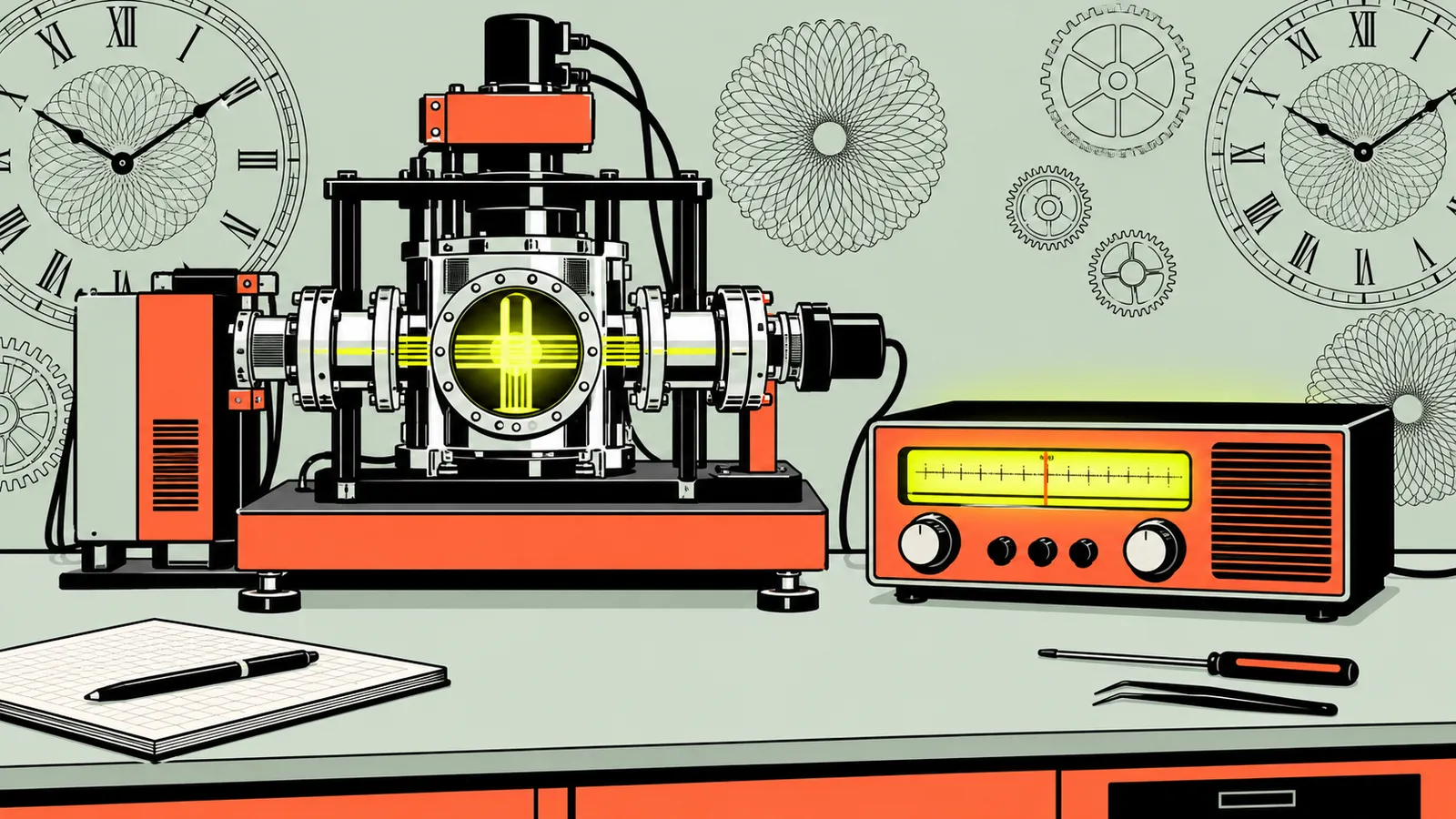
An atomic clock measures time by counting a precise frequency associated with an atom. The SI second is defined by exactly 9,192,631,770 cycles of radiation linked to a transition in cesium-133; laboratories use atomic clocks to maintain and compare time standards, rather than putting a primary standard in every phone or wristwatch. NIST explains the definition of the second.
- ICesium-133 defines the SI second.
- IIOne second equals 9,192,631,770 cesium radiation cycles.
- IIINIST-F2 was launched as a U.S. civilian standard in 2014.
- IVUTC is calculated from data contributed by laboratories worldwide.
- VInternet network delays affect the time accuracy you receive.
What is an atomic clock?
An atomic clock is a clock that uses a frequency associated with atoms as its timekeeping reference. It counts repeated cycles of radiation connected to an atomic energy-level transition. Because the reference is tied to a defined property of atoms, it provides a highly consistent way to measure seconds and calibrate other clocks.
“Atomic” does not mean that every clock contains a tiny device that directly displays the official time. A laboratory may use atomic standards to establish or check a time scale, then distribute time information through radio signals or computer networks. Your device can synchronize to a time server or radio broadcast without containing the laboratory’s primary standard.
Atomic clocks support more than clocks on walls. Precise time and frequency are used in communications, banking and stock transactions, power-grid operations, broadcasting, and navigation. For a plain-language guide to the standard those systems refer to, see what UTC is. If you want to check a displayed time against a reference, the official U.S. time guide explains NIST’s role.
The basic idea is similar to any clock: count a regular event. The difference is that an atomic transition supplies an exceptionally consistent reference frequency, while a pendulum or quartz crystal provides the repeating event in other kinds of clocks.
How cesium-133 defines one second
The International System of Units defines the second using cesium-133. One second is the duration of 9,192,631,770 cycles of radiation corresponding to a transition between two energy levels in the atom’s ground state. In practical terms, the number is a fixed definition: a clock counts those cycles, or uses an oscillator based on that resonance and counts its output.
This definition replaced a less precise basis for the unit with a repeatable atomic reference. It does not mean that every clock has to count each cycle individually in a simple counter. Atomic-clock designs generate a signal associated with the transition, and electronics can count or divide the signal to produce usable time intervals.
| Item | Value or meaning |
|---|---|
| Atom | Cesium-133 |
| Cycles in one second | 9,192,631,770 |
| What the cycles correspond to | Radiation associated with a transition between two ground-state energy levels |
The definition matters because it gives laboratories a shared unit to reproduce and compare. It is the foundation for national time standards and the coordinated timekeeping system used around the world. See NIST’s definition of the second for the formal wording, or use the UTC time page to check the common reference scale.
How an atomic clock works
Every clock needs a repeating process and a way to count it. In a pendulum clock, the pendulum swings; in a quartz watch, an electronic circuit counts vibrations from a quartz crystal. NIST says most wristwatch quartz crystals vibrate at about 32,768 cycles per second, and the circuit divides that frequency down to make one-second ticks.
An atomic clock uses a frequency associated with an atomic transition instead. The clock’s electronics produce or track a signal tied to that resonance, then count the signal to measure intervals. The atom provides a reference that can be compared with an oscillator; the complete instrument also needs electronics and methods to account for measurement effects.
These terms describe different qualities. Accuracy concerns how close a result is to the defined value, while stability describes how consistently a clock’s frequency behaves over time. A clock can be very stable but still need calibration to align it with the standard. NIST notes that uncertainty is generally preferred when reporting a quantitative measurement result, while “accuracy” is often used more broadly.
That distinction helps explain why one headline number does not tell you everything about a clock. The oscillator, the measurement process, calibration, and the time scale it supports all matter. NIST’s clock FAQ compares atomic oscillators with quartz and pendulum clocks and explains how frequency errors translate into time offsets.
What NIST-F2’s accuracy means
NIST-F2 is a primary frequency standard developed by the U.S. National Institute of Standards and Technology. NIST officially launched it on April 3, 2014, alongside NIST-F1. The standard measures the cesium-atom transition used to define the second and helps calibrate the ticks of other clocks.
NIST said NIST-F2 was designed to neither gain nor lose one second in about 300 million years. That is a design-performance description, not a promise that every clock receiving a time signal will stay within one second for that span. NIST reported that F2 was about three times as accurate as F1, and described it as the world’s most accurate time standard at the time of the 2014 announcement. That historical claim should not be read as a ranking of current clocks.
One design feature is its cold environment. NIST-F2’s cesium atoms are shielded at about −193 °C, compared with about 27 °C for NIST-F1. NIST explained that the colder environment reduces background radiation and some measurement errors that need correction in F1. Primary standards such as these operate for periods of a few weeks several times a year to calibrate NIST time scales.
Those time scales are maintained by collections of stable clocks, not by running the primary standard continuously as a public clock. Read NIST’s NIST-F2 announcement for the context behind the performance figure.
Optical clocks and what may come next
Cesium clocks define the second, but research also explores other atomic clocks, including optical atomic clocks. NIST’s description of the NIST-F2 launch said future optical atomic clocks could be more than 100 times as accurate as contemporary cesium standards. Separately, NIST’s clock FAQ describes experimental clocks based on other atoms as ten thousand times more precise than commercially available cesium clocks.
Those comparisons come from different descriptions and should not be treated as interchangeable measurements. They do indicate why researchers are interested in clocks beyond the established cesium standard: experimental designs may offer substantially improved precision. The cesium definition remains the unit reference in the supplied NIST material, even as research investigates other approaches.
It is also useful to distinguish a research clock from a time service. A highly precise laboratory instrument is not automatically the source your phone contacts or the signal your radio-controlled clock receives. National laboratories maintain time scales and compare them with standards; networks and broadcasts then distribute time in formats consumer devices can use.
For now, the practical point is that “optical” describes a developing direction in atomic-clock research, while cesium-133 provides the established definition of the second. NIST’s F2 announcement discusses the future potential of optical clocks, and its clock FAQ puts experimental clocks in context with commercial cesium clocks.
How atomic clocks contribute to UTC
No single clock keeps the official version of Coordinated Universal Time (UTC). UTC is calculated after laboratories around the world contribute clock data. The Bureau International des Poids et Mesures (BIPM) computes International Atomic Time from a weighted average of more than 300 atomic clocks at more than 60 timing laboratories; UTC is based on that time scale and adjusted with leap seconds to account for the difference between the definition of the second and Earth’s rotation.
NIST maintains a real-time representation called UTC(NIST). Its time scale uses an ensemble of cesium-beam and hydrogen-maser atomic clocks, typically around ten clocks, combined with a weighted average that gives more weight to the most stable clocks. NIST regularly calibrates those clocks with primary frequency standards. UTC(NIST) contributes to international timekeeping and is often within a few nanoseconds of the UTC calculated later from international data.
This is why “atomic time” does not mean one special clock controls every time display. Many clocks contribute to a coordinated system, and national laboratories maintain local realizations that track the international scale closely. NIST and the U.S. Naval Observatory both serve as official U.S. timekeepers; their UTC realizations are typically kept within 20 nanoseconds of each other.
For more on the relationship among these scales, see NIST’s explanation of UTC(NIST), UTC, and TAI. The world clock and time difference tool help translate a shared time reference into comparisons that are useful for daily schedules.
How atomic time reaches your phone, computer, or clock
Time reaches ordinary devices through distribution systems. Computers commonly synchronize over a network using the Network Time Protocol (NTP). NIST operates stratum-1 time servers directly linked to UTC(NIST), and its service provides time information traceable to that national time scale. Operating systems can contact time servers periodically in the background.
The network affects the accuracy you receive. NIST says its servers use the same synchronization algorithm and should have comparable timestamp accuracy, while the user’s result is usually largely determined by network stability and reciprocity. In other words, a highly accurate laboratory standard does not remove delays and variation between a server and your device. Learn more in our guide to Network Time Protocol and how computers keep time.
Radio is another route. NIST’s WWVB station broadcasts digital time codes on a 60 kHz carrier, and millions of North American clocks, clock radios, and watches use its signal to synchronize. GPS also depends on atomic clocks: satellite clocks are synchronized within nanoseconds of one another, supporting receivers that calculate position within a few meters.
These routes distribute a common standard in different ways. A network-connected device can request time, a radio-controlled clock can receive a broadcast, and a GPS receiver can use satellite timing as part of positioning. For a local display or a meeting across regions, apply the relevant local offset with the time zone converter; the underlying UTC reference itself does not change for daylight saving time.
What atomic-clock precision means for everyday time
Atomic clocks provide the reference behind high-precision timekeeping, but your everyday clock is several steps away from the primary standard. The time may pass through a laboratory time scale, a server or broadcast, a communication path, and your device’s own clock. Each step serves a purpose, and network or signal conditions can affect the result at the receiving end.
A common mistake is to assume that a phone contains a miniature version of NIST-F2. Most devices instead keep their own time and may periodically synchronize with a time service. Another is to assume that a clock described as “accurate to one second in millions of years” guarantees that a time shown on a screen will have that same performance. NIST-F2’s figure describes its design as a primary standard, not the complete delivery chain.
Atomic clocks measure intervals; local clock displays also depend on time-zone rules. For example, NIST lists Eastern Standard Time as UTC−5. So, as a simple winter conversion, 18:00 UTC minus five hours is 1:00 p.m. EST. Use a time zone converter when a date matters, because daylight saving rules can change the local offset.
If you need a stopwatch or timer for a task, use the stopwatch or another time tool suited to the job. Atomic standards matter because they make shared timing reliable; the right everyday tool makes that shared time easier to read and apply.
Questions people ask
What atom is used to define the second?
The SI second is defined using cesium-133. One second corresponds to exactly 9,192,631,770 cycles of radiation associated with a transition between two energy levels in the atom’s ground state. NIST provides the formal definition.
How accurate is NIST-F2?
NIST said NIST-F2 was designed to neither gain nor lose one second in about 300 million years. NIST announced it on April 3, 2014, and described it as about three times as accurate as NIST-F1. The figure describes the primary frequency standard, not the accuracy guaranteed on a phone or computer. NIST’s announcement gives the context.
Does my phone have an atomic clock inside?
Your phone does not need to contain a primary atomic standard to show synchronized time. Devices can periodically get time from a network service, while NIST servers provide time traceable to UTC(NIST). The result you receive can be affected by network stability and delay. NIST describes these services in its Internet Time Service information.
What is the difference between UTC and atomic time?
Atomic clocks contribute to time scales used to calculate International Atomic Time (TAI). UTC is based on TAI and adjusted with leap seconds to account for the difference between the defined second and Earth’s rotation. UTC is the standard used for general timekeeping. NIST explains how these scales relate.
How do atomic clocks help GPS?
GPS satellites have onboard atomic clocks synchronized to within nanoseconds of one another. Receivers use the timing of satellite signals to calculate position, which NIST says can be within a few meters. GPS time does not adjust for leap seconds, so receivers generally apply the broadcast offset from UTC automatically. NIST’s time-scale guide explains the relationship.
Are optical clocks more accurate than cesium clocks?
NIST describes experimental clocks based on other atoms as much more precise than commercially available cesium clocks, and its 2014 NIST-F2 announcement said future optical atomic clocks could be more than 100 times as accurate as contemporary cesium standards. These are research comparisons; cesium-133 remains the basis of the SI second in the cited NIST definition.
Sources
- Second: Introduction, NIST
- Timekeeping and clocks FAQs, NIST
- NIST Launches a New U.S. Time Standard: NIST-F2 Atomic Clock, NIST
- How is UTC(NIST) related to Coordinated Universal Time (UTC), International Atomic Time (TAI), Greenwich Mean Time (GMT), USNO time, GPS time and Zulu time?, NIST
- NIST Internet Time Service (ITS), NIST
- Radio Station WWVB, NIST
Edited by Leo, editor of WhatTimeIsIt.blog
Calculations on this page run in your browser using the IANA time zone database and standard calendar rules. Facts are checked against the government agency, standards body or official source linked in the text. Last reviewed November 10, 2026. See the editorial policy or report an error to hello@whattimeisit.blog.