
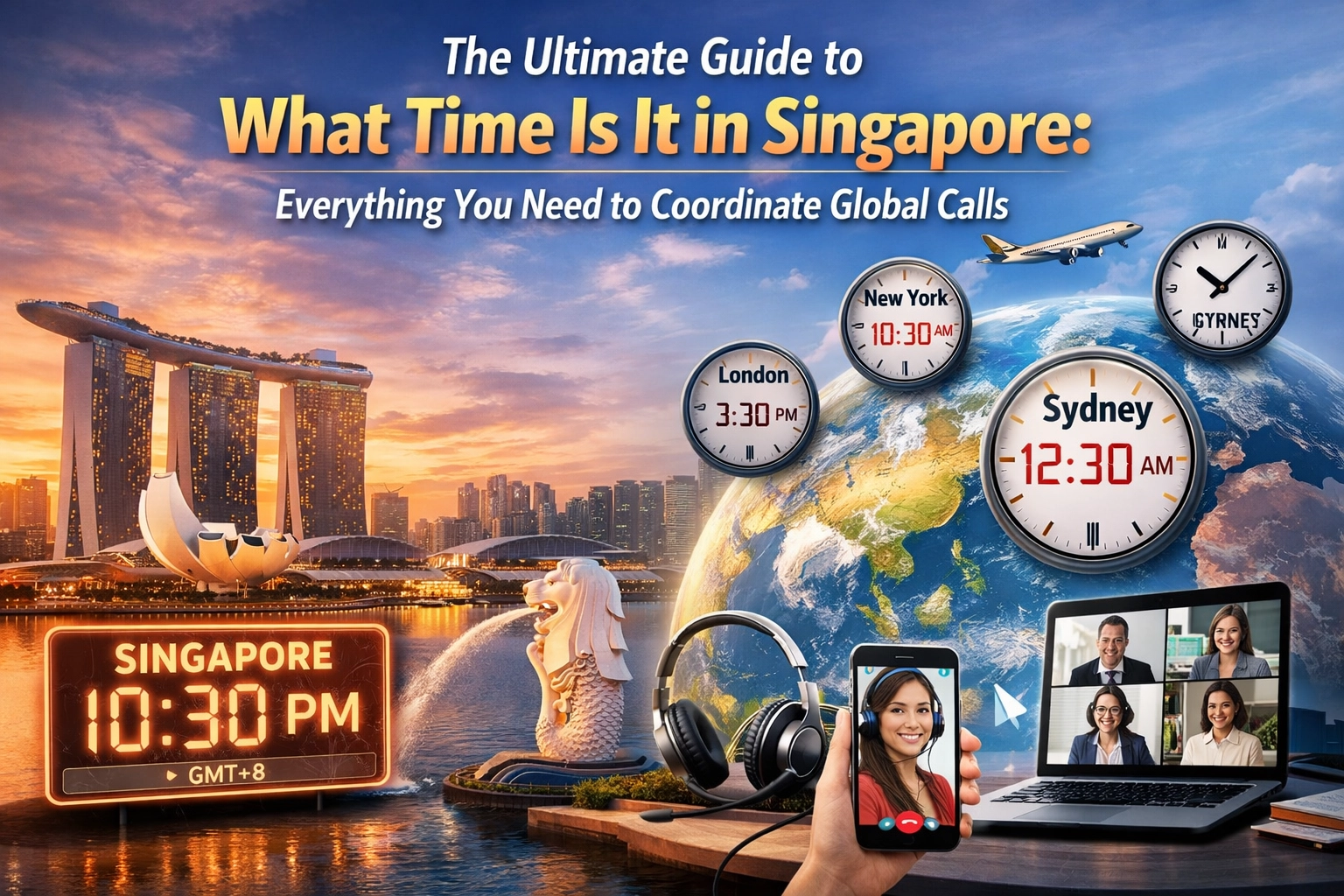
Singapore isn’t just a city-state; it is the definitive economic powerhouse of Southeast Asia. When you operate in this high-velocity environment, time is your most valuable currency. Navigating the Singapore Standard Time (SGT) offset is the difference between a closed deal and a missed opportunity.
As of Thursday, March 5, 2026, Singapore is firing on all cylinders. You are likely here because you need to synchronize a multi-continental team or you are prepping for a touchdown at Changi Airport. Either way, you need precision. You need the "expert-insider" blueprint to mastering the clock in the Lion City.
The Foundation: Understanding UTC+8
Singapore operates on Singapore Standard Time (SGT), which is UTC+8.
The most critical factor you must internalize is this: Singapore does not observe Daylight Saving Time (DST).
While the rest of the world fumbles with "springing forward" or "falling back," Singapore remains a fixed, immovable anchor. This stability is your secret weapon. You will never have to guess if your Singaporean counterparts shifted their clocks overnight. They haven't. They won't. Period.
Key Offsets for March 2026:
- London: 8 hours behind Singapore (GMT).
- New York: 13 hours behind Singapore (EST).
- San Francisco: 16 hours behind Singapore (PST).
- Tokyo: 1 hour ahead of Singapore (JST).
- Sydney: 3 hours ahead of Singapore (AEDT).
Coordinating the "Global Handshake": The Best Times for Calls
Mastering the UTC+8 offset requires tactical scheduling. Because Singapore sits in the middle of the Asia-Pacific corridor, you are perfectly positioned to bridge the gap between the West and the East: if you know the "Golden Hours."
1. The North American Bridge (The "Evening Hustle")
If you are in Singapore trying to reach New York or Toronto, your window is narrow. At 9:00 PM SGT, it is 8:00 AM on the US East Coast. This is the "Global Handshake." You will sacrifice your evening to catch their morning.
- Pro Tip: Schedule your high-stakes syncs for 9:00 PM – 11:00 PM SGT. You’ll be finishing your day while they are fueled by their first espresso.
2. The European Connection (The "Afternoon Sync")
For those coordinating with London, Paris, or Dublin, the timing is much more forgiving. At 4:00 PM SGT, London is just waking up at 8:00 AM.
- The Hack: Use your Singapore morning for deep work. Use the 4:00 PM – 7:00 PM SGT window for all European calls. You’ll hit their peak productivity hours without staying up past midnight.
3. The APAC Sprint
Coordinating with Hong Kong, Shanghai, or Perth? You are in luck. They share the UTC+8 zone. No math required. For Tokyo or Seoul, you only deal with a negligible one-hour difference. You will dominate the regional market because your biological clocks are perfectly aligned.
Navigating the Logistics: Travel and Jet Lag Mastery
Touching down in Singapore is a sensory explosion. The humidity hits you like a warm towel, and the neon-slick streets of Marina Bay beckon. But if you haven't managed your transition from the West, you will be a zombie by noon.
The Changi Strategy
You will arrive at Changi Airport, consistently voted the best in the world. Do not rush out immediately. If you’ve arrived on a long-haul flight from Lisbon or Copenhagen, your body is screaming for a reset.
- Hydrate immediately: The humidity in the city is high, but airplane air is lethal.
- Seek Natural Light: Head to the Jewel Changi. The sunlight hitting the Rain Vortex isn't just beautiful: it’s a biological reset for your circadian rhythm.

Jet Lag Protocol: The Eastbound Struggle
Traveling to Singapore from the West (e.g., from New York or London) is "Eastbound," which is notoriously harder on the body. You are "losing" time.
- The 3-Day Rule: You will need 72 hours to reach peak cognitive function.
- The Caffeine Cutoff: Stop all caffeine by 2:00 PM SGT. You need your body to recognize the tropical sunset as a signal for rest, even if your brain thinks it’s lunchtime in Helsinki.
Cultural Time Norms: The Singaporean "On Time"
In many parts of the world, "10:00 AM" means "10:10 AM." In Singapore, punctuality is a sign of respect and professional competence.
If you have a meeting at a boardroom in Raffles Place, you arrive at 9:55 AM. Being "on time" is considered late. The city operates with clinical, logistical precision. The MRT (Mass Rapid Transit) trains are timed to the second; you should be too.
The "Makan" Factor
Business in Singapore often happens over food (Makan). However, lunch starts at 12:00 PM sharp. By 12:15 PM, the most popular hawker stalls and restaurants will have "choped" seats (reserved with packs of tissues). If you are hosting a business lunch, you must secure your table early.
Technical Tools for the Global Professional
You cannot rely on manual calculations when millions are on the line. You need tools that remove ambiguity.
- World Clock Integration: Ensure your calendar is set to SGT (UTC+8) as your secondary time zone.
- WhatTimeIsIt.blog: Use our site to quickly cross-reference Singapore with other hubs like Oslo, Stockholm, or Brussels.
Mastering the time in Singapore is about more than just looking at a watch. It’s about understanding the flow of global capital. When you know that Singapore is 8 hours ahead of London, you know exactly when to hit "send" on that pitch deck to ensure it’s at the top of their inbox when they walk in.
Summary Checklist for Coordinating with Singapore
To ensure you never miss a beat in the 24-hour global cycle, follow this checklist:
- Confirm the Offset: Always start with UTC+8.
- Ignore DST: Remember that Singapore never changes its clocks.
- The 9 PM Rule: For North American calls, 9 PM SGT is your start time.
- The 4 PM Rule: For European calls, 4 PM SGT is your start time.
- Prioritize Punctuality: Arrive 5 minutes early for everything. No exceptions.
- Use Digital Sitemaps: For a broader view of global time, check our Sitemap Index to find any city you need.
Final Expert Insight
Singapore is a city that never sleeps, but it definitely follows a schedule. The "hustle" here is real, but it is organized. Whether you are navigating the labyrinthine corridors of a Suntec City trade show or taking a late-night call from a skyscraper overlooking the Esplanade, your mastery of time will be your greatest asset.
Prioritize the clock. Trust the data. Navigate the zones. You will find that when you master the time in Singapore, you master the pace of global business itself.
For more deep dives into international business hubs, explore our guides on Istanbul or our collection of 40 major international cities. The world is moving fast( stay ahead of it.)