Solar Eclipse 2027: August Path, Timing and Safe Viewing
A total solar eclipse crosses parts of southern Spain, North Africa and Egypt on August 2, 2027. Here’s where to look, how to plan around local time and how to protect your eyes.
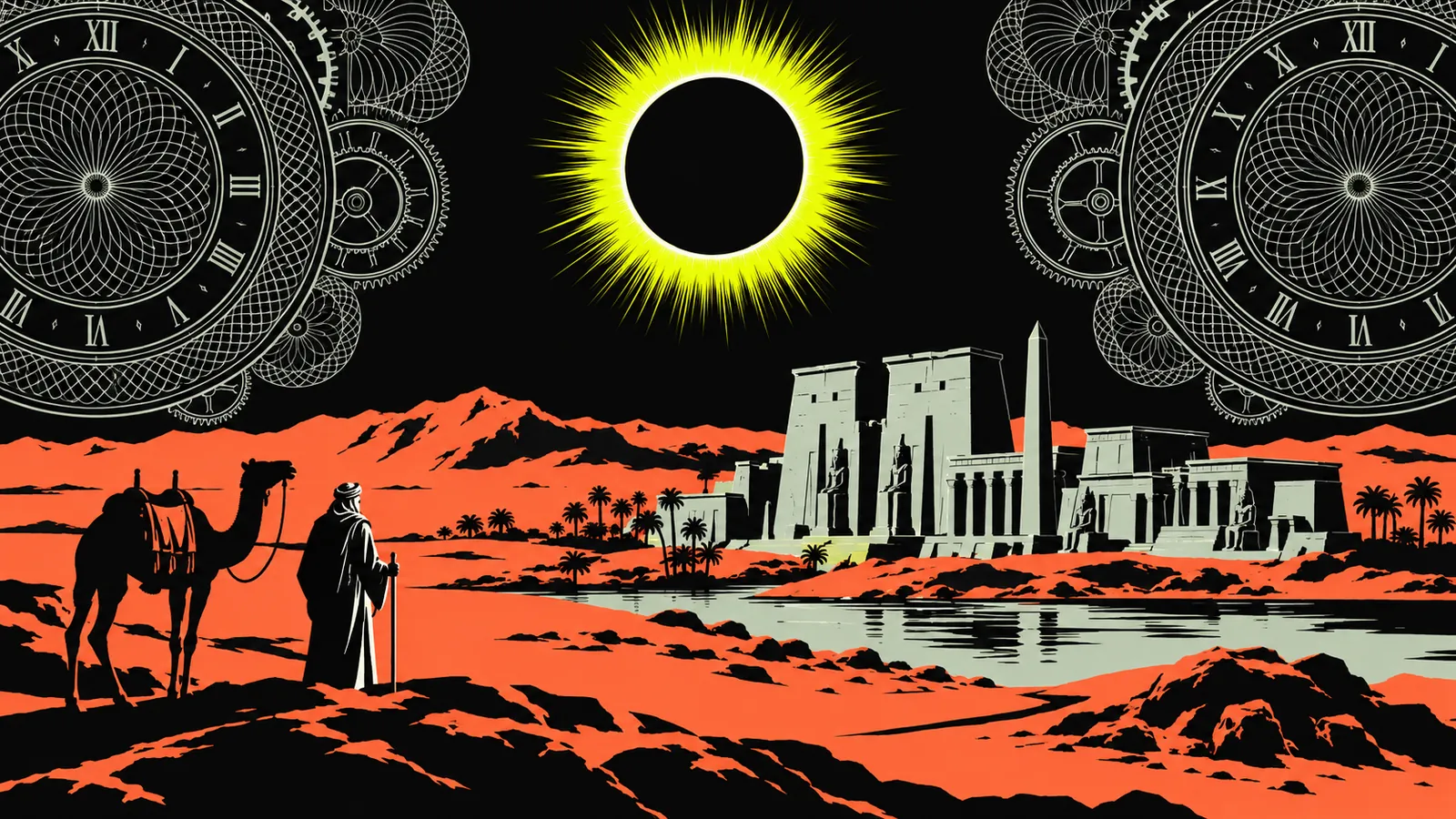
The main event is the total solar eclipse on August 2, 2027. Its path of totality crosses southern Spain, North Africa and Egypt, and NASA predicts a maximum totality of 6 minutes 23.2 seconds; a separate annular eclipse occurs on February 6, 2027. NASA’s eclipse list summarizes where each event is visible.
- ITotal solar eclipse: August 2, 2027
- IIMaximum totality: 6 minutes 23.2 seconds
- IIIThe path crosses southern Spain, North Africa and Egypt
- IVAn annular solar eclipse occurs February 6, 2027
- VUse eye protection except during totality
Solar Eclipse 2027 at a Glance
There are two solar eclipses to know about in 2027. The headline event is a total solar eclipse on August 2. Its path of totality crosses southern Spain, North Africa and Egypt, continuing east through Saudi Arabia and Yemen. NASA predicts that the longest totality along the path will last 6 minutes 23.2 seconds. The exact duration depends on where you are inside the path.
A separate annular solar eclipse occurs on February 6. During an annular eclipse, the Moon does not completely cover the Sun’s bright face, so there is no totality and no safe moment to look directly at the Sun without proper solar-viewing protection. Both events also have wider areas where observers can see a partial eclipse.
| Date | Type | Where to look |
|---|---|---|
| February 6, 2027 | Annular | Parts of South America and Africa; partial eclipse over a wider region |
| August 2, 2027 | Total | Path crosses southern Spain, North Africa, Egypt, Saudi Arabia and Yemen |
The eclipse date is the local calendar date where the event occurs, so check a location-specific map before making travel plans. NASA’s map gives event circumstances in Universal Time (UT), and its interactive marker calculates times and duration for a selected point. Use a date calculator to keep travel dates and the viewing date straight, especially if your trip crosses time zones.
Where Is the August 2, 2027 Path of Totality?
The path of totality is the narrow track where the Moon completely covers the Sun’s bright face. On August 2, that track crosses southern Spain and North Africa, then passes through Egypt, including the Luxor area, before continuing toward Saudi Arabia and Yemen. The supplied NASA future-eclipse listing identifies southern Spain, North Africa, Saudi Arabia and Yemen as regions of totality; NASA’s eclipse map lets you inspect the path and calculate circumstances for a chosen location.
Being in the same country as the path does not guarantee totality. A location outside the narrow track can still see a partial eclipse, in which the Moon covers only part of the Sun. That can be impressive, but it is not the same event: the sky does not experience the brief totality that occurs inside the path. Before booking lodging or transport, check the exact observing point against an eclipse map rather than relying on a country name or a broad regional description.
For a trip focused on Luxor or another Egyptian destination, look up the coordinates of your actual viewing site and check the map’s local circumstances there. The NASA map reports the Sun’s altitude and azimuth as well as eclipse timing. Those details help you judge whether the Sun will be clear of nearby obstructions, but the map does not account for every local feature or viewing condition. Recheck your plans if you change location, even by a relatively short distance.
For a trip that includes more than one country, compare local clocks before setting departure or meeting times. The time zone converter can help translate a published UT time into a destination’s clock time; the world clock is useful when coordinating with people at home. Always use the event times for your own location, not the time listed for a different city on the route.
How Long Will the 2027 Total Solar Eclipse Last?
The longest predicted totality on August 2, 2027 is 6 minutes 23.2 seconds, according to NASA. That is the maximum somewhere along the eclipse path, not a promise that every viewing site will get the same duration. Your own totality may be shorter, and places outside the path will see only a partial eclipse. NASA’s map reports totality duration for selected points and marks the location of greatest duration.
Think of totality as one short phase within a longer event. The partial phases begin before totality and resume afterward, so the full period when you may be observing the eclipse is longer than the minutes of complete coverage. The exact contact times depend on your location. Do not use the maximum-duration figure as a schedule for a particular town; use the map’s local circumstances instead.
NASA notes that its published eclipse predictions do not include the detailed profile of mountains and valleys on the Moon’s edge. Accounting for that lunar limb can change contact times and duration by about 1–3 seconds, shift the path limits by about 1–3 kilometers, and move the predicted greatest-duration location by about 10–20 kilometers. Those are prediction refinements, not reasons to ignore the map: they underline why the maximum is a forecast tied to a specific position.
For a simple way to understand the duration, 6 minutes 23.2 seconds is 383.2 seconds: 6 × 60 seconds plus 23.2 seconds. A time-duration calculator can help compare durations or work through a viewing schedule, while a countdown can mark the approach to a planned event. For actual eclipse contact times, however, use NASA’s location-specific map rather than a general-purpose timer.
The February 6, 2027 Annular Eclipse
The February event is a different kind of solar eclipse from the August total eclipse. NASA lists an annular solar eclipse for February 6, 2027, visible in parts of South America and Africa, including Chile, Argentina, Uruguay, Brazil, Ivory Coast, Ghana, Togo, Benin and Nigeria. A partial eclipse is visible across a broader area that includes parts of Antarctica and the South Pacific and South Atlantic oceans.
In an annular eclipse, the Moon does not completely cover the Sun’s bright face. The bright solar area remains visible, so the event has no totality. This difference matters for both expectations and safety: you cannot remove eclipse glasses to view an annular eclipse directly. Use safe solar-viewing protection whenever you look at the Sun during the annular event, including near its maximum.
Do not confuse the February and August dates when searching for a trip or sharing an eclipse schedule. The February 6 event is annular; the August 2 event is total along its path. NASA’s future eclipse listing describes the regions where the events are visible, while the August 2 map is specifically for the total eclipse. If you are planning to travel, check that the map and date you are using match your intended eclipse.
The two dates are about six months apart by calendar arithmetic, but their viewing regions differ. An eclipse visible as partial from a particular place is not automatically annular or total there. Eclipse type depends on whether the observer is inside the relevant track, so check the map for the exact location rather than treating a continent-wide visibility description as a local forecast.
How to Check Eclipse Times in Your Local Time Zone
NASA gives the eclipse map’s event times in Universal Time (UT). Convert those times to the local clock for your exact viewing location before setting alarms, booking transport or arranging a group meeting. The eclipse date is listed as the local date where the event occurs, so a conversion across time zones can sometimes change the calendar date for people following from elsewhere.
Here is a practical workflow: open NASA’s map, place its marker at your intended viewing point, note the listed event times, and then convert them to the local clock. For a viewer planning to be in Luxor, use Luxor’s location rather than a time printed for southern Spain or another Egyptian city. For someone coordinating with a person in New York, convert the same event time separately for each location. A time-zone converter can do the clock conversion, but it cannot tell you whether a particular spot is inside totality.
Time-zone and daylight-saving rules can change, so avoid assuming that a destination keeps the same offset throughout the year. The IANA time-zone database is the basis cited for the future-rule information in this guide. Confirm the destination’s current local-time setting close to your trip, then compare it with the UTC time from NASA’s map. For general planning, the site’s meeting planner can help coordinate with people in different regions.
For a worked but hypothetical example, suppose a map lists a contact at 10:00 UTC. Enter 10:00 UTC and the selected destination into a converter; do not assume that 10:00 is the local time in Luxor, Spain or New York. The example is not an eclipse contact time. Your actual schedule must come from NASA’s map for your selected coordinates, then be converted using the time-zone rules in effect on August 2, 2027.
Eye Safety: When to Wear Eclipse Glasses
Looking directly at the Sun requires specialized solar-viewing eye protection except during the brief total phase of a total solar eclipse, when the Moon completely blocks the Sun’s bright face. During the partial phases before and after totality, put your eclipse glasses or handheld solar viewer on. As soon as any part of the bright Sun reappears, put the protection back on. If you are not certain that totality has begun or ended, keep your protection in place.
For the February annular eclipse, there is no totality, so keep proper solar protection on whenever you look directly at the Sun. Ordinary sunglasses are not safe for solar viewing, regardless of how dark they appear. NASA advises using safe solar viewers that comply with the ISO 12312-2 international standard and inspecting them before use; discard viewers that are torn, scratched or otherwise damaged. Supervise children using eclipse glasses.
Do not look at the Sun through a camera, telescope, binoculars or another optical device while wearing eclipse glasses. Those devices require a solar filter attached to the front of the optical instrument, and NASA advises seeking expert guidance before using one. A simple alternative is a pinhole projector: project the Sun’s image onto a nearby surface with the Sun behind you, and look at the projected image, never through the pinhole.
Eye protection is only one part of being outside for an extended period. NASA also recommends sunscreen, a hat and protective clothing. Review NASA’s eclipse safety guidance before the event and share the rules with anyone watching with you. A sunrise and sunset tool can help you think about daylight at a destination, but it is not a substitute for eclipse timing or safe solar equipment.
How to Plan a Solar Eclipse 2027 Viewing
Start with the observing point, not just the destination. Confirm that the specific place is inside the August path of totality, then check NASA’s local contact times and predicted duration. The path crosses several countries and spans a large region, but the totality track is narrower than the area where a partial eclipse can be seen. A hotel or tour listing that says “eclipse viewing” is not enough to establish that the site lies inside the path.
- Choose a point: identify the exact town, property or open viewing area you plan to use.
- Check the map: use NASA’s interactive marker and note the local eclipse circumstances, not only the maximum duration for the whole event.
- Convert the schedule: use the map’s UT times and check the destination’s local time zone for August 2, 2027.
- Prepare protection: have undamaged, standards-compliant eclipse glasses ready for all partial phases and for the full annular eclipse in February.
- Allow for the full event: plan to be in position before the partial phase begins and stay through the end of the event, rather than arriving only for the short total phase.
Set an alert only after confirming the local schedule. The site’s countdown timer can help you track a selected moment, and an alarm clock can remind you when it is time to get to your viewing spot. These tools do not calculate eclipse circumstances, so enter a time verified for your own location.
If your group is spread across time zones, share both the local time and the UTC time to reduce confusion. Label each clearly and include the city. A date calculator can help count down the remaining days, but avoid using a generic calendar reminder as your only source for contact times. Recheck NASA’s map and local time-zone information before departure, especially if your itinerary changes.
Common Solar Eclipse 2027 Planning Mistakes
Using the maximum duration for every location. NASA’s 6 minutes 23.2 seconds is the greatest predicted duration along the path. It is not the duration everywhere in Egypt, Spain or North Africa. Select a precise point on the map to see the local duration.
Assuming a partial eclipse is total. The broad visibility area is much larger than the totality track. If the Moon covers part of the Sun from your location, you will not experience totality there. Check the track rather than relying on a country-level summary.
Removing glasses during an annular eclipse. An annular eclipse has no total phase. Keep certified solar-viewing protection on whenever you look directly at the Sun. During the August total eclipse, direct viewing without protection is safe only during the brief total phase, and glasses must go back on as soon as the bright Sun returns.
Mixing UT and local clock time. NASA’s map reports UT. A listed time is not automatically the clock time at your hotel or home, and time-zone rules can affect the conversion. Record the location, date and time zone alongside every schedule. Use the time zone converter for clock conversion, but use NASA’s map for the eclipse itself.
Using another city’s contact times. Eclipse timing varies by location. A schedule for a nearby city is not a substitute for checking your actual coordinates. Finally, do not look through binoculars, a camera or a telescope with eclipse glasses on; those optics need a correctly installed solar filter on the front of the device.
Questions people ask
When is the total solar eclipse in 2027?
The total solar eclipse occurs on August 2, 2027. NASA’s map predicts a maximum totality of 6 minutes 23.2 seconds along the path, but the duration varies by location. Check NASA’s map for a specific viewing point.
Will the 2027 total solar eclipse pass over Luxor, Egypt?
The August 2 path crosses Egypt, including the Luxor area, as it travels through North Africa toward Saudi Arabia and Yemen. Check NASA’s interactive map for your exact viewing location and local duration; a country or regional description does not confirm that every nearby site is inside totality.
How long will totality last in 2027?
The maximum predicted totality is 6 minutes 23.2 seconds somewhere along the August 2 path. Your location may have a shorter duration, so use NASA’s map marker for the local prediction. NASA says lunar-limb corrections can change predicted contact times and duration by about 1–3 seconds.
Is there another solar eclipse in 2027?
Yes. An annular solar eclipse occurs on February 6, 2027, and is visible in parts of South America and Africa. A partial eclipse is visible across a wider region. Annular eclipses have no totality, so use proper solar-viewing protection whenever looking directly at the Sun.
Can I look at the Sun without eclipse glasses during totality?
Only during the brief total phase of a total solar eclipse, when the Moon completely blocks the Sun’s bright face. Wear proper eclipse glasses during the partial phases before and after totality, and put them back on as soon as any part of the bright Sun reappears. There is no glasses-free phase during an annular eclipse.
What time will the August 2 eclipse happen where I live?
It depends on your location. NASA’s eclipse map gives event times in Universal Time (UT) and lets you select a point for local circumstances. Convert the relevant UT times using the time-zone rules for your destination on August 2, 2027; do not assume a time listed for another city applies to you.
Sources
- Total Solar Eclipse of 2027 Aug 02, NASA
- Future Eclipses, NASA
- Eclipse Viewing Safety, NASA
- Time zone database, IANA
Edited by Leo, editor of WhatTimeIsIt.blog
Calculations on this page run in your browser using the IANA time zone database and standard calendar rules. Facts are checked against the government agency, standards body or official source linked in the text. Last reviewed November 10, 2026. See the editorial policy or report an error to hello@whattimeisit.blog.