Moon Phases Explained: A Guide to the Eight Phases
The Moon’s changing appearance follows a repeating cycle of sunlight and viewing angle—not Earth’s shadow. Learn the eight phases, how waxing and waning work, and when the Moon usually rises.
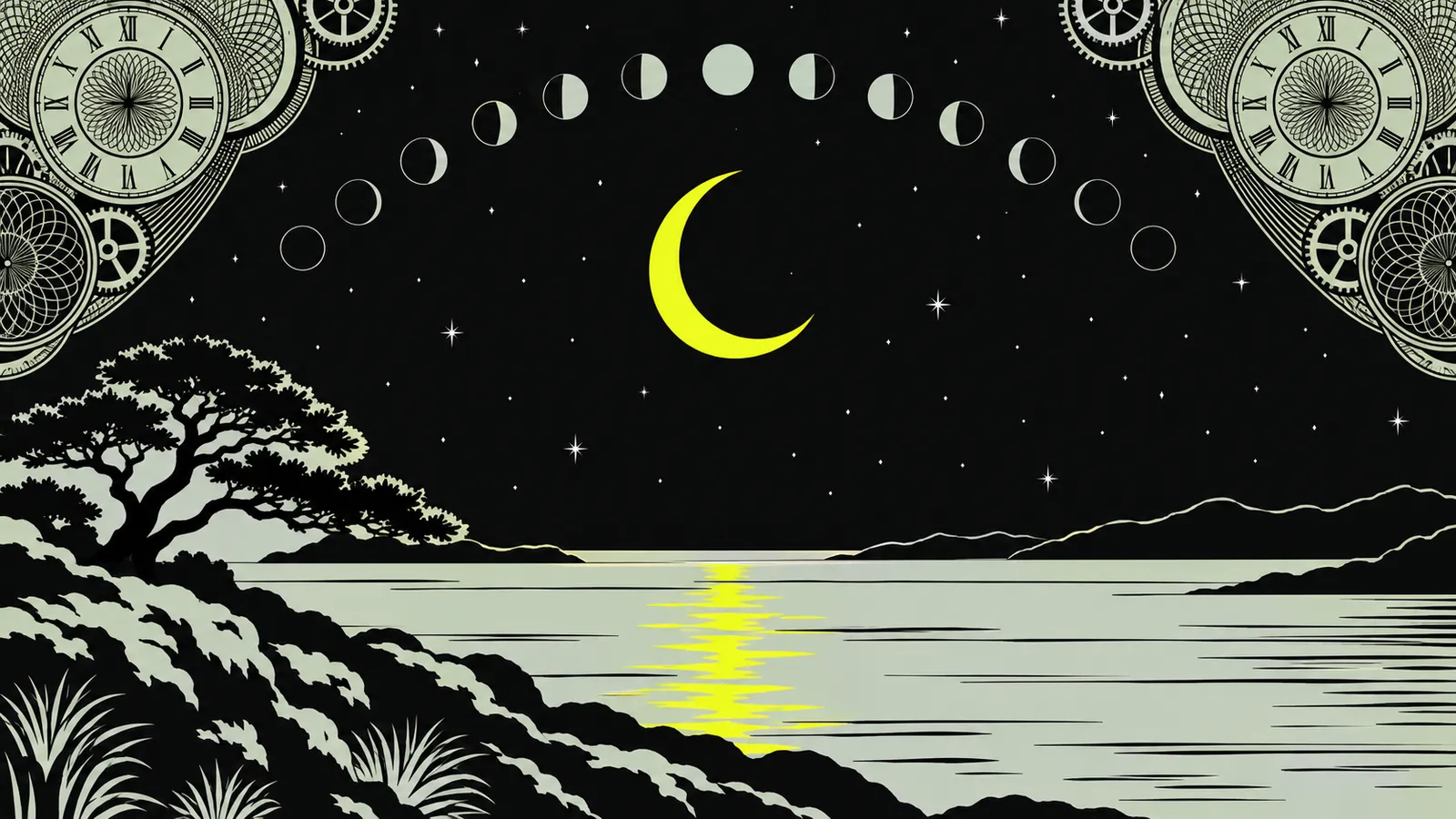
The Moon has eight phases in a cycle that takes about 29.5 days from one new Moon to the next. We see different portions of its sunlit half as it orbits Earth; a full Moon typically rises around sunset, while a new Moon rises and sets near the Sun. NASA explains the phases and their usual rise and set patterns.
- IThe new-Moon-to-new-Moon cycle lasts about 29.5 days.
- IIThe eight phases follow a repeating order.
- IIIWaxing means the visible lit portion is growing.
- IVA full Moon usually rises around sunset.
- VExact moonrise times depend on location and date.
Why Does the Moon Have Phases?
The Moon does not make its own light. Sunlight illuminates it, and as the Moon travels around Earth, our viewing angle changes. We see different amounts of the Moon’s sunlit half, so its visible shape appears to grow, shrink, or disappear. The Moon itself is not changing shape, and the phases are not usually caused by Earth’s shadow.
At new Moon, the Moon is between Earth and the Sun from our viewpoint. Its sunlit side faces generally away from us, so the Moon is usually hard to see. At full Moon, Earth is between the Sun and Moon in a broad sense, and the Moon’s near side looks fully lit. The alignment is not usually exact enough to put the Moon in Earth’s shadow. When Earth does cast its shadow on the Moon, that event is a lunar eclipse, not an ordinary phase. The Royal Observatory Greenwich explains that a lunar eclipse occurs when Earth lies directly between the Sun and Moon.
Think of the phases as a changing view of a sunlit object. The Moon is always moving along its orbit; what changes for an observer on Earth is how much of its illuminated face is turned toward us. The same side of the Moon faces Earth over time because the Moon is tidally locked, but that side does not remain equally illuminated throughout the cycle.
The Eight Moon Phases in Order
The phase names describe points and stretches in one repeating cycle. New Moon, first quarter, full Moon, and third quarter are the four primary phases. The crescent and gibbous phases fall between them. “Quarter” refers to the Moon’s progress through its cycle, not to how much of the visible disk is lit: a quarter Moon appears half illuminated from Earth.
| Phase | What you see |
|---|---|
| New Moon | The near side is mostly unlit from our viewpoint. |
| Waxing crescent | A growing sliver of the lit side is visible. |
| First quarter | About half of the visible disk is lit. |
| Waxing gibbous | More than half is lit, and the lit area is growing. |
| Full Moon | The near side appears fully illuminated. |
| Waning gibbous | More than half remains lit, but the lit area is shrinking. |
| Third quarter | About half of the visible disk is lit again. |
| Waning crescent | A shrinking sliver remains before new Moon. |
Each phase name describes an appearance, not a separate object or sudden physical change. Crescent and gibbous phases each last approximately a week, though the exact time between named phases varies. For a date-specific view, check the site’s Moon phases tool.
Waxing vs. Waning: How to Tell the Difference
Waxing means the visible illuminated portion is increasing from night to night. The Moon moves from new Moon through waxing crescent and first quarter to waxing gibbous, then reaches full Moon. Waning means the visible illuminated portion is decreasing. After full Moon, it passes through waning gibbous, third quarter, and waning crescent before the next new Moon.
A simple way to remember the sequence is to ask whether the lit area is getting larger or smaller over successive evenings. One glance can be misleading: clouds, a low horizon, or daylight can make the Moon difficult to compare. The first-quarter and third-quarter phases can also be confused because both look half lit. Their positions in the cycle are different: first quarter comes before full Moon; third quarter comes after it.
The visible orientation of the lit part can depend on where you are observing from, so a memorized “lit on the right” rule is not a reliable guide for every location. Use the waxing or waning trend across dates instead. A date calculator can help you count the days between two observations, while a day-of-the-year tool can help record observations against the calendar. The phase sequence itself remains the same even when the Moon’s orientation looks different from place to place.
Why the Lunar Phase Cycle Takes About 29.5 Days
The interval from one new Moon to the next is a synodic month, or lunar phase cycle. It lasts about 29.5 days. That is why the Moon does not repeat its phase on the same calendar date every month: the calendar month and lunar cycle are different lengths. Most calendar months contain one full Moon, but the dates shift as the cycles move through the calendar.
The Moon takes about 27.3 days to orbit Earth once, which is shorter than the new-Moon-to-new-Moon interval. The difference is that the phase cycle depends on the Moon lining up with the Sun as seen from Earth. While the Moon completes an orbit, Earth also moves along its orbit around the Sun, so the Moon needs additional time to return to the same Sun-Earth-Moon alignment. NASA gives the orbital period as about 27.322 days and the phase cycle as about 29.5 days in its phase guide.
For exact dates and times of the primary phases, the U.S. Naval Observatory phase service provides results in Universal Time. Convert a listed UTC time to your location with a time zone converter; the local calendar date can differ from the UTC date. You can also use a UTC time reference when comparing phase tables from different places.
Typical Moonrise Times by Phase
The Moon rises and sets at different times as its phase changes. The times below are useful patterns, not a local forecast. For example, a full Moon is usually rising around sunset and setting around sunrise, while a first-quarter Moon rises around midday and sets near the middle of the night. NASA summarizes these typical relationships in its Moon Phases guide.
| Phase | Typical rise | Typical set |
|---|---|---|
| New Moon | Near sunrise | Near sunset |
| Waxing crescent | Morning, after sunrise | Night, after sunset |
| First quarter | Around midday | Around the middle of the night |
| Waxing gibbous | Afternoon, before sunset | Early morning, before sunrise |
| Full Moon | Around sunset | Around sunrise |
| Waning gibbous | Night, after sunset | Morning, after sunrise |
| Third quarter | Around the middle of the night | Around midday |
| Waning crescent | Very early morning, before sunrise | Afternoon, before sunset |
The new Moon is often not visible because its unlit side faces Earth, even though it rises and sets at roughly the same time as the Sun. A sunrise and sunset calculator can help you compare the Moon’s approximate schedule with daylight, but use a location-specific moonrise forecast for exact times.
Why Moonrise Times Vary by Location and Date
The phase gives a useful general pattern, but it cannot tell you the exact time the Moon will appear above your horizon. Moonrise and moonset depend on the observer’s location, the date, and the Moon’s position. NASA recommends local predictions for exact times because the patterns vary with phase, time of year, and location.
Even a published rise time is a calculated horizon crossing, not a promise that you will see the Moon. Buildings, hills, trees, and cloud cover can block the view. The U.S. Naval Observatory explains that observer height and local topography can affect observed rise and set times, and that high-latitude predictions can be less reliable because celestial bodies meet the horizon at a shallow angle. Its rise, set, and twilight definitions also note that a rise or set may not occur on a particular date.
Moonrise is not limited to nighttime. A waning crescent can rise before sunrise, and a first-quarter Moon can be visible in the afternoon. To plan a viewing, check a forecast for your town and date, then allow for the actual horizon and weather. If you are comparing a UTC phase time with a local rise time, remember that they describe different things: one is a precise phase moment, and the other is when the Moon crosses your local horizon.
How to Use Moon Phases to Plan a Viewing
Start with the kind of view you want. Around full Moon, the Moon is bright and visible for much of the night, with a typical rise near sunset. Around new Moon, the Moon is usually difficult to see, but the darker sky can be useful if your goal is to look for objects other than the Moon. Crescent phases are easier to catch around dawn or dusk than in the middle of the night, so check the predicted rise and set times before choosing an observation window.
Then check the phase date and your local conditions. A phase occurs at a particular instant, while the Moon’s appearance changes gradually around it; NASA notes that a full Moon can appear full for a couple of days. Do not assume the Moon will be at its highest point at moonrise. The U.S. Naval Observatory describes a body’s transit as the time its center crosses the local meridian and is highest in the sky at low and middle latitudes.
Use the Moon phases tool to check the phase, and consult a local moonrise forecast for visibility times. A world clock can help when coordinating a viewing across locations, while the time zone converter can translate a phase time supplied in UTC. Check the local date as well as the clock time, especially when the phase instant is near midnight.
Common Moon-Phase Mistakes to Avoid
“The phases are Earth’s shadow.” Ordinary phases come from the changing view of the Moon’s sunlit half. Earth’s shadow on the Moon is associated with a lunar eclipse, which requires a more direct alignment. “A quarter Moon is one-quarter lit.” The name marks a quarter of the way through the phase cycle; the visible disk is about half illuminated at first and third quarter.
“A full Moon rises at exactly sunset everywhere.” Sunset is a useful approximation, not a precise local appointment. Moonrise and moonset vary by location and date, and local terrain can affect what you see. “The Moon rises only at night.” It can be above the horizon in daylight; moonrise and moonset patterns follow the phase rather than a night-only schedule. The U.S. Naval Observatory notes that the Moon can be visible during daylight and that nights can be moonless.
Finally, do not confuse the Moon’s orbital period with its phase cycle. One orbit takes about 27.3 days, while the new-Moon-to-new-Moon cycle is about 29.5 days. Nor should a phase time in UTC be treated as a local time without conversion. Check the source’s time standard, convert it if needed, and use local rise and set data to decide when the Moon will actually be above your horizon.
Questions people ask
What are the eight phases of the Moon?
In order, they are new Moon, waxing crescent, first quarter, waxing gibbous, full Moon, waning gibbous, third quarter (also called last quarter), and waning crescent. The cycle repeats from new Moon to new Moon in about 29.5 days. NASA lists the phases in this order.
Why does the Moon change shape?
The Moon does not physically change shape. Sunlight illuminates it, and as it orbits Earth, we see different portions of its sunlit half. Ordinary phases are not caused by Earth’s shadow; that shadow is involved in a lunar eclipse when the bodies align directly.
How long is one lunar phase cycle?
About 29.5 days from one new Moon to the next. That differs from the Moon’s orbit around Earth, which takes about 27.322 days. The extra time reflects the changing alignment of the Moon, Earth, and Sun as Earth moves around the Sun. NASA gives both approximate periods.
What time does a full Moon rise?
A full Moon typically rises around sunset and sets around sunrise. These are approximate patterns, not exact times for every place. Local moonrise depends on your location and date, so check a forecast for your area before planning to watch.
Does a first-quarter Moon rise at noon?
It rises around midday and usually sets around the middle of the night, rather than at one exact clock time. The actual time varies with location and date. “First quarter” means the Moon is about one-quarter of the way through its phase cycle; about half of its visible disk is lit.
Can you see the Moon during the day?
Yes. The Moon is sometimes above the horizon during daylight, including around phases such as first quarter. Whether it is easy to see depends on its position, the sky, and local conditions. The U.S. Naval Observatory notes that the Moon can be visible during daylight.
Sources
- Moon Phases, NASA
- Supermoons - NASA Science, Royal Observatory Greenwich (Royal Museums Greenwich)
- Dates of Primary Phases of the Moon, U.S. Naval Observatory
- Rise, Set, and Twilight Definitions, U.S. Naval Observatory
Edited by Leo, editor of WhatTimeIsIt.blog
Calculations on this page run in your browser using the IANA time zone database and standard calendar rules. Facts are checked against the government agency, standards body or official source linked in the text. Last reviewed November 10, 2026. See the editorial policy or report an error to hello@whattimeisit.blog.