

You are standing in the middle of a glass-walled boardroom in Manhattan, the late afternoon sun glinting off the Hudson. Your laptop is open, and you are staring at a calendar invite that has just dissolved into a mess of conflicting availability. You’ve got a team in London, a consultant in Istanbul, and a developer in Singapore. One person is just finishing their first double-espresso, another is looking for their car keys to head home, and the third is fast asleep.
This is the reality of the modern global hub-to-hub connection. If you fail to navigate the invisible lines of longitude, you won't just miss a meeting; you will burn out your team, stall your projects, and lose your competitive edge. You will master this complexity. You will transform your calendar from a source of anxiety into a precision-engineered tool for global dominance.
The Fatal Flaw: The Myth of the "Standard" Workday
The biggest pitfall you will encounter is the "9-to-5" delusion. When you are operating between global hubs like New York (UTC-5) and Istanbul (UTC+3), the traditional workday doesn't exist. You will stop searching for the "perfect" time that suits everyone simultaneously. It is a mathematical impossibility.
Instead, you will identify the Overlap Sweet Spot. For a New York to Istanbul connection, your morning is their late afternoon. You will schedule your high-intensity syncs between 9:00 AM and 11:00 AM EST, which lands at 5:00 PM to 7:00 PM in Istanbul. You will find that what time is it in Istanbul right now is the most critical variable in your morning routine.

1. Kill the Mental Math: Standardize on UTC
You will stop calculating time offsets in your head. Mental math is the primary cause of the "one hour late" disaster. You will adopt Coordinated Universal Time (UTC) as your team’s internal north star.
- The Shortcut: Always list the UTC time alongside the local time in every invite.
- The Benefit: This eliminates the confusion caused by regional Daylight Saving Time (DST) shifts. While the US might "spring forward" in March, the EU often waits until the end of the month. If you rely on UTC, the "anchor" never moves.
You will check the sitemap of your resources to ensure you have the exact offsets for every city on your itinerary.
2. The "Triple-Hub" Rotation Strategy
When your project spans the Americas, EMEA, and APAC, someone will always be the "sacrificial lamb": the person attending a meeting at 2:00 AM. You will not let this be the same person every week.
You will implement a Rotating Burden Policy.
- Week 1: Americas/EMEA friendly (Morning NY / Afternoon London). APAC joins late or watches the recording.
- Week 2: EMEA/APAC friendly (Morning London / Afternoon Singapore). Americas joins early or watches the recording.
- Week 3: APAC/Americas friendly (Morning Singapore / Evening NY). EMEA watches the recording.
This rotation builds resilience and cultural equity. You will find that teams in Helsinki, Oslo, and Stockholm are far more engaged when they aren't always the ones staying late. Check the current status for Helsinki, Oslo, and Stockholm to see how their UTC+2/UTC+3 shifts affect your rotation.
3. Cultural Time Norms: The "Soft" Logistics
You will recognize that "8:00 AM" means something different in Brussels than it does in Lisbon.
- In Northern Hubs: Cities like Copenhagen and Brussels value punctuality with clinical precision. If you are one minute late, you have already signaled a lack of respect.
- In Southern and Mediterranean Hubs: In Lisbon or Dublin, the first five minutes of a meeting are for relationship building: the "social lubricant" of business. Don't rush into the agenda.
You will adapt your communication style to the hub you are "entering." This isn't just logistics; it's diplomacy.

4. Travel and Jet Lag: Protecting the Asset (You)
When you are the one flying between these hubs, your internal clock is your most valuable asset. You will not leave your recovery to chance.
- The Pre-Flight Shift: Two days before flying from New York to London, you will shift your sleep schedule two hours earlier.
- The Hydration Protocol: You will drink 500ml of water for every hour in the air. Dehydration exacerbates jet lag symptoms significantly.
- The Sunlight Hack: Upon landing in a new hub: say, Dublin: you will seek direct sunlight immediately. This suppresses melatonin production and resets your circadian rhythm to the local Dublin time.
You will avoid the "coffee-to-stay-awake, wine-to-sleep" trap. It creates a chemical seesaw that ruins your cognitive function for days. Period.
5. High-Tech Coordination: Beyond the Calendar
You will move beyond basic calendar apps. You will use dynamic time zone converters that visualize the "daylight" overlap.
- Visual Scheduling: Use tools that show a "heatmap" of availability across all your hubs.
- Asynchronous-First Culture: For hubs with extreme differences (like San Francisco to Istanbul), you will prioritize asynchronous work. You will use video snippets, shared dashboards, and detailed documentation.
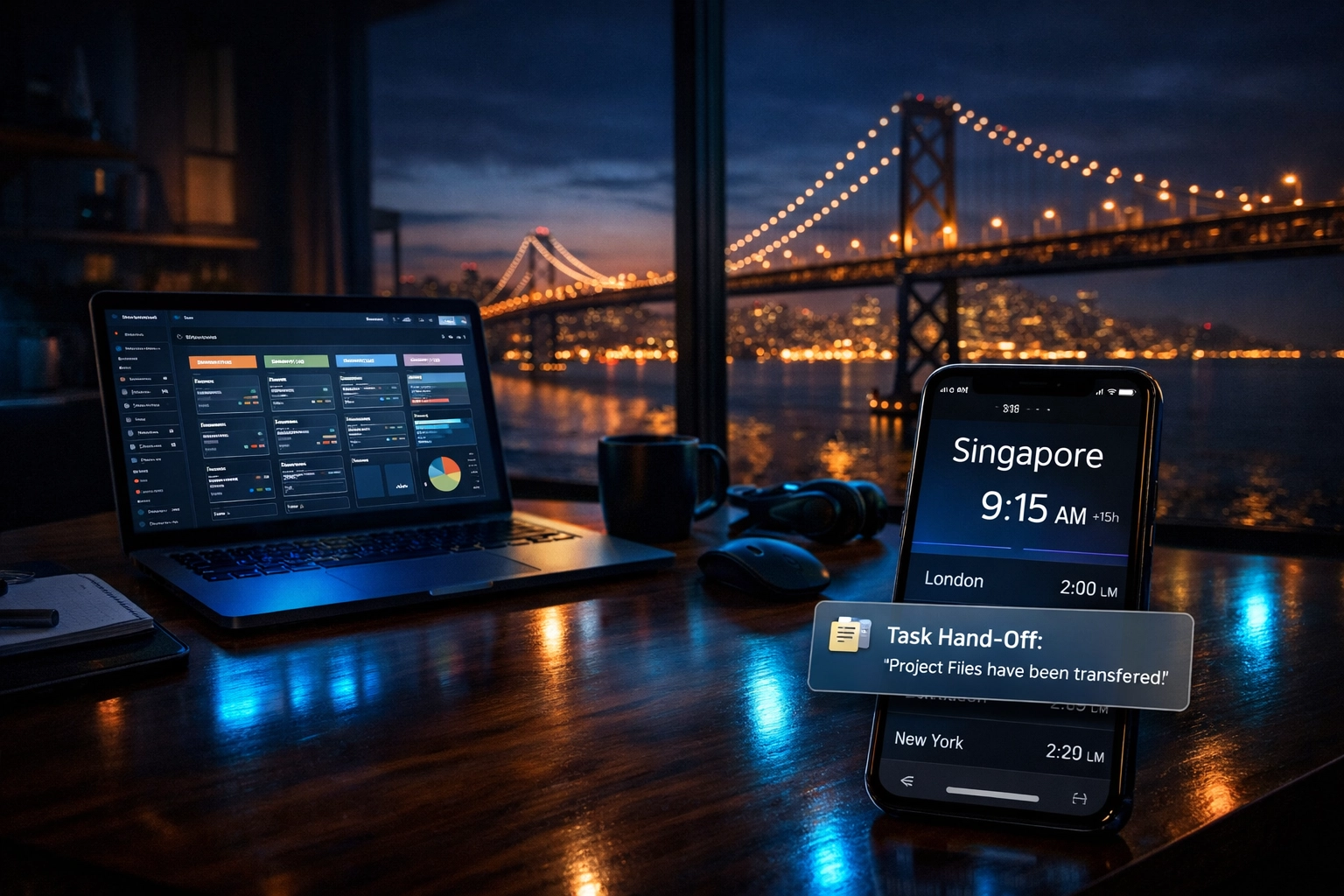
- The 24-Hour Cycle: You will structure your workflow so that when you "hand off" a task at the end of your day in New York, the team in Singapore is just waking up to start on it. This turns the 12-hour time difference into a 24-hour productivity engine.
6. The "Golden Hour" for Global Calls
If you are looking for the absolute best time for global calls involving the major international hubs, you will target the 12:00 PM to 2:00 PM UTC window.
- New York (UTC-5): 7:00 AM – 9:00 AM (Early start, but manageable).
- London/Lisbon (UTC+0/+1): 12:00 PM – 2:00 PM (Perfect mid-day sync).
- Istanbul/Helsinki (UTC+3): 3:00 PM – 5:00 PM (Late afternoon wrap-up).
This window is the "narrow bridge" of global commerce. You will guard this time on your calendar with your life. It is the only period where the "neon-slick streets" of the East and the "espresso steam" of the West are both bustling.
7. Navigating the Specifics: Hub Spotlights
To truly master the logistics, you must know your hubs. Use these deep-dive resources to understand the current state of play in each city:
- The Scandinavian Cluster: Coordination between Stockholm, Oslo, and Copenhagen is seamless as they share the same time zone, but their DST shifts are critical for your US-based team.
- The Atlantic Gateway: Lisbon and Dublin sit on the edge of Europe, often sharing the same time as London, making them the perfect "landing pads" for East Coast travelers.
- The Continental Core: Brussels serves as the administrative heart. When scheduling here, remember the "institutional" pace of the city.

Summary Checklist for Hub-to-Hub Success
- Always specify the time zone (e.g., "10 AM EST / 3 PM GMT / 5 PM TRT").
- Use UTC as the ultimate reference point to avoid DST confusion.
- Rotate meeting times to share the burden of inconvenient hours.
- Audit your "Overlap Sweet Spot" every time a region changes its clocks.
- Respect the cultural "tempo" of the hub you are calling.
You will no longer be a victim of the clock. You will navigate the globe’s hubs with the precision of a master chronometer. You will arrive at your meetings: whether via Zoom or in a mahogany-clad room in Istanbul: refreshed, synchronized, and ready to lead.
For a full list of all major business hubs and their current times, visit our major international cities guide or browse our post sitemap.
The world is moving. You are now in sync with it.