
You hate clock whiplash. Arizona does too. Under the Uniform Time Act, it opted out and locks into Mountain Standard Time all year—no spring forward lies, no fall back fog. Heat rules here; earlier sunsets waste no sweat. Except the Navajo Nation flips with DST, so your meeting might, explode. Phones glitch. Flights shift. Calendars betray. You want the fix, the traps, the why—and the easy hacks?
Key Takeaways
- The U.S. shifts clocks for DST—forward in March, back in November—to push more daylight into evenings.
- The Uniform Time Act allows states to opt out; Arizona chose permanent Mountain Standard Time.
- Arizona’s heat favors earlier sunsets, lowering evening AC demand and fitting early-morning work routines.
- Year-round MST avoids biannual clock changes, reducing sleep disruption and scheduling confusion.
- Exception: Navajo Nation observes DST within Arizona, creating time-boundary quirks near tribal lands.
How Daylight Saving Time Works in the U.S
Springing forward, then stumbling back—that’s the U.S. time dance. You move the clock ahead one hour in March, you spring forward, and you pretend it’s fine. Sunrise shifts later. Evening drags on. You chase light like it owes you money. Then November hits. You fall back, grab that hour like a trophy, and act relieved. Commutes flip. Sleep gets messy. Schedules wobble. Farmers don’t cheer. Kids wait for buses in darkness. Airlines and apps scramble, and yes, you show up early, or late, or both. For months you run on social jet lag. Supposed savings? Thin. Confusion? Thick. But you still play along, twice a year, because habit bullies you. Admit it. The clock moves, and you obey. You hate it. Do it anyway.
Arizona’s Choice Under the Uniform Time Act
You think every state must play the spring‑forward game—wrong. Under the Uniform Time Act’s exemption, you choose to opt out of DST, and Arizona did exactly that, locking the whole state to MST all year like a stubborn mule that won’t budge. Hate it or love it, you set one time and you keep it, and when everyone else stumbles at 2 a.m. you laugh and go to bed.
Opting Out of DST
While the rest of America plays the clock‑flipping game, Arizona simply says no.
You keep one time, one rhythm, one sane morning.
No spring‑forward whiplash. No fall‑back fog.
You dodge Health Impacts that punch sleep, mood, and safety.
You also see Global Examples: Japan, Iceland, most of Africa—no DST circus, no applause.
Hot sun rules here.
You respect it, so you don’t chase later sunsets that cook sidewalks and tempers.
Simple move.
Big payoff.
| Scene | Feeling |
|---|---|
| Dawn run | Cool relief |
| Dinner early | Soft light |
Tourists grumble. You shrug.
Businesses adapt. Phones auto-sync. Crisis averted.
You gain predictable evenings, cooler errands, fewer yawns, fewer crashes.
And clarity.
Your clock means what it says, all day.
Hate that? Set alarms for chaos.
Love it? Own it.
Uniform Time Act Exemption
Because Congress wrote an escape hatch, Arizona took it. You know the one—the Uniform Time Act’s neat loophole. It lets a state skip Daylight Saving Time if it does so uniformly. Not cute. Legal. You push a resolution. You file a statute. You opt out. Boom. The legislative history shows Congress feared chaos yet still offered choice, a federal wink. You seize it. You stop the seasonal clock yo‑yo, and you dare neighbors to complain. And they do. Airlines shuffle. Broadcasts shift. Meetings wobble. Those interstate implications? Real, messy, hilarious. You adapt anyway. You choose consistency over clock theater. You reject springing forward like a trained seal. You don’t apologize. You don’t blink. You read the law and say, fine—then we’re out. Right now.
Statewide Observance of MST
Although Congress dangled Daylight Saving like candy, Arizona slapped it away and locked the whole state to Mountain Standard Time all year. You live by sun, not by Congress. One clock. One rhythm. No springing, no falling, no groggy Monday circus. Your phone doesn’t betray you. Streetlights keep their deal. Agricultural routines stop taking punches; irrigation starts before dawn and stays sane. Kids? They wake with light, not a bureaucrat’s pen. School schedules quit whiplash. Buses roll on time, not on fantasy. You plan dinner without guessing the sky’s mood. Turquoise sky, steady time, simple math. Businesses align, travelers adapt, you win. Hate it? Move. Love it? Prove it. Set your watch once, then fight your day, not your clock. Every single Arizona day.
Heat, Energy, and Lifestyle Reasons to Skip the Switch
You hate paying to blast AC at 8 p.m., right? Skip the switch and the sun sets “earlier,” your house cools sooner, and your power bill stops screaming. You wake early anyway—work, hikes, kids, the dog—so you grab morning light, slash evening heat, and tell clock games to take a hike.
Lower Evening Cooling Demand
When the sun refuses to quit, your AC doesn’t either—and that’s the whole point of skipping the switch. You keep evenings shorter. You dodge extra glare. Fewer hot hours means lower cooling demand when you actually want to relax. Thermal inertia still bites—roofs and roads store heat—but you don’t feed it with late sun. Your neighborhood’s nighttime microclimate calms sooner. Windows open? Maybe. Wallet opens? Not as much.
| Time | Sunlight | Load |
|---|---|---|
| 5pm | Blazing | High |
| 7pm | Softening | Moderate |
| 9pm | Dark | Low |
See the drop? That’s the idea. Shift nothing. Save something. You hate waste. Good. Let dusk arrive on time. Let compressors cycle off. Less hum. More calm. You win. Grid wins. Everybody stops sweating the bill. Turn lights later, not AC later, and watch peak charges lose their teeth at twilight.
Aligning With Early Routines
Evening calm is great; mornings run the show.
You wake early because desert heat doesn’t wait. Sun hits, asphalt sizzles, and you move or you melt. So why would you shove clock forward and sabotage morning productivity? You wouldn’t. You like light at dawn, not at dinner. Commute cooler. Work sharper. Finish faster. That’s energy saved, sweat dodged, tempers cooled. Call it what it is: circadian alignment, not calendar cosplay. Your body knows sunrise. Your AC knows bills. Keep time steady, keep routines ruthless. Kids catch buses without jet‑lag theater. Crews pour concrete before noon, not in broiler hours. Farmers irrigate early and go. You want results, not rituals. Skip the switch. Beat the heat. Own the day. Or chase it, yawning, late, paying.
Mountain Standard Time All Year: What That Means
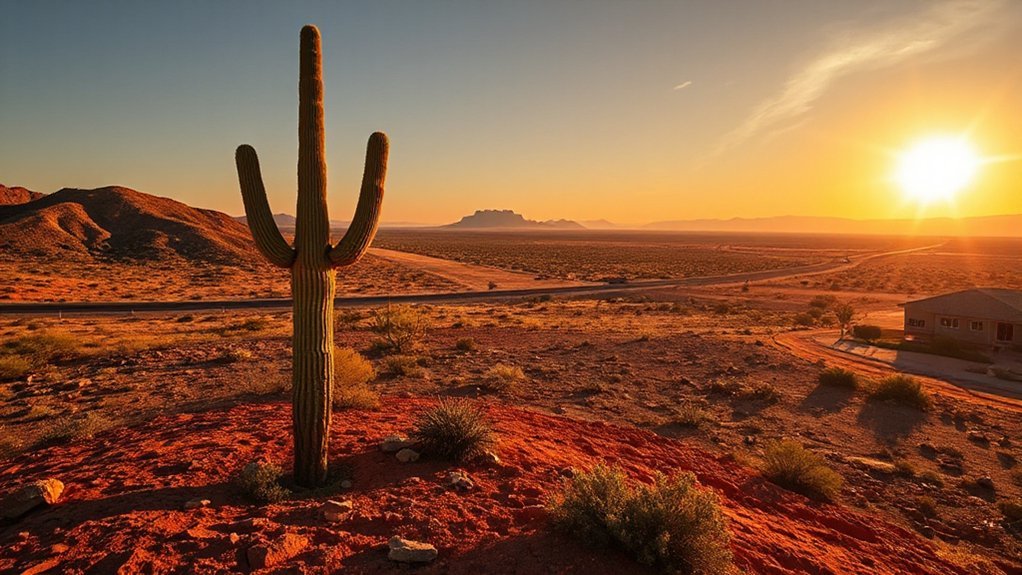
Always, Arizona locks the clock and rides Mountain Standard Time year‑round. You don’t leap forward. You don’t fall back. You hold the line. That means your morning sun shows up when it should, nearer Solar Noon, not faked by politics. Longitude Effects still matter—Phoenix sits west in the zone, so sunrises lag a bit, sunsets linger—yet you dodge the biannual whiplash. Neighbors flip to daylight time and suddenly you’re aligned with Pacific hours. Then they flop back and you snap to Mountain again. Annoying? Sure. Manageable? Absolutely. You plan calls. You catch games. You stop arguing with your oven clock. Schools start sane. Your body thanks you. Time stops being a moving target. Simple. Stable. Boring? Good. Predictability wins. No drama. Just daylight truth.
The Navajo Nation Exception Within Arizona
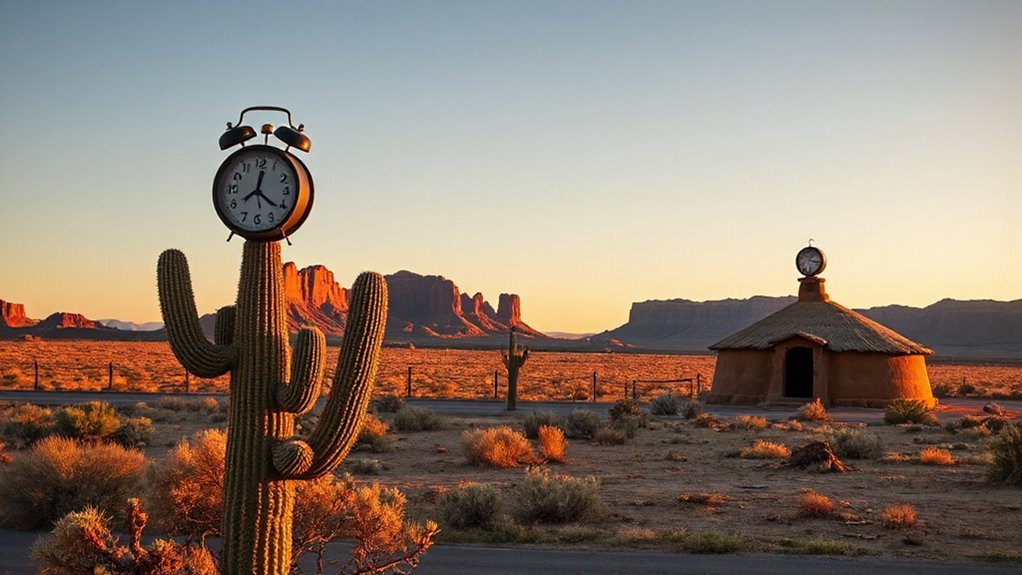
Think Arizona never changes clocks? You’re wrong—partly. The Navajo Nation says yes to daylight saving, because tribal sovereignty means it chooses. Not Phoenix. Not you. Them. Their land their rules. Federal law backs that choice. So the state sticks to Mountain Standard Time, but the Nation springs forward and falls back. Simple? Not with boundary complexities. Hopi land sits inside Navajo land, and Hopi rejects DST. Then tiny Navajo pockets sit inside Hopi. Rings within rings. A clockwork maze, drawn on red rock and sage. Culture beats convenience. Identity over uniformity. You want one map, one time, one answer. Too bad. Arizona shrugs. Navajo insists. Hopi doubles down. This isn’t confusion. It’s authority. It’s history yelling, We’re still here. Loud, unapologetic, exact, and enduring.
Timing Pitfalls for Travelers and Businesses
While your phone smugly “updates automatically,” you cross an invisible line and your schedule detonates. Arizona shrugs. You don’t. You land at Sky Harbor and your watch lies. Now the sales call starts without you. Meeting miscoordination? You invented it. The client waits. You pace. Everyone blames “the system.” Cute. Meanwhile your flight connections evaporate because Phoenix ignores springing forward, and your layover math explodes. You chase time zones like a dog after a train. Spoiler: the train wins. Drive north, hit tribal land, flip again. Calendar says one thing. Reality says no. You miss the demo. You miss dinner. You miss money. Stop pretending the clock cares. It doesn’t. Arizona isn’t late. You are. Fix your timing before it fixes you for good.
Make Your Devices Behave: Phone and Calendar Tips
Because your phone loves guesswork, you have to bully it. In Arizona, you don’t chase clocks. So force a timezone lock. Set Region: United States, State: Arizona, City: Phoenix. Not vague. Manual, not auto. Kill network time if it flips you. Airplane on. Airplane off. Check again. Ruthless.
Now your calendar. Stop chaos before it RSVP’s. Turn on calendar syncing but tag events with the right zone—Arizona, not “who knows.” Add “AZ” to titles. Noon with New York? Schedule as their time, then lock yours. Meeting with Denver after March? Expect drift. Adjust or eat the blame.
Double check alarms. Test one for 7 a.m. tomorrow. Screenshot settings. Share them with coworkers who act shocked twice a year. You’re the clock boss now. Seriously.