

You might not realize that when you whisper “What time is it in the USA?” the country actually answers in many voices at once—New York rushing toward sunset, Chicago pausing at noon, Los Angeles just waking up to coffee and headlines. If you’ve ever felt out of sync with someone a few states away, you’ve already touched this puzzle of presence and clocks, and it’s about to get more interesting.
Key Takeaways
- The U.S. has multiple time zones; there is no single “USA time” at any given moment.
- Continental U.S. main zones are Eastern, Central, Mountain, and Pacific, each one hour apart.
- When it is noon in New York (Eastern), it is 11 a.m. Chicago, 10 a.m. Denver, and 9 a.m. Los Angeles.
- Daylight Saving Time (March–November) shifts clocks forward one hour in most states but not in Hawaii, most of Arizona, or territories.
- For the exact current U.S. times by city/zone, use an official source like NIST time.gov or your device’s world clock.
Understanding Time Zones Across the United States

Even before you look at a clock, you can feel that time in the United States doesn’t move in just one straight line—it ripples across the country, arriving in waves from the Atlantic to the Pacific.
You stand in that tide whenever you ask, “What time is it, USA?” and realize that one moment holds many hours at once.
When it’s noon in New York, it’s 11:00 in Chicago, 10:00 in Denver, 9:00 in Los Angeles, yet it’s the same shared instant, the same breath.
You move through four main continental zones—Eastern, Central, Mountain, Pacific—plus far‑flung territories that stretch the map into 11.
Boundary anomalies appear like little puzzles on road trips, one side of a street technically “later” than the other.
Daylight Saving Time: When and Where It Applies

At a certain point each March, long before summer really arrives, the United States does something small but bold with its clocks—you push the hour hand forward, you “lose” a bit of sleep, and you step into a lighter evening. On the second Sunday in March, at 2:00 a.m. local time, you jump to 3:00 a.m., then on the first Sunday in November, you fall back, returning to standard time.
From March to November, every mainland zone—Eastern, Central, Mountain, Pacific—moves one hour closer to sunrise and sunset, while Hawaii, most of Arizona, and the territories keep their steady rhythm.
| Region | Follows DST? | Notes |
|---|---|---|
| Eastern–Pacific mainland | Yes | Clocks shift one hour |
| Hawaii, most Arizona, territories | No | Time stays constant |
Notice how your evenings stretch, how your mornings compress, and consider both the Health Effects and the Economic Impact with honesty and gratitude. Treat these changes as invitations to slow down, check in with your body, and choose habits that protect your sleep, mood, and relationships during this shift gently.
Current Local Time in Major U.S. Cities
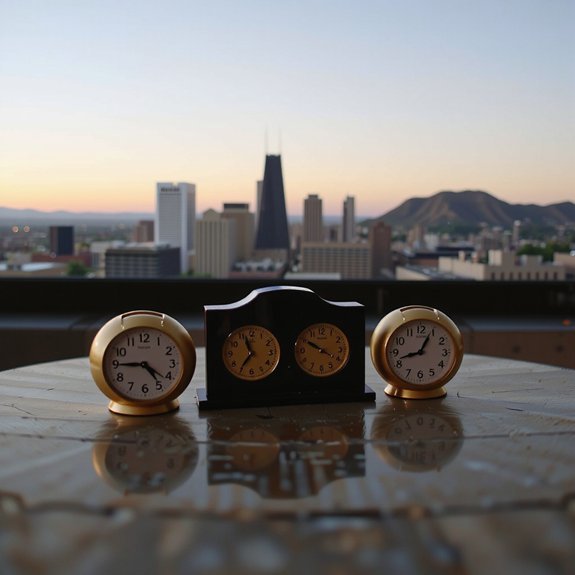
In this very moment, while lights glow in New York apartments,
traffic hums along Los Angeles freeways, and a soft breeze brushes the palms in Honolulu, each city keeps its own quiet beat of time. Right now, you straddle those zones in your mind, feeling how one country stretches from fast‑paced Eastern evenings to lingering Pacific sunsets.
Between them, Chicago, Denver, and Honolulu mark their own steady hours, each reminding you that time is both shared and personal. Use that awareness as a quiet tool for planning your day with intention:
- For Meeting Planning, picture teammates in New York and Los Angeles.
- For Broadcast Scheduling, see headlines reaching New York, then drifting toward California.
- Let Chicago’s Central time steady shared check‑ins and quick decisions.
- Use Denver’s Mountain hours for deep work, quieter meetings, or focused study.
- End your day with Honolulu’s soft night, honoring rest and renewed intention.
Official Sources for Accurate U.S. Time
How do you stay grounded in your day when every clock around you seems to tick a little differently?
You begin by trusting the quiet guardians of time that work in the background, steady and unseen.
Through NIST services, especially the official site time.gov, you can see U.S. civil time as it flows straight from atomic clocks, not from a random phone app that might drift while you’re rushing to catch a train.
You can listen for radio signals from WWV or WWVB, or let your computer sync to NIST’s time.nist.gov servers, where strong NTP security helps shield you from fake or tampered time.
You can look to the U.S. Naval Observatory and the GPS satellites above you, knowing their master clocks guide planes, power grids, and phone networks, then pause, breathe, and feel your own life lining up with that same precise, shared moment in the USA.
Adding Live U.S. Time Widgets to Your Website
Letting the exact U.S. time glow quietly on your website does more than fill a corner of the screen—it gives your visitors a small anchor, a shared moment they can trust.
A simple, precise U.S. clock turns passing seconds into a quiet, shared point of trust.
When you add a live clock, you’re not just showing numbers, you’re offering presence, gratitude, and a little sense of order in a noisy day.
Choose a reputable provider like NIST, 24TimeZones, or timeanddate, and protect Widget Security by using only HTTPS embeds or scripts.
Pick the right IANA time zone—America/New_York, America/Chicago, America/Denver, America/Los_Angeles—or display UTC with the proper offset so daylight saving never surprises anyone.
Then place the snippet where you want the clock to live, and let it update every second.
- Use Intl.DateTimeFormat for custom clocks you host
- Design for Responsive Design across phones and desktops
- Add aria-labels and clear timezone text
- Provide graceful fallback content
- Test with assistive tech
Frequently Asked Questions
How Did the United States End up With Its Current Time Zone Boundaries?
You inherit today’s time zones from 19th‑century Railroad Standardization, when rail companies pushed towns to sync scattered local times so trains stopped crashing.
Later, Congress adjusted lines through Political Compromises, following state borders, city needs, even coal towns begging for more evening light.
When you look at those crooked maps, you’re really seeing history’s presence—technology, commerce, and local voices stitched into one restless, ticking patchwork of gratitude and shared responsibility.
How Can I Easily Schedule Meetings Across Multiple U.S. Time Zones?
You schedule across time zones by choosing a single “home” zone, then letting smart Calendar Tools convert automatically, so you protect everyone’s focus and presence.
Start by finding small Overlap Windows—maybe early Pacific, late Eastern—then lock those in as shared meeting hours.
Always show times with zones, send invites instead of loose emails, and pause before clicking “send,” asking, “Would I feel respected getting this?” each day with quiet gratitude.
How Do U.S. Airlines Handle Time Zones on Tickets and Boarding Passes?
You step into the airport and the clock might feel like it’s doing cartwheels.
Airlines keep your world steady by printing departure and arrival in Local Times for each city, never some guess.
You’ll usually see no UTC Labels on tickets—those stay in the background for crews and systems.
so you focus on the place you’re in, breathe, double‑check the city name, and trust the time that matches your gate.
How Should I Teach Kids in the U.S. to Read and Convert Time Zones?
Start by anchoring kids in their local time, then gently stretch their world.
Use Clock manipulatives to show side‑by‑side times—New York, Chicago, Denver, Los Angeles—moving the hands while they whisper the differences.
Tell simple Time stories about cousins traveling, video calls with grandparents, or game launches at midnight, asking, “What time is it for them?”
Practice often, celebrate small wins, and model patience, curiosity, and gratitude in each shared moment.
How Do TV Networks and Streaming Services Manage Show Times Across the U.S.?
You see networks and streamers manage show times by building everything around Eastern time, then adjusting schedules with feed delays so each zone still gets a clean, polished broadcast.
You’ll notice apps auto-detect your location, guide you with local start times, and swap in localized promos that mention your city or cable provider, so you feel a presence and gratitude, like the story’s arriving just for you, right on time.
Conclusion
So when you ask, “What time is it in the USA?” you’re really testing the quiet theory that one nation can hold many moments at once, and still stay connected. Look up your city’s time, notice who’s just waking, who’s heading to bed, and let that awareness deepen your presence and gratitude. Set your clocks, trust the official sources, then step into your own hour fully—because this moment, right here, is completely yours.


