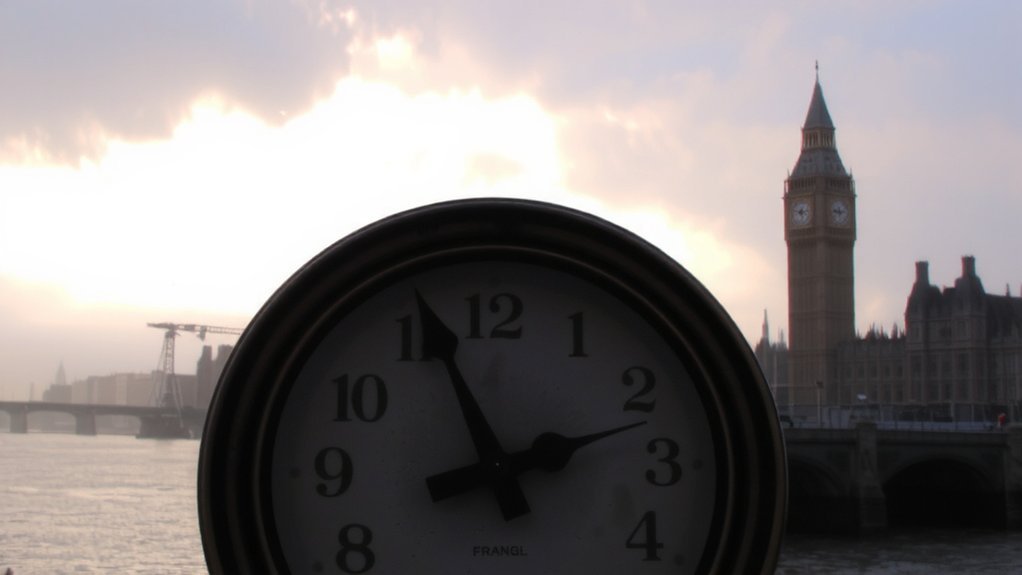

You check the clock, you glance at your phone, you wonder what time it really is in the UK right now. Maybe you’re planning a call, tracking a flight, or just trying to feel close to someone across the sea—either way, time suddenly feels more personal, almost like a shared heartbeat. Before you trust that quick guess in your head, pause for a moment, because UK time has a quiet twist.
Key Takeaways
- The UK uses a single time zone nationwide, legally defined as Europe/London.
- In winter, UK civil time is Greenwich Mean Time (GMT), which aligns with UTC+0.
- In summer, clocks shift to British Summer Time (BST), which is UTC+1.
- During GMT, the UK is 5 hours ahead of New York and 1 hour behind Paris and Berlin.
- For the exact current UK time, use online tools like Time.is or Timeanddate.com.
Current Local Time Across the United Kingdom
In this present moment, the whole of the United Kingdom moves in step under one shared clock—Greenwich Mean Time—so whether you’re walking through London’s crowded streets, standing by the grey winter sea in Glasgow, or watching the lights come on in Cardiff, the local time is the same everywhere.
You look up at public clocks on station walls, digital boards on buses, or the screen on your phone, and they all agree, holding you in the same minute as everyone from Birmingham, Belfast, Manchester, Edinburgh. Because the country keeps a single civil time, you can plan office hours, family calls, and train journeys without second‑guessing where anyone is, instead you can focus on how you want to use each hour.
Outside, the late‑December sun climbs slowly, glows, then slips away before dinner, inviting you to treat every patch of daylight as something to notice, to savor, to protect.
UK Time Zones, GMT, and British Summer Time (BST)

As you explore UK time, you’re really stepping into a simple yet fascinating rhythm—one shared time zone across the whole country, shifting gently with the seasons.
You’ll see how Greenwich Mean Time (GMT) and Coordinated Universal Time (UTC) relate, why clocks sit at UTC+0 in winter and then jump to UTC+1 during British Summer Time, and how that single hour can shape travel plans, meetings, and even quiet evening walks.
Stay present as you learn when BST starts and ends each year, notice how that early spring hour “lost” before sunrise and the soft autumn hour “gained” in the dark can subtly change how you feel the days passing.
Understanding UK Time Zones
Although time can feel like an invisible river running through your days, UK time actually follows a clear and steady pattern—anchored first in Greenwich Mean Time (GMT) and then lifted an hour forward into British Summer Time (BST).
When you look at a clock in Britain, you’re touching living timekeeping history, yet also standing inside precise legal definitions, written into law as the Europe/London time zone.
In winter you live on GMT, often called “winter time,” calm, dark mornings inviting slower starts.
Then, on the last Sunday in March, clocks jump from 01:00 GMT to 02:00 BST, and evenings suddenly feel wider, brighter, more possible. On the last Sunday in October, you gain back an hour, a small gift of rest and quiet gratitude.
GMT and UTC Explained
You’ve already walked along the riverbank of UK time—feeling the shift from dark GMT mornings to bright BST evenings—so now it helps to meet the two quiet anchors underneath it all: GMT and UTC.
GMT grew from historical origins at the Royal Observatory in Greenwich, where ships set their clocks and charted distant seas, so when you hear “Greenwich,” you can almost feel brass instruments, cool stone, steady stars.
UTC, by contrast, lives in atomic clocks, invisible yet exact, adding leap seconds when Earth’s spin drifts, holding a calm, global rhythm.
In daily UK life you treat them as twins—both sit at UTC+0 in winter—while your devices quietly follow the Europe/London setting, translating that precision into everyday presence, and filling each hour with gratitude.
When BST Is Active
While the calendar moves in its steady loop, British Summer Time steps in like a quiet stagehand, nudging the lights a little brighter and shifting the scene one hour forward.
You feel it on the last Sunday in March, when 1:00 a.m. suddenly becomes 2:00 a.m., and the UK slides from GMT to BST—UTC+1 on every phone, oven clock, and train board. That missing hour may bring sleep disruption, yet it also stretches the evening light, inviting walks, games, and unhurried dinners. Farmers adjust agricultural practices, pilots update flight plans, coders set servers to Europe/London so switches happen cleanly.
Then, on the last Sunday in October, you gently return to GMT, gaining an hour, noticing the darker evenings, choosing steadiness over rush, calmly present.
Daylight Saving Time Changes and Clock Adjustments

As you move through the UK year, the shifting Daylight Saving schedule quietly shapes your days—brighter evenings in British Summer Time, softer, earlier nights when the clocks return to GMT.
You “spring forward” each March, setting the clock ahead one hour and feeling that subtle mix of excitement and disruption, like stepping out into cooler air that still carries a promise of light.
Then, in late October, you “fall back,” turning the clock to an earlier hour and gaining a pocket of extra rest—a small reset that invites you to notice your own rhythm, your presence, and the changing season outside your window.
UK Daylight Saving Schedule
In every UK year, there’s a quiet moment in the night when time itself seems to take a small step, and the country shifts from the steady anchor of Greenwich Mean Time to the longer light of British Summer Time.
You live inside that pattern, from the last Sunday in March to the last Sunday in October, guided by the Europe/London time zone even if you never see the code.
To hold the rhythm, remember:
- Mark the March and October Sundays in your calendar, treat them as small seasonal rituals.
- Notice your sleep, mood, and focus—Health impacts often whisper before they shout.
- Stay curious about Policy proposals, and let your own daily choices reflect the kind of schedule you want most.
Spring Forward Clock Change
You don’t just live through the UK’s daylight saving pattern—you help shape how it feels, especially on that early spring night when the clocks leap forward and the year seems to take a fresh breath.
On the last Sunday in March, at 01:00 GMT, UK time jumps to 02:00 BST, and you surrender one quiet hour of darkness for a longer, brighter evening.
You might feel sleep disruption on that first Monday, yet you can soften it—go to bed earlier, dim the lights, treat the lost hour as a small offering to future sunsets.
Set your analog clocks, ovens, and bedside alarms before you sleep, and you’ll wake with more calm, more presence, more gratitude.
On the roads, guard your focus, protecting road safety.
Autumn Clock Rollback
On the last Sunday of October, the UK quietly turns the clocks back, and the night seems to stretch, offering you a bonus hour that feels like time handed back with a gentle smile.
As 02:00 BST becomes 01:00 GMT, you step into that repeated hour, noticing how streets fall quieter, how darkness arrives earlier, how your own presence in the moment can feel sharper.
- Notice the shift: sunrise and sunset slide an hour earlier, and evenings grow denser, cinematic, inviting warm lamps and slower conversations.
- Remember the Historical origins—wartime clocks, savings, trains—then weigh Public opinion, often split between safety and simple convenience.
- Use the extra hour with intention—sleep, journal with gratitude, or walk under colder stars, choosing authenticity over autopilot.
Time Differences Between the UK and Major Cities Worldwide
Although a clock face looks simple, its meaning shifts the moment you cross a border, and understanding how UK time lines up with other cities can quietly transform how you plan, connect, and show up for people who live far away.
Every timezone gap carries a quiet message about how you value someone else’s morning, evening, and in‑between hours
When it’s winter and you’re on GMT, you sit 5 hours ahead of New York and 8 hours ahead of Los Angeles, so emails you send at your noon land in their early morning, shaping market overlaps and gentle meeting etiquette.
You’re 1 hour behind Paris and Berlin, yet 8 hours behind Beijing and 9 behind Tokyo, so Europe feels close, while Asia asks for more deliberate care.
In British Summer Time, the gap to New York and Los Angeles shrinks by an hour, inviting late‑day calls that don’t steal anyone’s sleep.
Always pause, check DST rules, and let that small act express presence and quiet gratitude.
Sunrise, Sunset, and Moon Phases in the UK
In the deep tilt of a UK winter, sunrise slipping in around 8:06 AM and sunset fading by 4:00 PM can make the day feel small, yet this short window of light—just under eight hours, with the Sun climbing only about 15° high at solar noon—invites you to notice time with a different kind of presence.
You step out in civil twilight, 7:26–8:06 AM, sky rinsed in blue, birds calling above pavements.
After 4:00 PM, twilight holds to 4:40, shapes turning to ink, windows glowing as small fires.
Use this rhythm:
- Watch wildlife behavior at the edges of light, when foxes slip hedges and birds crowd feeders.
- Try simple photography tips—face the glow, slow your breathing, catch silhouettes against the color.
- Track the Moon, 79.5% bright, rising near 12:15 PM and setting around 3:26 AM, between First Quarter and Full, a lantern you can trust.
Best Online Tools to Check the Exact Time in the UK
Sometimes you just need to know the exact UK time—down to the second—so your calls land gently, your travel plans line up, and your days carry more calm and confidence.
When you open a clock site, you’re really opening a tiny doorway into shared presence, trusting that what you see is true.
Start with Time.is, which syncs to atomic clocks and shows the precise UK time, your offset from UTC, and whether DST is in play.
Timeanddate.com goes further, adding sunrise, sunset, moon phases, and a meeting planner that lets you slide times around like puzzle pieces until everything fits.
WorldTimeServer and WorldTimeBuddy help you compare London with other cities side by side, so global calls feel simple, not stressful. If you build websites or apps, explore their embeddable clocks, Widget Customization options, and APIs—API Reliability here means your users can breathe out and trust every second.
Frequently Asked Questions
How Did the Uk’s Current Timekeeping System Develop Historically?
You trace the UK’s timekeeping back to messy local clocks, church bells, and stationmasters guessing noon, then you watch railways demand shared timetables, pulling towns toward Greenwich.
You see Naval Chronometers guiding ships through fog and war, proving precise time saves lives.
With Meridian Adoption, you align the world to one prime line, and you inherit coordinated time—quiet, steady, almost invisible, yet shaping every meeting, memory, moment, you today deeply.
How Does UK Time Affect Stock Market Trading Hours Worldwide?
You feel UK time most when major exchanges open and close, because it anchors European sessions and bridges Asian nights with New York afternoons.
You watch Market Overlap like a tide—London with New York, London with Frankfurt—because spreads often tighten and volume swells.
You plan for Liquidity Shifts around the London open and close, stay patient during quieter hours, and let that rhythm guide disciplined, grateful trading, with presence, authenticity.
What Time Conventions Do UK Businesses Use for International Meetings?
You treat time like a lighthouse blazing across a stormy sea, because for international meetings you anchor everything to UK local time, then clearly share matching utc offsets in every invite.
You confirm daylight‑saving changes, repeat times aloud, and follow up in writing, so everyone feels seen and prepared.
When you’re unsure, you ask participants their preferred format, then restate it with calm presence, quiet gratitude, and steady, authentic leadership.
How Is Time Displayed on UK Train and Bus Timetables?
On UK train and bus timetables, you’ll almost always see times shown in the 24 hour clock, so 3:15 pm appears as 15:15 and midnight services feel clear, not confusing.
You read across neat columns, notice symbols in the timetable legends, then match them to days, routes, or notes about holidays.
Take a breath, trace each line slowly, and trust that steady pattern to guide your journey with calm gratitude.
Do UK Schools and Workplaces Adjust Schedules Seasonally Beyond Clock Changes?
Winter darkness meets summer light—you’ll see only modest shifts beyond clock changes.
UK schools use term time adjustments more than seasons, adding revision sessions before exams, trimming after‑school clubs on icy evenings, stretching activities on bright spring days.
Many workplaces lean on flexible schedules instead, letting you start earlier or work from home, while core hours stay steady, giving your days a reliable spine and your routine steady focused presence.
Conclusion
When you ask, “What time is it in the UK?” you’re really reaching for more than numbers—you’re reaching for presence, for rhythm, for a shared moment that stretches beyond miles. Let each tick of the clock guide you—plan your calls, honor your rest, notice each sunrise and fading moon. Hold this simple truth with quiet gratitude: you can keep pace with the UK’s heartbeat, steady and clear, like a lighthouse blinking across a dark sea.


