
You’ll want the precise time in Washington, D.C.—it follows Eastern Time, switching between EST (UTC−5) and EDT (UTC−4) each year. If your device uses network time it’s automatic, but international scheduling and daylight‑saving shifts can still catch you off guard. Keep a quick method at hand, and I’ll show the simplest ways to confirm the current local time and avoid common scheduling errors.
How Washington, D.C. Keeps Time

Keeping accurate time in Washington, D.C. rests on two things: the Eastern Time Zone and precision atomic time kept and distributed by federal labs. You rely on those standards whenever you schedule meetings, file records, or synchronize devices. The National Institute of Standards and Technology and the U.S. Naval Observatory operate atomic clocks and publish Coordinated Universal Time references that underpin civil time. They distribute time via radio signals, GPS, Network Time Protocol servers, and official publications so your systems can align to the same epoch. Local authorities adopt and enforce the zone’s legal time for government, courts, and transportation. When you check a clock, you’re seeing an implementation of these federally maintained references translated into everyday civil time for Washington and national coordination.
Eastern Standard Vs Eastern Daylight Time
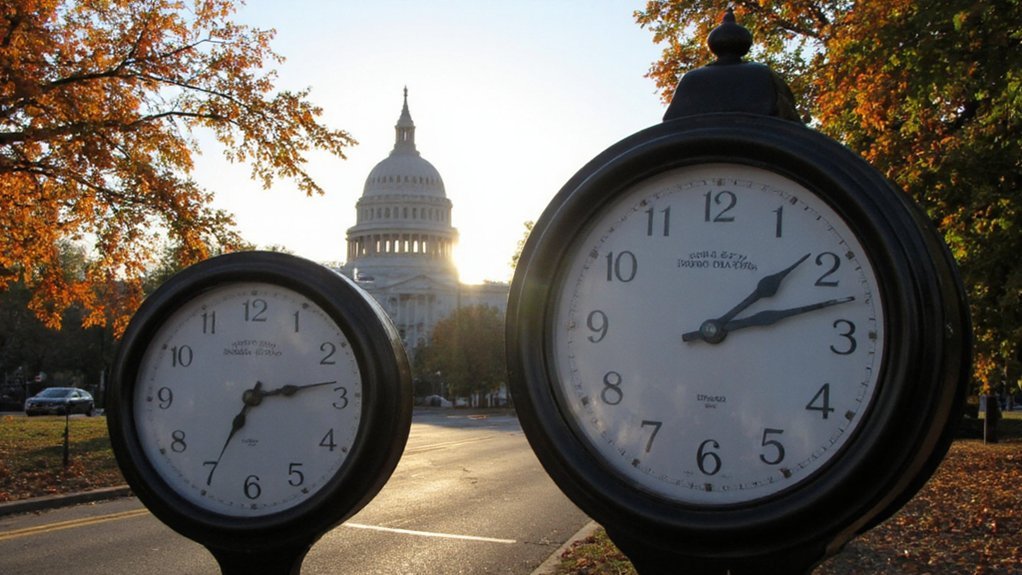
You should know Eastern Standard Time (EST) is UTC−5 and Eastern Daylight Time (EDT) is UTC−4, with EDT observed during the spring and summer months. Clocks spring forward on the second Sunday in March and fall back on the first Sunday in November. That one-hour shift can change meeting times, travel plans, and calendar entries, so you should confirm the time zone when scheduling appointments.
Standard Vs Daylight
When clocks shift in spring and fall, Eastern Time alternates between Eastern Standard Time (UTC−5) and Eastern Daylight Time (UTC−4), which changes scheduling, legal time references, and timestamp interpretation. You need to know which offset applies when you interpret meeting times, contracts, or data logs. Standard time uses UTC−5 and yields earlier clock readings; daylight time uses UTC−4 and yields later clock readings relative to UTC. Distinguish them in records and systems to avoid errors. Consider these practical implications:
- Scheduling: confirm the offset to guarantee meeting accuracy.
- Legal: cite the applicable designation to prevent contractual ambiguity.
- Technology: configure systems to store UTC and display the correct local offset.
Treat labels and offsets as authoritative for consistent timekeeping. Follow this guidance consistently.
When Clocks Change
Although the exact dates shift each year, clocks in the Eastern Time Zone move forward one hour to Eastern Daylight Time (UTC−4) in spring and back one hour to Eastern Standard Time (UTC−5) in fall, and you’ll need to account for those changes when scheduling, logging events, or citing legal times. In the United States you adjust clocks at 2:00 a.m. local time on prescribed Sundays: DST begins on the second Sunday in March and ends on the first Sunday in November. Washington, D.C., follows federal rules without exception. When you record times, use explicit zone identifiers or UTC offsets, store timestamps in UTC, and convert for display. That prevents ambiguity around the repeated hour in fall and the skipped hour in spring regularly.
Effects on Appointments
Switching between Eastern Standard Time (UTC−5) and Eastern Daylight Time (UTC−4) changes the local clock and can shift appointment times by an hour. You must verify scheduled times when clocks change to avoid missed meetings or early arrivals. Confirm timezone settings on devices, calendar entries, and communication from others. Adjust travel and preparation windows accordingly. Consider these practical steps:
- Check calendar timezones and update recurring events.
- Confirm meeting times with remote participants and include UTC references.
- Set reminders earlier or later to match the shifted clock.
Current UTC Offset for Washington, D.C
As of now, Washington, D.C. uses Eastern Daylight Time (EDT), which is UTC−4; during standard time it observes Eastern Standard Time (EST), UTC−5. You should understand that the UTC offset indicates how many hours the local time is ahead of or behind Coordinated Universal Time. Between March and November, clocks are set forward one hour to UTC−4 for daylight saving, reducing the offset. From November to March, clocks revert to UTC−5 for standard time, increasing the offset. When coordinating events or systems across zones, you’ll reference the current UTC offset to convert times accurately. Keep in mind federal and local regulations set the shifts; they aren’t adjusted by individual organizations, so rely on official timekeeping sources. You can plan accordingly for international scheduling needs.
How to Check Washington, D.C. Time on a Smartphone
To check Washington, D.C. time on your smartphone, make sure your device’s time zone is set to Eastern Time (US & Canada) or to automatic network time. Open the World Clock in your phone’s Clock app and add Washington, D.C. for quick reference. Or ask your voice assistant (Siri, Google Assistant, or Alexa) “What time is it in Washington, D.C.?” for an immediate answer.
Set Phone Time Zone
Need the correct Washington, D.C. time? Set your phone’s time zone to make sure displayed time matches Eastern Time (ET). On iPhone, go to Settings > General > Date & Time and toggle off Set Automatically to choose Eastern Time (UTC−05:00/−04:00). On Android, open Settings > System > Date & time, disable Automatic time zone, and select America/New_York. Confirm the change and restart apps that cache time data.
Follow these steps:
- Open Date & Time settings.
- Disable automatic time zone.
- Select Eastern Time (America/New_York) and verify.
You’ll avoid misaligned calendars, alarms, and timestamps when traveling or using VPNs. If you rely on accurate time, re-enable automatic when back in your home region.
Use World Clock App
How quickly can you confirm Washington, D.C.’s current time on your phone? Open your phone’s Clock app, select World Clock, and tap the plus icon. Type “Washington” or “Washington, D.C.” in the search field, then choose the correct result. The app adds Washington, D.C. with its current local time, daylight saving indicator when applicable, and time zone label (Eastern). You can reorder entries for faster access or remove duplicates. On most phones the World Clock updates automatically and reflects changes from Daylight Saving Time or network time settings, so you’ll see accurate time without manual adjustment. Rely on the World Clock for quick reference when scheduling calls or checking local hours. Keep it pinned in the app for immediate visibility across time-sensitive daily tasks.
Ask Voice Assistant
Want the current time in Washington, D.C.? Ask your phone’s voice assistant and get an instant, reliable answer. Activate it verbally—say “Hey Siri,” “OK Google,” or “Hey Alexa”—then ask, “What time is it in Washington, D.C.?” The assistant will respond with the current local time and may offer timezone details.
- Confirm your device’s location services and time settings.
- Phrase the question clearly, specifying “Washington, D.C.”
- Use follow-ups like “what’s the time there in 24-hour format?”
You can rely on voice assistants for quick checks when you’re driving or hands-free. They’ll pull authoritative time data and update for daylight saving automatically, so you won’t misread the hour. If you travel, double-check with an official source for legal or meeting-critical timestamps and confirmations
How to Check Washington, D.C. Time on a Computer
Where’s the quickest way to check Washington, D.C. time on your computer? Look at your system clock: Windows shows it on the taskbar, macOS displays it in the menu bar. Make sure your computer’s time zone is set to Eastern Time (UTC−5 standard, UTC−4 daylight). On Windows open Settings → Time & Language → Date & time; on Mac open System Settings → General → Date & Time or Time Zone. The Calendar app and menu clock reflect that setting. If you need exact synchronization, enable automatic internet time syncing in the same settings. For quick verification you can run a local date/time command in a terminal or PowerShell. Those methods give precise local Washington, D.C. time without visiting external clock sites or apps locally.
Using World Clocks and Time Zone Websites
Consulting world clocks and time zone websites gives you a quick, reliable way to compare current times, convert between zones, and account for daylight saving changes. You can open a reputable site or app, select Washington, D.C., and see the official local time with DST status displayed. Use features to add multiple cities for instant comparison. Check synchronization indicators to verify the site updates from atomic or NTP sources. Verify that the site uses IANA time zone names (America/New_York) for accuracy. Follow these steps:
- Choose a trusted site or app with NTP/atomic sync.
- Add Washington, D.C., and any other cities to your list.
- Confirm DST status and IANA zone for precision.
You’ll get concise, authoritative time data without manual calculation effort.
Scheduling Calls Across Time Zones
After checking reliable world clocks, plan meeting times to minimize inconvenience for participants across zones.
| Option | UTC | Local |
|---|---|---|
| Morning | 09:00 | Varies |
| Evening | 17:00 | Varies |
You’ll set core hours that overlap for most attendees, rotate meeting times to distribute inconvenience, and use calendar invites with explicit time zone conversion. Always state meeting time in UTC and local time for clarity. Confirm daylight saving rules where relevant and set automated reminders adjusted to recipients’ zones. Use a shared scheduling poll to identify acceptable slots and lock the final choice promptly. For critical decisions, schedule multiple shorter sessions rather than one long all-hands call. Maintain a concise policy on acceptable meeting hours and exception procedures so everyone knows expectations. Review outcomes and iterate scheduling as needed regularly.
Travel Tips for Time Changes in Washington, D.C
When you travel to Washington, D.C., plan to reset your sleep and meeting schedule to Eastern Time (ET) immediately: set devices to local time, move bedtime and light exposure an hour earlier or later per your origin, and avoid heavy commitments in the first 24 hours. You’ll coordinate transportation and reservations around local time, confirm flight and train arrival times, and prioritize daytime activity to anchor your circadian rhythm. Pack adaptors and reliable alarm, and use brief strategic naps to maintain alertness without disrupting nighttime sleep. Follow a simple routine to reduce jet lag and maintain productivity. Recommended actions:
- Set phone, watch, and calendar to ET on arrival.
- Expose yourself to daylight within two hours.
- Schedule low-pressure activities on day one.
Common Time Zone Mistakes to Avoid
Having set your devices and daylight exposure plan, watch for common time-zone mistakes that can undo that effort: leaving calendars or meeting invites in another zone, ignoring daylight saving changes, relying on device auto-detect without double-checking, and mixing 12- and 24-hour formats. Confirm calendar zone per event, lock your device to local time, and verify participants’ zones. Test alarms after travel and update travel apps. Use clear AM/PM labels or 24-hour times consistently. Table below gives quick checks and actions.
| Issue | Quick check | Action |
|---|---|---|
| Calendar zone mismatch | Inspect event settings | Convert to local |
| DST oversight | Check date rules | Adjust entries |
| Auto-detect error | Compare two devices | Set manually |
| Format confusion | Read time format | Standardize format |
Follow these steps and you’ll avoid common disruptions in Washington.
Conclusion
Now that you know Washington, D.C. follows Eastern Time and shifts between EST (UTC−5) and EDT (UTC−4), set your device to America/New_York or enable network time to stay accurate. When scheduling across zones, always confirm daylight saving status and use a reliable world clock or time zone converter to avoid mistakes. If you travel, update your device on arrival. These steps keep your appointments timely and reduce confusion, and protect your calendar integrity every time.