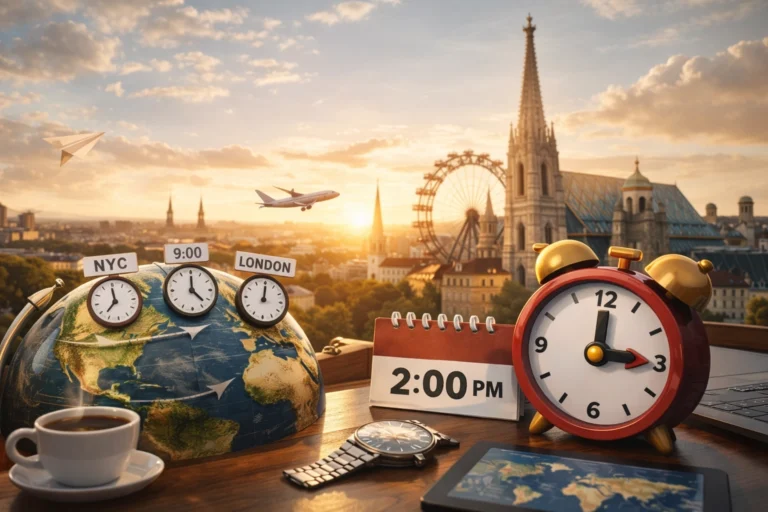

You land at Charles de Gaulle, the cabin pressure hissed away by the sound of French announcements, and your first instinct is to check your wrist. You aren't just here for the croissants; you’re here to perform, to meet, and to navigate one of the world’s most influential hubs. But before you can hail a G7 taxi or order that first café au lait, you need to master the most critical variable in your itinerary: The Paris Clock.
As of Thursday, March 5, 2026, Paris is operating on Central European Time (CET). If you are looking at your watch right now, the city is sitting at UTC+1.
In this guide, you will master the logistical nuances of the Paris time zone. You will learn how to bridge the gap between your home office and the 8th Arrondissement without losing a wink of sleep. You'll navigate the "spring forward" trap that catches thousands of travelers off guard every March. Most importantly, you will move through the City of Light with the precision of a local.
The Technical Breakdown: CET vs. CEST
Paris doesn't just stay still. To be an expert traveler, you must understand the "why" behind the digits. Currently, the city is in its winter rhythm.
- Current Standard: Central European Time (CET).
- Offset: UTC/GMT +1 hour.
- The Upcoming Shift: On March 29, 2026, Paris will transition to Central European Summer Time (CEST).
When that shift happens, the offset jumps to UTC+2. You will lose an hour of sleep, but you’ll gain the golden evening light that makes the Seine look like a moving painting. If your trip spans the end of March, you must manually verify that your digital devices have updated. Relying on "auto-sync" in an underground metro station is a rookie mistake. Verify.
Scheduling Meetings: The Global Bridge
Managing a global team from a Parisian bistro sounds romantic until you realize you’ve scheduled a Zoom call for 3:00 AM local time. To maintain your "expert-insider" status, you will use the Paris Window.
The East Coast Connection (New York/Toronto)
Paris is 6 hours ahead of Eastern Standard Time (EST).
- The Sweet Spot: 2:00 PM – 6:00 PM (Paris Time).
- The Result: You catch your US colleagues as they start their morning (8:00 AM – 12:00 PM). You’ll have your morning free to explore the Louvre or handle local errands, then hit your "high-intensity" work block in the afternoon.
The London Gap
The proximity of London often tricks travelers into thinking they are in the same zone. They aren't. Paris is 1 hour ahead of London (GMT/BST).
- The Trap: Scheduling a 9:00 AM meeting "London time" means you are starting at 10:00 AM.
- The Pro Move: Always specify CET or CEST in your calendar invites. Ambiguity is the enemy of efficiency.
The Asia-Pacific Stretch (Tokyo/Sydney)
This is where the logistics get "labyrinthine." Paris is currently 8 hours behind Tokyo.
- The Strategy: You must be a "morning warrior." Your 8:00 AM espresso in Paris is 4:00 PM in Tokyo. If you wait until after lunch, your Japanese partners have already headed to izakayas for the night.
The Rhythm of the Day: Sunlight and Strategy
On this March 5th, you are looking at a sunrise of 7:24 AM and a sunset of 6:40 PM. You have approximately 11 hours and 16 minutes of daylight to play with.
As the vernal equinox approaches on March 20th, the days are lengthening rapidly. You will feel the city’s energy shift. The "neon-slick streets" of the winter are giving way to the "espresso steam" of spring sidewalk culture.
The Insider Hack: Use the 7:24 AM sunrise to photograph the Trocadéro before the tourist crowds arrive. By 9:00 AM, the city is in full "hustle" mode. If you want to see the What Time Is It In Istanbul comparison, remember that Istanbul is further east and operates on a permanent UTC+3. Paris, by contrast, is more "deliberate" with its light.

Navigating the March 29th "Spring Forward"
Mark your calendar. At 2:00 AM on Sunday, March 29, 2026, the clocks will skip to 3:00 AM.
For the business traveler, this is the danger zone. You will find that:
- Transport Schedules Shift: Flights and trains departing on Sunday morning may feel "earlier" than expected.
- Meeting Offsets Change: If your home country hasn't shifted its Daylight Savings yet (like parts of the US that shift earlier in March), the gap between you and home will change by one hour.
Efficiency Tip: On Saturday night, set your alarm 15 minutes earlier than usual. Give your body the "buffer" it needs to handle the physiological jump to UTC+2.
Cultural Time vs. Clock Time
In Paris, time is a suggestion for social gatherings but a law for business.
- Dining: Do not show up for dinner at 6:00 PM. You will find the restaurant empty or the staff still eating their own "family meal." Prioritize reservations for 8:00 PM or later. That is when the "electric energy" of the city peaks.
- Business Etiquette: "Quarter-hour" grace periods are common, but for high-level briefings, arrive exactly on time. Precision signals respect.
- Retail: Many smaller boutiques in the Marais may not open until 10:00 AM or 11:00 AM. Don't rush your morning. Linger over your breakfast.

Tech Logistics: Syncing Your Life
You are an expert, so stop checking your phone every five minutes to calculate the offset.
- World Clock Widgets: Set your lock screen to show both "Local" (Paris) and "Home."
- Timed Entry: Most Parisian landmarks (The Eiffel Tower, Musee d'Orsay) now require timed entry tickets. Your 10:30 AM slot means 10:30 AM. They will not "squeeze you in" if you are late due to a time zone calculation error.
- Jet Lag Resilience: Since Paris is likely ahead of your home time (if traveling from the West), do not nap when you arrive. Force yourself to stay awake until 9:00 PM CET. You will thank yourself on day two when you wake up refreshed at 7:00 AM.
Why Paris Time Matters More Than You Think
Time zones are the invisible architecture of international travel. When you understand that Paris is UTC+1, you aren't just knowing the time; you are mastering the flow of information and energy.
Whether you are checking What Time Is It In California to call your family or What Time Is It In Texas to check on a shipment, your location in Paris puts you in the heart of the "Global Midday." You are the bridge between the closing markets of Asia and the opening bells of New York.
The Action Plan:
- Confirm your current offset (UTC+1).
- Identify your "Meeting Window" (usually late afternoon).
- Audit your calendar for the March 29th shift.
- Embrace the 8:00 PM dinner culture.
Final "Expert-Insider" Tip: The CDG Factor
If you have a flight departing from Charles de Gaulle (CDG) at 10:00 AM, you are actually dealing with a 7:00 AM "Arrival at Airport" time. Considering the RER B train or the taxi traffic from the center of Paris, your "internal clock" needs to start at 6:00 AM.
Paris is a city that rewards the prepared. It punishes the rushed. By mastering the clock, you transition from a "tourist" struggling with an itinerary to a "traveler" who commands the environment.
Master the time. Command the city. Period.
For more deep dives into global time management, check out our Major International Cities guide or see how Paris stacks up against the West Coast with our Hawaii Live Clock analysis.
Safe travels, and enjoy the 11 hours and 16 minutes of Parisian light today. You’ve earned it.