

You are standing at the intersection of ancient history and hyper-modern commerce. In Cairo, the air is thick with the scent of roasted coffee and the relentless hum of 22 million people in motion. But for you, the high-stakes traveler, the only thing that matters is the precision of your digital calendar. Today is Thursday, March 5, 2026, and if you are planning to sync your operations with the Egyptian capital, you need more than just a passing glance at a world clock. You need a strategy.
Navigating time zones is a dark art. Master it, and you achieve electric energy in your professional relationships. Fail, and you’ll find yourself staring at a blank Zoom screen at 3:00 AM, clutching a cold espresso. Cairo is a city that thrives on late nights and early starts, and understanding its current UTC+2 offset is your first step toward total logistical dominance.
The Technical Baseline: UTC+2 and the March Reality
Right now, Cairo is operating on Eastern European Time (EET). This means the city sits at UTC+2. It is a stable, predictable window: for now. While much of the world is currently navigating the tail end of winter schedules, Egypt is holding steady.
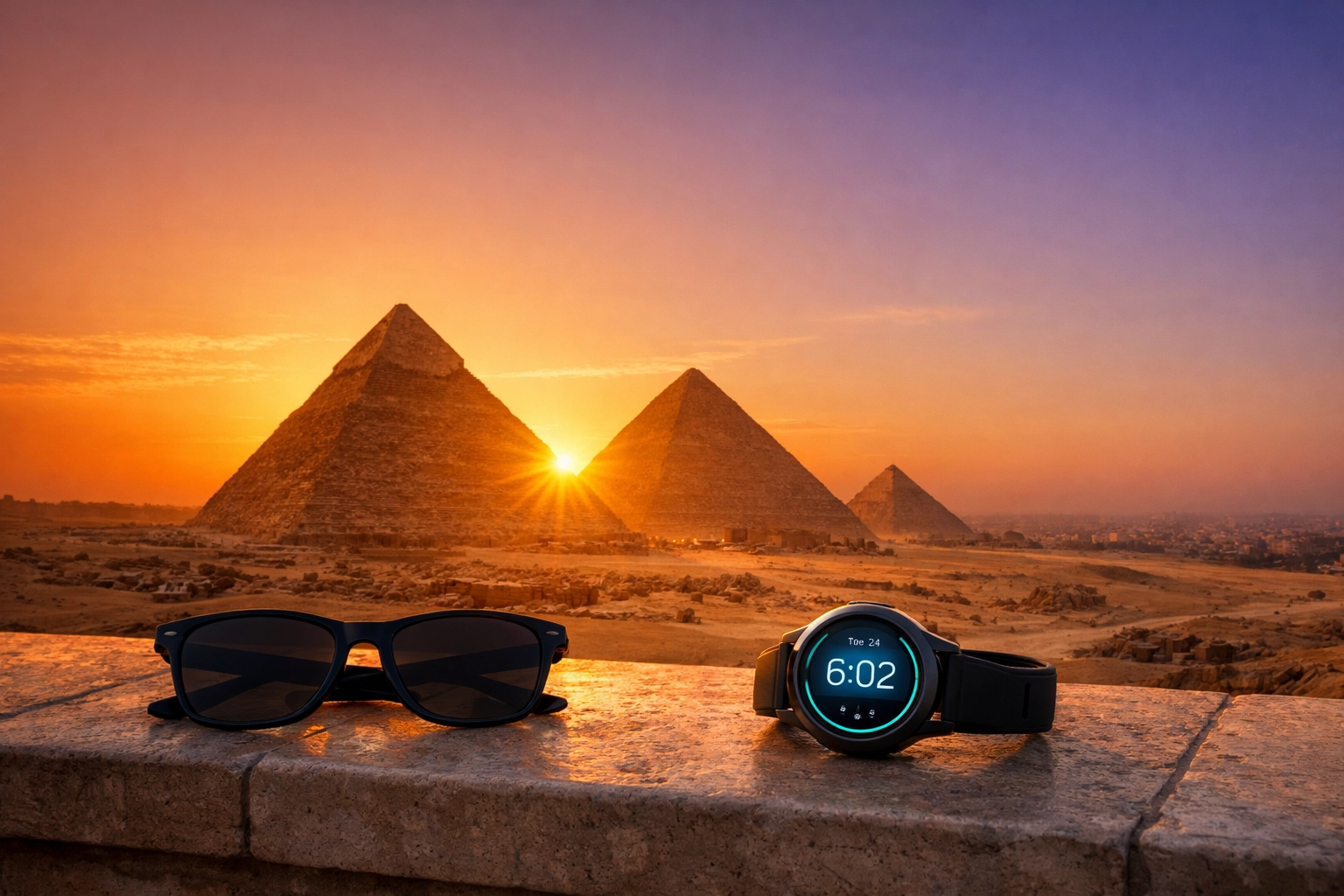
When you look at your watch on this March 5, you will see a city that wakes up with the sun at 6:16 AM and watches it dip behind the Pyramids at 5:57 PM. This gives you a solid 11 hours and 40 minutes of daylight to execute your ground operations. But the clock is ticking toward a shift. You must mark your calendar for April 24, 2026. On that day, Egypt will transition to Daylight Saving Time (DST), leaping forward to UTC+3.
If you are scheduling recurring meetings that stretch into May, you will adjust your invites now or face the consequences of missed connections. Precision. Period.
The Global Grid: Cairo vs. The World
To win in the global market, you must visualize the world as a series of interlocking gears. Cairo is the hub connecting the West to the Middle East and Africa. Here is how your UTC+2 reality stacks up against the major financial and tech centers right now:
- New York (EST): Cairo is 7 hours ahead. When you are finishing lunch in Cairo, your Manhattan counterparts are just hitting "snooze" on their first alarm.
- London (GMT): Cairo is 2 hours ahead. This is your "sweet spot." The overlap here is massive, allowing for full-day collaboration.
- Paris/Zurich (CET): Cairo is 1 hour ahead. This is practically local. You can manage teams in France or Switzerland with zero lag.
- Los Angeles (PST): Cairo is 10 hours ahead. This is the danger zone. You will need to leverage "asynchronous" communication to survive this gap.
- Beijing (CST): Cairo is 6 hours behind. Your morning is their late afternoon. Hit them early, or wait until your late night.
If you are managing teams across the United States, you might find it helpful to check the specific offsets for regions like California or Texas to ensure your calculations are surgical.
Mapping the "Golden Windows" for Meetings
You don't just book meetings; you architect them for maximum impact. In Cairo, the traditional work week runs from Sunday to Thursday. This is a critical distinction. If you schedule a "Monday morning" kickoff, you are already one day behind the local momentum. Conversely, trying to reach a high-level executive on a Friday afternoon is a fool’s errand: Friday is the day of rest and family.
The Western Overlap (US & Canada)
To reach New York or Toronto, you will prioritize the Cairo evening.
- 3:00 PM – 6:00 PM (Cairo Time): This aligns with 8:00 AM – 11:00 AM (EST).
- This is the high-value window. You will use your morning for deep work and your late afternoon for live coordination with the Western Hemisphere.
The European Connection
Because Cairo is only 1 or 2 hours ahead of most European capitals, you have an almost perfect 8-hour overlap.
- 9:00 AM – 5:00 PM (Cairo Time): You will enjoy seamless communication with London, Berlin, and Rome.
- Trust this window for long-form strategy sessions and complex negotiations.
The West Coast Challenge
Connecting with Los Angeles or San Francisco requires sacrifice.
- 6:00 PM – 8:00 PM (Cairo Time): This is 8:00 AM – 10:00 AM (PST).
- You will be working late. There is no way around it. Embrace the neon-slick streets of Cairo at night, grab a heavy tea, and power through.

Cultural Etiquette: Timing is Everything
In Cairo, time is often viewed through a lens of "Inshallah" (God willing). While the corporate sector is becoming increasingly punctual, you will encounter a more fluid approach to time in social and mid-level business settings.
- Don't Rush the Start: A meeting scheduled for 10:00 AM might actually begin at 10:15 AM after the mandatory exchange of pleasantries and coffee. You will factor this "buffer" into your schedule.
- The Late Night Culture: Cairo is a city that never sleeps. It is not uncommon to see business dinners starting at 9:00 PM or 10:00 PM. If you are invited to a late meal, accept. This is where the real deals are closed.
- The Friday Gap: Never, under any circumstances, expect a response on a Friday. It is the core of the Egyptian weekend. Use this day to explore the labyrinthine markets of Khan el-Khalili or find serendipity in the quiet corners of Zamalek.
Jet Lag Management: The Cairo Protocol
Flying into Cairo usually involves a significant time jump. To maintain your resilience and professional edge, you must force your body to adopt EET immediately upon landing.
- Sunlight Exposure: Your first morning, get outside by 7:00 AM. The Cairo sun is intense. Let it reset your circadian rhythm.
- Hydration: The desert air is unforgiving. You will drink twice as much water as you think you need.
- Strategic Napping: If you arrive in the morning, do not sleep. Force yourself to stay awake until at least 9:00 PM local time. You'll wake up on Friday morning feeling like a local.

Upcoming Calendar Alerts
As an expert-insider, you are always looking three moves ahead. The current UTC+2 status is a temporary bridge.
- April 24, 2026: Egypt moves to UTC+3.
- March 2026: Most of the US will shift to Daylight Saving Time earlier than Egypt, creating a two-week period where the time difference fluctuates by an extra hour.
Stay vigilant. Check the sitemap for updates on how these shifts affect other global hubs like Istanbul.
The Final Instruction
Mastering the clock in Cairo isn't just about math; it's about respect. When you show up on time: accounting for traffic, cultural buffers, and the UTC+2 offset: you signal that you are a serious player in the Mediterranean market.
Prioritize the 3:00 PM – 5:00 PM window for your most important global calls. Trust the Sunday-to-Thursday work week. Navigate the city with the confidence of someone who knows exactly what time it is, both on the wall and in the heart of the culture.
Cairo is waiting. The clock is running. Execute.