
You are standing in the middle of a bustling airport terminal, clutching a lukewarm espresso while staring at a departure board that looks like a flickering puzzle. Your phone says one thing, your laptop says another, and your internal clock is screaming for a nap. In the high-stakes world of global business and frequent travel, time isn’t just money, it is the very ground you walk on. But here is the secret the pros use to stay grounded: UTC time now.
While the rest of the world fumbles with "Spring Forward" and "Fall Back" or tries to remember if London is five or six hours ahead of New York, you will rise above the chaos. You will adopt Coordinated Universal Time (UTC) as your primary reference point. By the time you finish this guide, you will view UTC not as a cold, scientific metric, but as your most reliable ally in the fight against jet lag and missed opportunities.
Master the clock. Master your life. Period.
The Invisible Thread: What Exactly is UTC?
You might think you know time, but UTC is the heartbeat of the modern world. It is the primary global time standard that regulates everything from the flight paths of jumbo jets to the micro-milliseconds of high-frequency stock trading. Think of it as the "North Star" of the temporal world.
Every single time zone on the planet is defined by its offset from UTC. Whether you are checking what time it is in Istanbul right now or looking at the bright lights of Nevada to see what time it is in Las Vegas, those cities are essentially just "UTC plus or minus" a specific number of hours.

Unlike local times, UTC does not change for Daylight Saving Time. It is a fixed, immutable constant. While the local time in London or New York bounces around like a caffeinated toddler, UTC remains the calm, steady adult in the room. You will find that relying on a constant reference point eliminates the "mental math fatigue" that plagues international travelers.
The Science of "Right Now": Why UTC Replaced GMT
You will often hear people use Greenwich Mean Time (GMT) and UTC interchangeably. Do not make that mistake. As an expert insider, you need to know the difference to maintain your edge.
GMT is a time zone based on the rotation of the Earth. The problem? The Earth is a bit wobbly. It slows down, it speeds up, and it is generally unreliable for the precision required by modern technology. UTC, on the other hand, is based on International Atomic Time (TAI). It is derived from hundreds of ultra-precise atomic clocks located around the globe.
Why the Name "UTC"?
You might notice the acronym doesn't quite match the English "Coordinated Universal Time" (which would be CUT) or the French "Temps Universel Coordonné" (which would be TUC). The name UTC was a compromise to ensure no single language was prioritized. This commitment to neutrality is exactly why it works as a global standard. It belongs to everyone and no one at the same time.

The Business Traveler’s Tactical Edge
You are a professional who moves across borders. You deal with teams in Vienna, Austria, and clients in Tokyo. Using UTC time now as your base of operations provides several high-value takeaways:
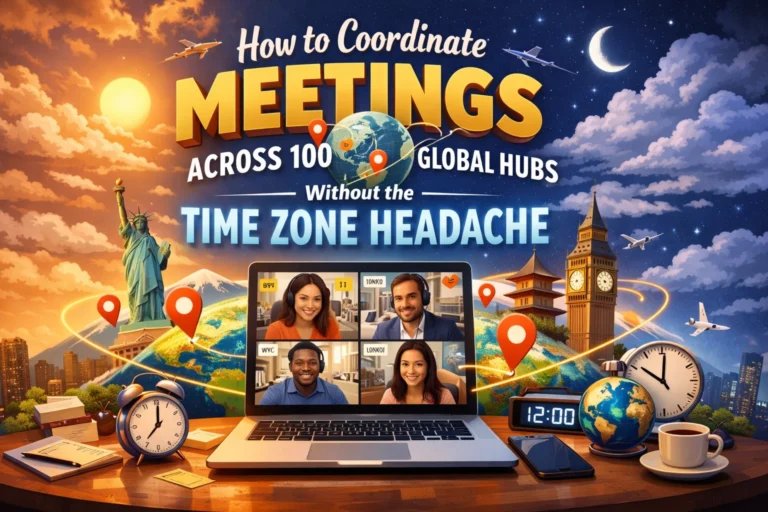
- Eliminate Meeting Confusion: When you tell a team "We meet at 14:00 UTC," there is zero ambiguity. They check their offset, you check yours, and everyone arrives at the same moment. No more "Wait, did you mean your time or my time?" disasters.
- Navigate Logistics with Precision: Airlines and shipping companies run on UTC. When you understand the underlying standard, you can interpret flight logs and tracking data with clinical accuracy.
- Digital Resilience: If you work in tech, finance, or data, your servers are likely timestamped in UTC. Matching your mental clock to the system clock allows you to troubleshoot and manage operations without the need for a conversion calculator.
You will achieve a level of electric energy in your productivity when you stop wasting brainpower on simple addition and subtraction. Trust the standard.
The Daylight Saving Trap: How UTC Saves Your Sanity
Daylight Saving Time (DST) is a logistical nightmare. Different countries start and end DST on different dates. Some countries, like Japan or parts of Australia, don't use it at all. If you are trying to coordinate a call between someone in Pennsylvania’s time zones and someone in London during that awkward two-week window in March when the US has shifted but the UK hasn't, you are asking for a headache.
UTC is the cure. Because UTC never shifts, it acts as an anchor. You will always know that the gap between UTC and the "true" time is constant. You simply adjust your local offset, rather than trying to calculate the shifting relationship between two different moving targets.

Implementing the UTC Lifestyle: Practical Steps
You don't need to be a scientist to live by UTC. You just need to change your habits. Follow these steps to integrate UTC time now into your daily workflow:
- Set a Secondary Clock: Most smartphones and smartwatches allow you to add multiple time zones. Set one of them to "UTC" or "London (GMT)" (keeping in mind the DST difference).
- Update Your Calendar Invites: For international calls, always include the UTC time in the description. It signals to your colleagues that you prioritize efficiency and clarity.
- Trust the Apps: Use professional-grade tools to verify offsets. If you are heading to Europe, check what time it is in Vienna and immediately note its current offset from UTC (e.g., UTC+1).
- Master the 24-Hour Clock: UTC is almost always expressed in the 24-hour format. Get used to saying "17:00" instead of "5 PM." It removes the risk of AM/PM errors entirely.
The Technical Backbone: Atomic Clocks and Leap Seconds
The precision of UTC time now is staggering. It is maintained by the International Bureau of Weights and Measures (BIPM). They use the vibrations of atoms to measure time down to the nanosecond.
However, because we still want our clocks to align with the rising and setting of the sun, we occasionally use "leap seconds." These are added to UTC to keep it within 0.9 seconds of the Earth's actual rotation (UT1). This blend of atomic perfection and planetary reality is what makes UTC the ultimate hybrid standard.

For the high-level traveler, knowing this isn't just trivia: it's about understanding the resilience of the systems you rely on. You are operating on a system that is literally calibrated by the fundamental laws of physics.
Beyond the Logistics: The Philosophy of Global Time
When you embrace UTC time now, you are doing more than just fixing your schedule. You are adopting a global mindset. You are recognizing that while we live in different places: from the neon-slick streets of Tokyo to the espresso-scented cafes of Italy: we are all existing in the same "now."
This perspective fosters deliberate travel. Instead of being a victim of time zones, you become a master of them. You choose when to linger and when to move because you understand exactly where you sit in the global sequence. You navigate the labyrinthine schedules of international transit with the ease of a local.
Conclusion: Your New Command of Time
You will no longer be the person asking, "Wait, what time is it there?" You will be the person who says, "Let's sync at 12:00 UTC." You will move through airports with a sense of inevitable success because you have mastered the foundational language of the modern world.
UTC is not just a scientific standard; it is the ultimate "hack" for the modern business traveler. It provides a level of clarity that local time simply cannot match. Use it. Trust it. Prioritize it.
If you need to check specific local times to see how they currently stack up against the global standard, you can always explore our comprehensive city guides or browse our full sitemap for more time zone secrets.
The world is moving fast. UTC time now is the only way to keep up without losing your mind. Stay synchronized. Stay ahead. Period.