

Jet lag isn’t a badge of honor; it’s a tax you pay for sloppy timing. You bounce from NYC to Tokyo and wonder why meetings explode. Time zones aren’t magic—they’re math. UTC offsets, DST traps, and quick add‑subtract hacks save your sanity. You want fewer missed calls, fewer angry clients, fewer 3 a.m. “oops”? Good. Grab your phone, set smarter clocks, shift sleep now—because the brutal part hits next.
Key Takeaways
- Anchor all plans in UTC and note each city’s offset; confirm offsets near borders or islands.
- Always verify local DST rules; clocks shift on different dates, often 2 a.m. Sundays.
- Use world clock apps and widgets; pin home and destination, and double-check DST and date-line crossings.
- Build buffers: ≥2-hour layovers, morning-after meetings, and backup tasks; reconfirm times with hosts.
- Pre-shift sleep 30–60 minutes for three nights; hydrate, manage light exposure, and avoid late caffeine to reduce jet lag.
How Time Zones and UTC Offsets Work

Why do clocks disagree the second you cross a line on a map? Because time zones are human fences pretending to tame the sun. You follow longitude basics: Earth spins, 360 degrees, about 24 hours, roughly 15 degrees per hour. So you jump an hour when a border says so. Not romance. Bureaucracy. UTC anchors the mess. Coordinated time, no drift, set by atomic bullies that don’t care about clouds or moods. UTC history? Railroads, telegraphs, chaos, then standardization slammed into place so trains stopped kissing each other. Your local time becomes UTC plus or minus an offset. Simple math. UTC+3. UTC−7. You convert. You move. You stop whining. Crossing oceans? You’ll stack offsets like poker chips and win. Do the math. Now move.
Daylight Saving Time: What Changes and When
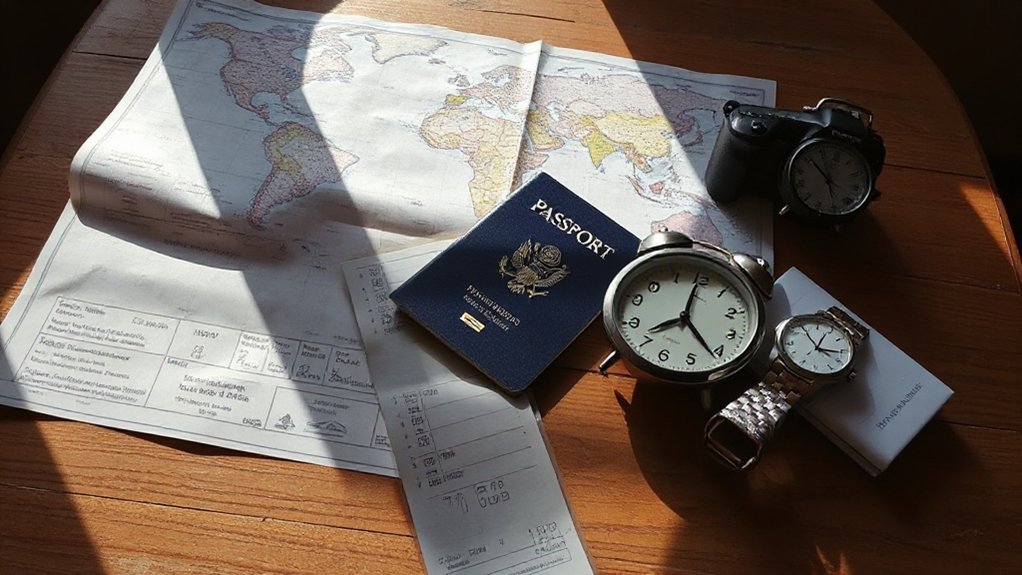
You think time stays put? Wrong—clocks jump forward in March and back in November in the U.S., while Europe flips on different dates just to mess with your flights. Some places play, others refuse: most of North America and Europe observe it, but Arizona, Hawaii, most of Africa, and big chunks of Asia say no thanks. You plan or you pay—check local rules before you book, because that 9 a.m. can become 8 or 10 overnight and your schedule explodes.
Clock Shifts and Dates
While the planet spins like it always has, the clocks don’t play nice—they jump.
You spring forward, you fall back, you swear.
One lost hour here, one random gain there, and your plans wobble.
Flights tighten.
Alarms betray you.
Meetings vanish.
You want logic?
Fine.
Most switches hit at 2 a.m. local time on a Sunday, because officials love sleepy chaos.
Expect a forward shove around March and a smug rollback near late October or early November.
Not precise enough for you?
Then track calendar reforms and the sneaky holiday shifts that shove dates around and torch routines.
Set alerts.
Double‑check tickets.
Screen‑grab itineraries like evidence.
Nap early, hydrate, and stop pretending you’ll adapt magically.
You won’t.
You plan hard, or you pay.
Now.
Regions Observing or Exempt
Because maps lie, the rules split by country and even by city. You think DST is global truth. It’s a patchwork quilt with frayed edges. Spain flips, but the Canary Islands wink a minute later. Arizona says no thanks, while the Navajo Nation says yes. Confused yet? Good. Autonomous Regions flex. Greenland toggles while parts ignore the circus. Overseas Territories play their own games, far from the capital clock. Australia swings hard, then Queensland shrugs. Mexico’s border towns chase U.S. time, inland towns don’t. You want order. You get chaos. So verify every leg, every layover, every sleepy connection. Ask the airline. Check the airport. Check again. Alarms lie. Calendars glitch. Your brain will, too. Trust data, not vibes. Right now. No excuses. Ever.
Quick Methods to Convert Time on the Go

Stop guessing time like it’s 1999—you whip out your phone, hit the World Clock, and boom, Tokyo vs. Toronto sorted. No signal? You do the brutal math: plus nine, minus three, cross the date line, and yes, your 7 p.m. call becomes tomorrow at stupid o’clock. Too lazy or rushing a gate? Bark at your voice assistant—“What time is it in Nairobi right now?”—and stop torturing your brain.
Smartphone World Clock Apps
Though jet lag swings first, your phone swings harder with a world clock that crushes confusion in seconds.
Add cities. Pin home, layover, client. Stop guessing. You tap, you know. Alarms line up across continents, merciless. Convert meeting times with one swipe, because yes, you care about Tuesday in Tokyo. UI customization matters. Dark theme at 3 a.m. Fonts when your eyes revolt. Widgets on the lock screen, front center, no excuses. Notification management keeps pings precise, not chaotic. Quiet Dubai, wake New York, silence the rest. Share screenshots. Prove you’re on it. Apps like Clock, World Time Buddy, and Timebuddy-style widgets do the grunt work. You just decide. Move flights. Make calls. Don’t apologize. Be the clock. Own the hour. Win the day.
Mental Math Time Offsets
Your phone nails the time zones, sure, but batteries die and planes lie. You need brain power, not excuses. Start with a number line in your head. Draw zero at you, shove London at plus five, New York at minus three, Tokyo at plus nine. Snap them into place. Now jump. Meeting at 3 p.m. in Paris? Slide right one from you if you’re in London. Simple. Australia calling at sunrise? Stop whining. Subtract hard, then add a day if you cross midnight.
Build a memory palace. Put cities in rooms. Kitchen is Cape Town, hallway is Hong Kong, balcony is Bogotá. Walk fast, grab the offset.
Drill. Repeat. Flip signs when you fly west. Add when you chase sunrise. No calculator. No panic.
Voice Assistants Time Checks
How fast do you want the answer? Ask Siri, Alexa, or Google: “What time is it in Tokyo?” Boom. You get the call window, not guesswork. Driving? Use a wake word and keep your hands clean. Missed sleep? Ask again. You’ll get tomorrow’s offset for that red‑eye, right now. But don’t be naive. Privacy Risks are real. Your requests aren’t secrets, and hotels have smart speakers that aren’t yours. Mute them or use your phone. Worried about Response Latency? Kill noise, speak clearly, and skip rambling context. Short command. Fast return. No signal? Download offline packages and set a world clock widget. Double‑check with a manual search when stakes are high. Meetings, flights, proposals. You’re the boss, not the clock. Own the time, always.
Essential Apps and Tools for Timekeeping

Gear up and stop losing hours to jet‑lag math. Your phone can keep you honest if you let it. Install a world clock app with ruthless clarity: big digits, multiple cities, zero fluff. Pin widgets on your lock screen. No excuses. Grab a converter that auto-detects location and daylight‑saving shifts, because you won’t. Pair it with flight trackers so gate changes don’t nuke your plans.
You want precision? Fine. Wear atomic watches that sync nightly. Let them bully your wrist with seconds pulled from time servers. Add a smartwatch face with dual time. Tap. Done. Set a brutal alarm app that forces a photo check or math test. Snooze dies. Pack a travel timer for naps. Thirty. No drama. Wake up on time, everywhere.
Scheduling Across Continents Without Confusion

All that tech means nothing if you book meetings that strangle sleep. You want clarity. Not chaos. Set availability expectations, loudly. Publish your window. Guard it like oxygen. Ask for theirs. Then negotiate like a grown‑up. No martyr hours. Use UTC as the anchor, not your ego. Send invites with city tags and plain times. Repeat them in the body. Triple check the date. Daylight saving? Assume betrayal. Confirm. Practice ruthless meeting etiquette: short agendas, hard stops, no hostages. Record when needed. Share notes. When conflicts hit, rotate fairness. You’ll miss a sunrise, not your sanity.
| Pair | Window |
|---|---|
| US Europe | early ET only please |
| Europe Asia | late morning CET favors teams |
| Asia US | late afternoon PT works |
| Global group | rotate slots share pain kindly |
Multi-City Itinerary Planning and Buffer Tips
Because your trip spans three cities and five time zones, you need buffers like body armor. Build slack into everything. Miss a connection? Your plan survives. Book flights with fat margins, not cute sprints. That 35‑minute dash? Comedy, not strategy. Use Layover Strategies like a pro: target hubs with showers, power, and real food, stack two hours minimum, and park meetings the next morning, not right after touchdown.
Now the calendar. Cut the noise. Do ruthless Activity Prioritization. One anchor task per city. Two backups max. Everything else is extra, or gone. Block buffer blocks between events, yes double buffers, because traffic laughs at you. Pin local time on your phone. Confirm time zones with hosts. Then confirm again. Don’t flinch. Move now, boss.
Jet Lag Prevention and Recovery Strategies
Crushing jet lag starts before wheels up. You shift your sleep three nights out. Not later. You nudge it 30–60 minutes each day, then lock it. You move your meal timing too. Breakfast when your destination eats breakfast. Yes, even at 10 p.m. at home. Hydrate hard. Ditch booze. You’re not a cactus or a hero. On board, chase light or dodge it with sunglasses. Use light therapy after landing to slam your body clock into place. Morning light eastbound. Late-afternoon light westbound. Set alarms. Nap short. Twenty minutes. Not fifty. Walk outside. Sweat a little. Then stop scrolling at 2 a.m. Blue glow lies. Caffeine early, never after lunch. Big rule? Act like you’re there the second you land. No excuses. Do it.