
Coincidence: the “longest day” strikes everywhere at once, yet your clock swears it’s different. You chase the summer solstice, but time zones shove it around, latitude stretches or stunts your daylight, and DST plays cute. In Reykjavik, midnight sun. In Quito, meh. Your sunset lingers thanks to refraction—yes, the air cheats for you. Think you know when it peaks where you stand? Prove it—or get surprised next.
Key Takeaways
- The solstice is one global instant (UTC); local date/time differ by time zone and longitude.
- Check the precise solstice time in UTC, then convert locally, accounting for daylight saving.
- June solstice is Northern Hemisphere summer; December is Southern summer; higher latitudes get longer daylight, tropics show minimal change.
- Example June solstice daylight: Reykjavik near 24 hours; London ~16.5 hours; New York ~15 hours.
- Use ephemeris sources or apps (Timeanddate, JPL Horizons, NOAA) with your coordinates for exact timing.
What the Summer Solstice Is and Why the Time Varies
Because the Earth can’t sit up straight, the summer solstice hits when our tilted planet leans hardest toward the Sun—boom, maximum daylight, longest day, no debate. You face the Sun’s peak swagger. Shadows shrink. Birds yell. Old minds knew it, which is why pagan festivals exploded then, drums, fires, bravado. Stone alignments point like arrows, daring the dawn to miss. It doesn’t.
How Time Zones, Longitude, and Latitude Shift the Moment
When does it hit for you, exactly? The solstice isn’t some polite global ding. It lands by longitude, not your watch. Your time zone fakes unity; the Sun doesn’t care. Slide east, you meet it sooner. Creep west, you wait. Simple. Latitude messes with daylight bragging rights, stretching highs near the Arctic while the tropics shrug. But the moment stays planetary, one instant, many clocks. Then there’s Solar Offset, that annoying gap between civil noon and when the Sun peaks. Yeah, your town’s late. Or early. Blame borders, politics, and geometry. Add Leap Seconds, tossed in to tame Earth’s wobble. Tiny fixes, big attitude. You crave precision? Learn the map. Track the meridian. Stop trusting the microwave. Ask astronomers; they time it, not you.
Northern Hemisphere: Local Times by Major Cities (June)
You want the solstice, city by city, not fairy dust—fine: New York, London, and Tokyo hit the same cosmic moment, but your wall clocks argue like cousins at dinner. Time zones smack you with offset reality—five hours here, eight there, tomorrow in Tokyo while you’re still pretending it’s today. And latitude? Moscow and Reykjavik stretch daylight like show‑offs, Madrid shrugs with a late sunset, and you—yes you—decide if that endless light thrills you or wrecks your sleep.
Solstice Timing by City
How does one Sun stand still and still show up at wildly different hours city to city?
You want the solstice, not excuses. You chase peak daylight, you plan Festival timings, you check Astronomical clocks, and you demand results. Here’s the blunt map: latitude rules the drama. Far north laughs longest. Closer to the tropics, the show trims fast. Coasts, hills, and haze tweak the edges, but the script stays ruthless: angle of light decides. Compare these cities. Argue with them. I dare you.
| City | June solstice feel |
|---|---|
| Reykjavik | Night barely exists; blink and it’s dawn again |
| London | Long glide, late glow, stubborn twilight |
| New York | Early light, long hustle, honest dark returns |
| Cairo | Fierce noon, quicker bookends, heat first last |
Own the light.
Time Zone Differences
Same Sun, different clocks. You hate it, admit it. Noon in New York, not even breakfast in Los Angeles. London yawns while Tokyo already wrapped tomorrow’s emails. Time zones slice your day like lazy knives. They don’t follow nature, they follow Political Boundaries and power. You live by lines on a map. Digital Timestamps pretend to be truth, but they’re only agreements. You click refresh, the numbers jump, you obey. June solstice? Same moment worldwide, different local times, different moods. Paris applauds at 10:50 pm, Chicago shrugs at 4:50 pm, and you still miss the cue. Blame clocks, not the Sun. Plan smarter. Set alarms. Check offsets. Stop whining. You want the longest day? Then beat the bureaucracy. Own your schedule. Start now, relentlessly.
Latitude Daylight Extremes
While the solstice hits everyone at once, latitude rigs the daylight game. You feel it city by city. Reykjavik laughs first light near 3 a.m., barely bothers with night. Oslo drags dusk to almost midnight. London holds about sixteen and a half hours. Paris too. Berlin pushes long golden commutes. New York squeezes roughly fifteen. Chicago matches. San Francisco pretends it’s sunny, fog says otherwise. Denver rides high sun late. Miami? Thirteen plus and done. Mexico City shorter still.
That spread isn’t cute. It drives Ecological impacts you can’t dodge. Birds mistime songs. Bugs swarm longer. People get wired. Crops shift schedules. You pivot irrigation and harvest. Call it Agricultural shifts or survival. So check your latitude. Plan your clock. Or get burned today.
Southern Hemisphere: Local Times by Major Cities (December)
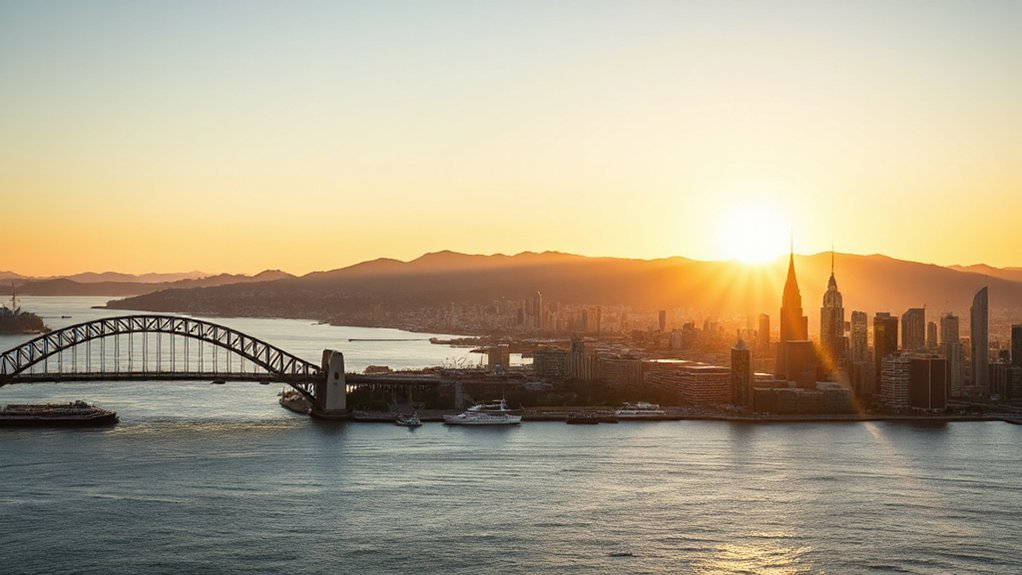
On the December solstice, the South slams the lights to full blast—and your clock won’t play nice. You want times? Fine. Sydney blazes from about 5:40 a.m. to 8:10 p.m. Melbourne pushes later, sunrise near 5:55, sunset near 8:50. Perth wakes absurdly early, 5:05, then coasts to 7:35. Hobart drags daylight to almost 8:55. Auckland and Wellington? Call it 5:55 to 8:55, big grin included. Cape Town runs roughly 5:30 to 8:00; Johannesburg shorter, about 5:10 to 6:55. Buenos Aires sits near 5:30 to 8:10; Santiago hits around 6:35 to 9:00. Plan your festive traditions or accept chaos. Your sleep schedule? Toast. Your tourism patterns? Shoved forward, hard. Book late dinners. Chase late light. Stop pretending darkness is in charge. Not today. Move. Now.
Regional Breakdown: North America

You want North America? Fine—head to the Arctic and you stare at a smug sun that refuses to set, midnight blasting daylight like it owns you. Slide south toward the tropics—Yucatán, Havana, even Miami—and guess what, the solstice barely budges the clock, a tiny change that feels like a prank, so stop expecting fireworks.
Arctic Daylight Extremes
How do you sleep when the sun won’t quit? You don’t. Not easily. North of the Arctic Circle, your clock melts. Utqiaġvik to Resolute, midnight looks like noon. Your blinds fail. Your brain rebels. Melatonin bails. You pace. You snack. You consider duct tape and tinfoil. Extreme daylight hijacks rhythm and sparks sleep disorders you didn’t order. You want darkness? Too bad.
Tropics Minimal Change
While the Arctic pulls an all‑nighter, the tropical slice of North America just shrugs. You don’t get drama. You get near‑steady daylight, sunrise after sunrise like a metronome. Admit it, you barely notice the solstice. And that’s the point. Your body locks in. Strong circadian entrainment. Farmers know it too. Agricultural timing stays boring, which secretly wins. Crops don’t care about your need for spectacle. They want consistency. So do you. Want fireworks? Look north. Want results? Stay here. Miami, San Juan, Belize City—same script, small tweaks, zero excuses. You can plan, plant, train, sleep. No daylight whiplash. No heroic coffee runs at 2 a.m. Just reliable light, ruthless routine. You think that’s dull? Fine. Enjoy chaos elsewhere. You’ll keep harvesting. All season long.
Regional Breakdown: Europe and North Africa
Because the map doesn’t play fair, Europe and North Africa rip the solstice into wildly different realities. You feel it from Iceland’s midnight glow to Morocco’s blunt sunset drop. North tilts greedy. South shrugs. You chase light because why not. Midsummer Festivals explode in Scandinavia, bonfires, wreaths, delirious dancing, like daylight dares you to blink. You don’t. Farther south, heat slams the door early, yet nights wake up fast. Coastal Traditions hold the line: Atlantic mist in Galicia, Mediterranean swims in Marseille, lanterns along Tunis bays. You time dinner with the horizon. You clap when the sun fakes an encore. Then it quits. Harsh. You learn the rule. Latitude bosses you around. Complain louder. The sky won’t care. But you will. Change your plans.
Regional Breakdown: Asia and Oceania
In June, Asia and Oceania split the solstice like a stubborn fruit. You stand on the line and the sky laughs. North of the equator, you get marathon light. South, you get the long chill. Tokyo lingers in evening glow. Manila sweats. Sydney snaps on jackets. Auckland says nope, not summer.
You don’t just watch clocks. You move. Cultural Festivals roar in the north—bonfires, drumming, rooftop shouts, you name it. In the south, you lean into night, candles and breath hanging white. Listen closer. Indigenous Celebrations hit deeper. Ainu prayers to sun strength. Yolŋu songlines marking cold season law. You feel time, not numbers. You chase first light or guard last embers. Pick a side. Or straddle both. Either way, the day dares you.
Regional Breakdown: South America
Think Asia and Oceania split the solstice? South America does it louder. You straddle the equator, so timing flips. North of it, your longest day hits in June. South of it, you cash in during December. Simple. Quito shrugs—daylength barely budges. Lima stretches. Santiago lingers. Patagonia pushes dusk late, and you feel it in your bones.
So plan like you mean it. Festivals shift with latitude. Indigenous Celebrations mark the sun’s power, even when dates diverge. You read sky first, calendar second. Farmers do too. Agricultural Calendars move with planting rains, with ripening heat, with that brutal noon glare.
You want drama? Stand in Montevideo on December’s crest. Shadows crawl. Traffic slows. Your watch argues. The sun refuses to leave. And you grin. Hard.
Polar Circles and the Midnight Sun
You want the Midnight Sun—blame Earth’s tilt; above the polar circles the sun refuses to set, skimming the horizon like a stubborn flashlight at 2 a.m. In the Arctic, your summer solstice means day after day of glare for real towns and restless people, but in Antarctica the big show hits their summer instead—same physics, different season, almost no one to cheer. Think you can handle “day” that lasts weeks, then months, then too much—prove it, because the clock won’t help and shadows quit.
Causes of Polar Day
Because our planet tilts like a show‑off at 23.4 degrees, the poles pull a daylight stunt—no sunset. You face a tilted Earth that shoves the Sun above the horizon and dares it to leave. The spin keeps aiming that region Sunward. Result? Midnight Sun, loud and unapologetic. orbital eccentricity tweaks timing, not the trick. precessional wobble slowly shifts the calendar bullseye, but the tilt still wins.
| Factor | What it does | Your takeaway |
|---|---|---|
| Axial tilt | Points a pole at the Sun | Day refuses to end |
| Earth’s rotation | Sweeps light in circles | You get midnight glare |
| Orbital eccentricity | Changes distance, pace | Brightness and dates drift |
| Precessional wobble | Re-aims seasons over millennia | Solstice target slides |
| Refraction | Bends light near horizon | Sun hangs on longer |
Deal with it.
Arctic Vs Antarctic Daylight
We just blamed the tilt for the endless day—now name names. Up north, the Arctic flips the light switch on and walks away. You get the Midnight Sun for months. Towns play baseball at 2 a.m. Kids laugh at curtains. Seals nap like bosses. Wildlife Adaptations aren’t cute; they’re survival. In the south, Antarctica hoards daylight too, but mostly for ice and scientists, not cities. No cozy villages. Just wind, glare, and brutal miles.
Here’s the split you can’t ignore. The Arctic has people, roads, and coffee. Research Logistics feel human. The Antarctic has stations, crevasse fields, and helicopters. Research Logistics feel alien. You want summer solstice drama? Pick your ring. Warm-ish blue water or white infinity. Either way, sleep loses. Excuses do too.
How to Find the Exact Solstice Time for Your Location
How do you nail the exact solstice time where you stand? Stop guessing. Pull your coordinates, not your ego. Use a site with ephemeris access or an app that runs astronomical algorithms. Timeanddate, JPL Horizons, NOAA. Pick one. Enter latitude, longitude, and time zone. Demand UTC first, then convert cleanly. Don’t let daylight saving ambush you. Cross‑check with a second source. Yes, you can be that precise.
Want faster? Your phone’s GPS plus an astronomy app will spit out the instant the Sun hits maximum declination. Set an alert. Brag later.
Nerd mode? Download an ephemeris, feed it to open‑source code, and solve for the Sun’s declination minimum or maximum. You’ll get seconds. Or you’ll get humbled. Either way, you’ll know. Down to microseconds.


