

You are operating in a world where time is the ultimate currency. To trade effectively in the Lion City, you must master the mechanics of Singapore Standard Time (SGT). Singapore is not just a geographical hub; it is a temporal bridge connecting the giants of the West with the rising powers of the East. Whether you are closing a series-A round from a glass tower in Manhattan or coordinating a supply chain from a rainy office in London, your success hinges on your ability to sync with the UTC+8 heartbeat of Southeast Asia.
The Singapore Anchor: Understanding UTC+8
Singapore does not play games with its clocks. Unlike many Western nations, Singapore does not observe Daylight Saving Time. You will find a refreshing consistency here. While the rest of the world shifts their gears twice a year, Singapore remains fixed at UTC+8. This stability is your greatest asset.
You will encounter a standard business day that typically runs from 09:00 to 17:00 (9:00 AM to 5:00 PM). However, the city’s status as a global financial titan means many sectors: especially fintech and logistics: operate on a 24-hour cycle. You'll notice that retail and dining often push later, staying open until 21:00 or 22:00, reflecting the city's "work hard, play late" culture.
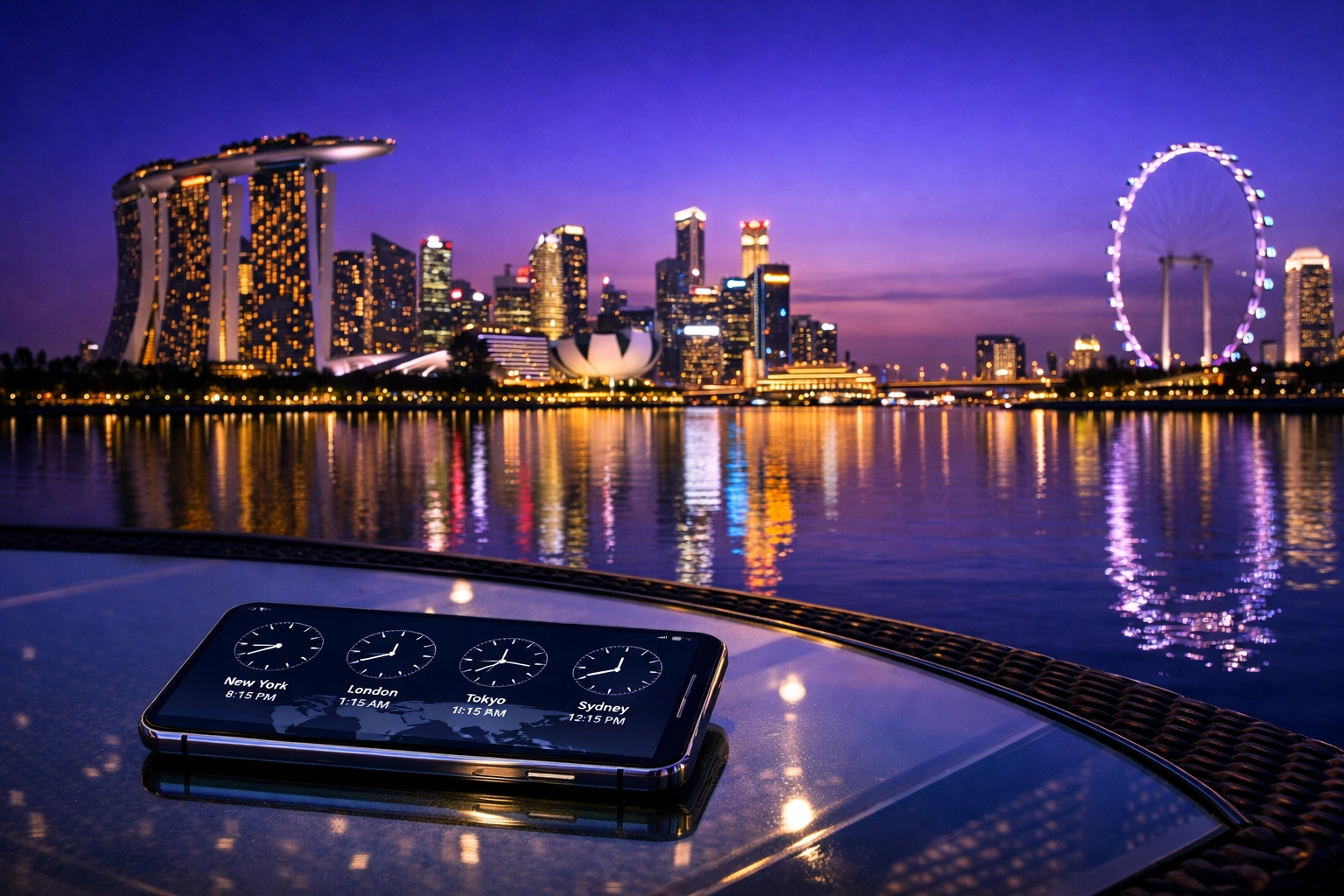
Mapping the Global Grid: Your Overlap Strategy
To dominate your global schedule, you must visualize the world as a series of overlapping windows. You will face three primary scenarios based on your location.
1. The Americas: The "Flip" Challenge
If you are based in New York (UTC-5) or San Francisco (UTC-8), you are looking at a near-total inversion of the clock.
- New York: You are 13 hours behind Singapore. When it is 9:00 AM in Singapore, it is 8:00 PM the previous evening in NYC.
- Action Plan: You will schedule your most critical calls for 8:00 PM – 10:00 PM EST. This aligns with the start of the Singapore business day. Alternatively, catch them at their end-of-day by waking up at 6:00 AM EST to hit their 7:00 PM SGT.
2. Europe and the UK: The Afternoon Bridge
London and Paris are better positioned, but the window is still narrow.
- London (UTC+0): You are 8 hours behind. When your workday starts at 9:00 AM, Singapore is already hitting 5:00 PM.
- Action Plan: You'll prioritize a "power hour" at 8:00 AM GMT. This catches the Singapore team before they head out for dinner. For a deeper dive into how these shifts affect your productivity, check out our confessions of a remote worker.
3. Asia-Pacific: The Seamless Sync
If you are in Sydney (UTC+11) or Tokyo (UTC+9), you are the lucky ones.
- Sydney: You are 3 hours ahead. Their 9:00 AM is your noon.
- Action Plan: Use your morning for deep work and keep your afternoons for collaborative sessions with Singapore.
The Best Times for Global Calls
You will not find a "perfect" time that suits everyone, but you will find the "least painful" time.
-
The Global Sweet Spot (Singapore / London / NYC):
- Singapore: 9:00 PM
- London: 1:00 PM
- New York: 8:00 AM
- Verdict: This is the golden window. Everyone is awake, and most are within "reasonable" working hours.
-
The APAC/EMEA Bridge:
- Singapore: 4:00 PM
- London: 8:00 AM
- Dubai: 12:00 PM
- Verdict: Perfect for operational updates between Asian headquarters and European branches.

Cultural Time Norms: The "SGT" Mentality
In Singapore, punctuality is more than a courtesy; it is a metric of your professional integrity. You will arrive five minutes early for every meeting. Being "on time" is often perceived as being late.
The Hierarchy of Time:
- Preparation: Do not waste the first ten minutes of a call on small talk. In Singapore, efficiency is king. You will dive into the agenda immediately.
- The "Dinner" Boundary: While Singaporeans are hard workers, the evening meal is a sacred social ritual. Avoid scheduling calls during the 19:00 to 20:30 window unless it is a dire emergency.
- The Public Holiday Factor: You will clear your calendar during Lunar New Year (February 17-18, 2026) and National Day (August 10). The city shuts down. Attempting to schedule a "quick sync" during these times will signal a lack of cultural awareness.
For more on how different cultures handle these shifts, explore our journey around the world in 24 hours.
Master the Logistics: Travel and Jet Lag Advice
When you fly into Changi Airport, you aren't just entering a terminal; you are entering a precision-engineered environment designed to mitigate the physical toll of travel.
The Jet Lag Hack:
If you are coming from the West, you will face a "forward" shift. To survive, you must fast on the plane and only eat your first meal during Singapore's breakfast time (around 08:00 SGT). This resets your internal metabolic clock.
The "Lion City" Landing Routine:
- Hydrate: The humidity in Singapore is intense. You will drink double your usual water intake.
- Sunlight: Spend your first morning at the Gardens by the Bay. The natural light will help suppress melatonin and sync you to UTC+8.
- Stay Moving: Use the MRT system. It is clinical, efficient, and keeps you on a strict schedule.

Digital Tools for the Global Professional
You cannot rely on mental math. You will use tools to visualize the Singapore business hours against your own.
- World Time Buddy: A visual grid that lets you drag and drop meeting times.
- Clockify: For tracking how much of your "Singapore time" is being spent on productive tasks versus administrative lag.
- Our Sitemap Resources: For a comprehensive look at how Singapore fits into the global network, visit our post-type-page-sitemap-1.xml or check out major international cities to see how other hubs compare.
2026 Critical Dates to Remember
Your 2026 schedule must account for the following "dead zones" where business in Singapore will effectively pause:
- New Year’s Day: January 1
- Lunar New Year: February 17 & 18 (Expect a week of slow responses)
- Good Friday: April 3
- Hari Raya Puasa: March 20 (Estimated)
- Labour Day: May 1
- Vesak Day: May 31
- Hari Raya Haji: May 27 (Estimated)
- National Day: August 10 (Observed)
- Deepavali: November 9
- Christmas Day: December 25
The Strategic Advantage of UTC+8
By integrating Singapore business hours into your workflow, you aren't just "adding a meeting." You are tapping into the ASEAN market. Singapore serves as the regional headquarters for thousands of multinational corporations. When you master SGT, you simultaneously unlock access to Jakarta, Bangkok, and Manila.
You will find that your presence in this time zone allows you to "follow the sun." As your Singapore team finishes their day, they can hand off tasks to Europe, which then hands off to the Americas. This creates a 24-hour productivity loop that can accelerate your project timelines by 300%.
Summary Checklist for Success
- Confirm the Offset: Always check what time is it in Singapore right now before hitting "Send" on an invite.
- Audit Your Calendar: Ensure no meetings fall on the 11 public holidays of 2026.
- Set the Standard: Use SGT as your "anchor" for all Asian operations to avoid confusion with shifting DST in other regions.
- Respect the "Face": Be punctual, be prepared, and be professional. Period.
You now possess the blueprint for navigating the temporal landscape of one of the world's most vibrant business hubs. Use it with precision. Use it with confidence. The Lion City is waiting.