You gain an hour; you lose your mind. Twice a year you smash your sleep with a smiling clock. Spring steals a morning. Fall bribes you with fake rest. You call it efficient. Your body calls it chaos. More yawns, more mistakes, sometimes more crashes. Coffee helps, barely. Your phone updates. Your oven mocks you. Want fewer groggy Mondays, fewer dumb risks, fewer pointless resets—then ask why we still do this—
Key Takeaways
- Clocks move forward one hour in spring (2:00 to 3:00) and back one hour in fall (2:00 to 1:00).
- Purpose: shift evening daylight later; solar time unchanged; many devices auto-update, others need manual change.
- U.S. observes DST from second Sunday in March to first Sunday in November; Europe last Sunday March to last Sunday October.
- Not all places observe DST; Arizona (mostly), Hawaii, Japan, most of China opt out; southern hemisphere months are opposite.
- Impacts include brief sleep disruption, safety risks, and debatable energy savings; prepare by gradual bedtime shifts and strong morning routines.
What Daylight Saving Time Is and How It Works

The deal is simple, and somehow still a mess: Daylight Saving Time is when you shove the clock forward an hour in spring and yank it back in fall, like time’s a toy and you’re bored. Definition basics: you adjust civil time to chase evening light. You don’t change the sun. You change your schedule, on command. One hour. Brutal. Clean. The Mechanics overview? At 2:00 a.m., you jump to 3:00 in spring, then drop back to 1:00 in fall. Phones auto flip. Microwaves don’t. You feel it Monday. Your sleep staggers. Traffic shifts. Kids wait in weird light. Work still wants you on time. You argue. You comply. You grumble. Then you brag about “extra” daylight like you invented it. Sure, you cope.
A Brief History and Origins
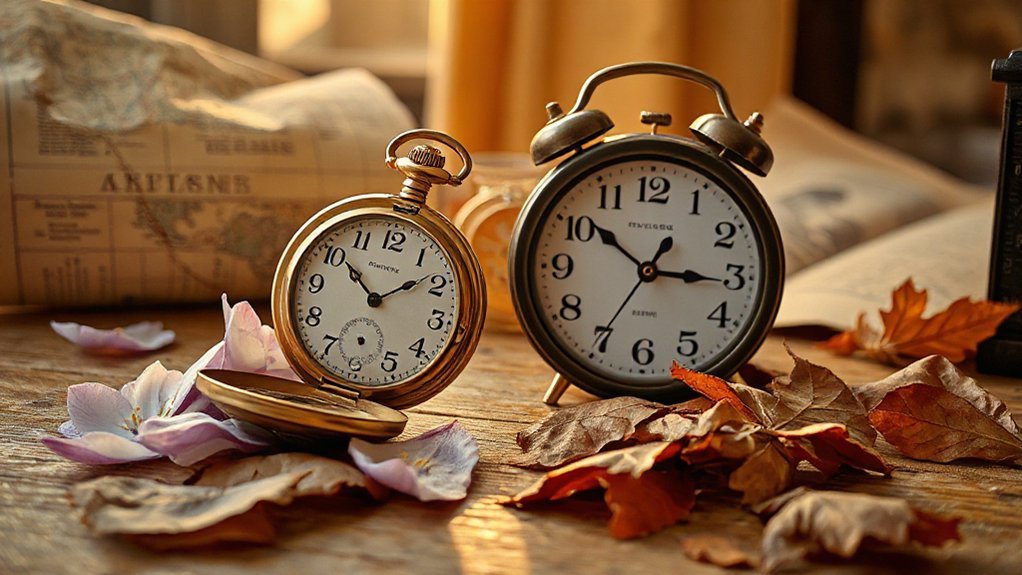
Why did we start messing with clocks in the first place? You chased daylight like it owed you rent. Long before wristwatches, people followed the sun, ancient calendars, seasonal festivals, farm bells. Then factories roared. Schedules froze. You wanted more evening light and fewer smoky lamps. Enter cheeky ideas. Benjamin Franklin joked about saving candles by waking earlier. Not a bad troll. Later, William Willett rode at dawn, saw sleeping houses, and raged. Push the clock, he said. Make morning useful. Wars hit. Fuel ran thin. Governments grabbed the scheme and flipped the hours. Efficiency, they swore. You got longer twilights, and a lifetime of groggy Mondays. Was it genius, or a glorified alarm clock hack? Be honest. You still argue. Every. Single. Year.
Where and When It’s Observed

You scan the globe and get whiplash—some countries jump an hour, others roll their eyes and skip the circus. Think it’s universal? Arizona and Hawaii say no, most of Africa and Asia shrug, and Iceland barely plays along. Start and end dates mess with you—U.S. runs March to November, Europe late March to late October, while Australia flips seasons and switches when you don’t.
Global Adoption Map
While clocks fight their petty wars, the world can’t even agree on what “time” means. You want a global adoption map. Fine. Look north and south, where seasons swing hard, and you’ll see the switch. Spring forward, fall back. Europe moves in late March and late October. North America, March and November. Parts of South America play along. Oceania too. Big swaths near the equator? Not worth the hassle. Light doesn’t change enough, so they shrug.
You need rules, not vibes. Use mapping criteria: latitude bands, policy status, and shift dates per region. Then pull real data sources: IANA time zones, government bulletins, ISO codes, historical change logs. Plot it. Watch the patchwork glow. Useful? Yes. Elegant? Not even close. Still, you navigate it.
Regional Exceptions and Holdouts
Maps glow pretty, but they hide the rebels. You think clocks march in sync. They don’t. Some places flip the script, others refuse the play. Arizona says hard no, except stubborn little Navajo pockets that do switch, creating border anomalies you can literally drive through in minutes. Hawaii laughs at the mainland. So do Iceland, Japan, and most of China. Parts of Australia fight their own civil time wars. Saskatchewan shrugs. Mexico’s border cities shadow the north while interiors resist. Why? Power bills. Commutes. Sunlight for kids. And cultural traditions that won’t bow to a clock bully. You want order. You get a patchwork, stitched tight then ripped. Traveling through it? Pay attention. Or show up early, late, and loudly confused. Your move, traveler.
Start and End Dates
Because clocks love drama, the switch hits on Sundays, and never the same ones everywhere. You spring forward, then you groan. In the U.S., it starts the second Sunday in March and ends the first Sunday in November, at 2 a.m., because apparently midnight is too basic. Europe? Last Sunday in March to last Sunday in October. Different hour. Different nerve. Australia flips in October and April, south of the equator, because seasons laugh at you. Some countries test new rules, then yank them back. You chase notices, not logic. Calendar mechanics rule you. Date computation bites. You want certainty. You get moving targets, carved by politics and power outages. So set alarms. Check zones. Then fight it, or play along. For now, buddy.
The Energy-Savings Debate

You think DST saves energy? Cute—you cut lighting at night, then you hammer HVAC with late‑day AC or early‑morning heat. Lighting vs HVAC, pick your villain, because the studies can’t agree and you get noise, whiplash, and a bill—so argue harder or fix it.
Lighting Vs HVAC
While you argue about clocks, the real fight is inside your building: lights vs HVAC. Lights sip watts. HVAC gulps power like a linebacker at a buffet. You want savings? Aim at the hog. Kill wasted cooling at 5 p.m. Shut dampers. Raise setpoints. Let daylight carry the hallways, then dim the LEDs hard. Don’t whine. Coordinate them. Use integration protocols so sensors talk and schedules hit on time. Motion trips lights. CO2 steers airflow. Simple. Brutal. Effective. Old gear? Fine. Pick smart retrofit strategies and cut the bloat without ripping ceilings. You like comfort. I get it. But stop chilling empty rooms while every lamp plays hero. HVAC wins the bill. Lights get the credit. Flip that script now. Do it this season.
Mixed Empirical Results
Despite all the hype, the data fights itself. You chase savings, the numbers dodge you. One study cheers, another snarls. Lighting drops, HVAC roars. Net zero, or worse. Feel whiplash? Good. You should. Because publication bias shoves wins to the spotlight while duds vanish. You’re not seeing the whole ring. Add measurement inconsistency—different baselines, goofy weather years, sloppy meters—and the scoreboard turns to fog. Cities brag. Households shrug. Retail smiles; factories groan. Who’s right? Both, sometimes. That’s the maddening part. Your clocks jump, your bill may not. So test your building, not their myth. Track kWh, hour by hour, season by season, and own the truth. If it saves, keep it. If it doesn’t, call it out. Loud. No excuses. Demand proof or stop.
Health and Sleep Impacts

Because Daylight Saving Time yanks the clock forward, your body pays. Your inner clock sulks. Circadian disruption slams your rhythm like a cheap alarm. You go to bed tired and wake up wired. Great plan, right? Sleep deprivation piles on fast. One lost hour snowballs into mood storms, sugar binges, and fog. Your heart races. Your gut grumbles. Headaches nag. You snap at people who breathe too loud. And for what? Your hormones hate this stunt. Melatonin shows up late, cortisol barges early, and you ride a jittery see‑saw. You try caffeine. It nibbles, then backfires. Naps help, but only short ones. Dim lights sooner. Move earlier. Guard bedtime like rent money. Don’t surrender your mornings. Fight back, and sleep anyway. You deserve rest.
Productivity, Safety, and Accident Trends
Set the clock ahead and watch the chaos tax kick in. You feel it before breakfast. Your inbox stalls. Your brain misfires. Shift Productivity drops because attention slips and timing goes weird. You rush anyway. Mistake city. Machines don’t blink but you do, and errors multiply. Then the roads bite. Commuter Accidents spike as drowsy drivers chase green lights they barely see. Sirens do the talking. You wanted longer evening light, you got longer odds. Workplaces post the numbers, pretend it’s fine, and move on. You don’t. You pay with slower reactions, sloppy handoffs, missed calls. Tiny gaps become cracks. Cracks become headlines. Tell yourself it’s just an hour. Sure. And gravity is just a suggestion. Your calendar laughs. Your margins vanish. You bleed.
Tips to Adjust Your Routine
Prepping beats coping. You hate the clock jump. Good. Use it. Start nudging bedtime back fifteen minutes for three nights. Then stop whining and sleep. Lock your room like a fortress—screens off, lights low, fan on. You want results, not excuses. Build brutal alarm strategies: set two alarms, different tones, across the room; add a backup on a smart speaker that mocks you. Stand up, drink water, face light. Move. Squats if you dare. Eat steady breakfasts, not sugar bombs. Caffeine? Earlier, not later. Walk at lunch. Protect evenings—dim, quiet, boring. Pets matter too, so fix pet routines now: feed and walk them on the new schedule in small shifts. They adapt. You adapt. Decide. Then do. No drama, just discipline, daily, relentless practice.
The Future: Policy Proposals and Public Opinion
You handled your own clock like a pro—good. Now face the fight. Lawmakers smell headlines, and you’re the prize. Some push permanent Standard Time. Others chase endless sunset selfies with permanent DST. Pick a side or get steamrolled. Legislative Momentum builds fast, then stalls, then roars again. You’ve seen it on phones, town halls, late‑night rants. Opinion Polling swings hard. Mornings or evenings. Kids at bus stops or late‑night games. You can’t have both. States nibble, Congress waffles, you wait. That’s cute. Demand hearings. Demand clarity. Tell them sleep isn’t a toy. Tell them commerce isn’t a god. Push pilots, sunset clauses, real data. No more clock acrobatics. Choose one time. Lock it. Defend it. Or get dragged again. Your move, not theirs. Decide