We plan, we pause, we reset—Chicago time keeps us grounded and moving. We live on Central Time, shifting from CST to CDT, always an hour behind New York and two ahead of Los Angeles, a rhythm you can feel on a chilly March morning when clocks jump forward. Remember that missed call at O’Hare or the late tip-off at the United Center? Let’s fix that, with presence and precision, starting now—shall we?
Key Takeaways
- Chicago observes Central Time (CT), one hour behind Eastern and one hour ahead Mountain, with clocks aligned across city life and operations.
- Daylight Saving Time: clocks spring forward at 2:00 a.m. second Sunday in March; fall back at 2:00 a.m. first Sunday in November.
- During DST, Chicago shifts CST to CDT; expect darker mornings, sleep impacts, and schedule adjustments—set reminders and ease routines.
- Common conversions: 8:00 a.m. CT equals 9:00 a.m. New York, 6:00 a.m. Los Angeles, and usually 2:00 p.m. London; verify during DST.
- Best practices: write times with zones, enable automatic device time, label calendar events “CT,” add buffers, and confirm flights, markets, sports, and meeting times.
What Is Central Time (CT) and How Chicago Uses It
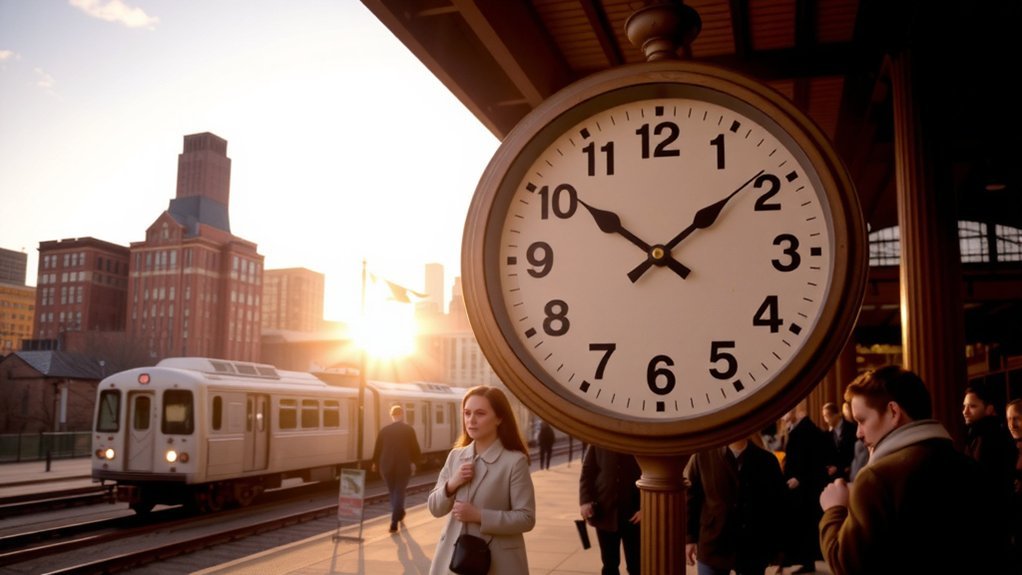
Why does time feel different in a city that hums before sunrise and glows long after dinner? Central Time, the rhythm that steadies Chicago, sets our clocks one hour behind the East, one hour ahead of the mountains, so meetings line up, trains connect, and everyday life moves with presence and authenticity. Shaped by railroads and regional boundaries, refined through governmental adoption, CT gives neighborhoods a shared beat—lake breeze mornings, noon crowds on the Riverwalk, stadium lights blooming at dusk. We plan lunches, courts open, schools dismiss, and broadcasts begin by this trusted frame. We remember a winter commute—coffee steaming, the ‘L’ rattling—when we all glanced at our watches together. Hold that simple gratitude, and let’s keep pace, steady, kind, on Central Time today.
Daylight Saving Time: Start/End Dates and Clock Changes

Our shared beat on Central Time shifts twice a year, and Chicago feels it—streetlights lingering a little longer in March, sunrise meeting us earlier in November, commuters rubbing their eyes, then smiling anyway. We spring forward on the second Sunday in March, at 2:00 a.m. the clocks jump to 3:00 a.m., and Central Standard Time becomes Central Daylight Time. We fall back on the first Sunday in November, at 2:00 a.m. the clocks return to 1:00 a.m., and CDT settles into CST. The practice has historical origins in wartime conservation and long, bright evenings, yet we also weigh health impacts—sleep shifts, darker mornings, changing moods. Set reminders, ease your routine, welcome the light, respect the dark, keep presence and gratitude through each gentle change.
Converting Chicago Time With New York, Los Angeles, London, and More

How do we turn a Chicago morning into someone else’s afternoon with ease and presence? We start by naming city offsets—simple anchors that steady us. Chicago sits in Central Time; New York runs one hour ahead, Los Angeles two hours behind, London usually six hours ahead. Picture 8 a.m. coffee on a crisp Lake Michigan sidewalk: it’s 9 a.m. in Manhattan, 6 a.m. in L.A., 2 p.m. in London. These conversion examples keep conversations smooth, our tone calm, our timing humane.
When daylight shifts, adjust the math, hold gratitude for shared effort, and double‑check authenticity—are we hearing noon or their noon? Write times with zones, confirm once, breathe twice, and trust the rhythm. Time math isn’t cold; it’s neighborly. We show up together.
Scheduling Across Industries: Flights, Events, Markets, and Sports

Even as the sun edges over the Loop and the river glows pewter, schedules across industries lean on Central Time to keep us steady—flights lining up at O’Hare, doors opening for conferences at McCormick Place, traders eyeing the 8:30 a.m.
Dawn over the Loop, Central Time steadies us—O’Hare queues, McCormick doors, markets wake.
From tarmac to ticker, we plan in lockstep—airline coordination mapping crews and gates, ground teams moving with precision.
In ballparks and arenas, first pitch and tipoff ride CT, so broadcasters sync, concessions prep, fans arrive ready.
Conferences and festivals flourish when event staffing anchors shifts to local minutes, offering presence, patience, and authentic care.
Let’s honor the beat: build buffers, share times, confirm kickoffs, protect rest.
Chicago’s clock isn’t a cage; it’s a compass—quiet, reliable, guiding flights, deals, and games with gratitude and resolve.
Setting Devices and Avoiding Common Time Pitfalls

When we set our phones, laptops, and calendars to do the quiet work for us, we free our heads for the work that matters—showing up with presence, gratitude, and authenticity. In Chicago’s Central Time, we trust automation, yet we verify—open smartphone settings, enable automatic time zone, then restart if clocks drift at daylight’s edge. We double-check shared calendars, because small toggles can create big calendar conflicts, missed rides, or a child waiting at practice.
- Label events with “CT,” note the location, and add a gentle buffer, so traffic, lines, and weather don’t steal our calm.
- Set travel calendars to local time on arrival, then review alerts before bed—reliable.
- Compare meeting invites weekly, archive duplicates, and message hosts when times feel off.
Conclusion
We’ve mapped Chicago’s Central Time—its CST and CDT shifts, its ties to New York, Los Angeles, and London—and we’ve learned to set devices, label calendars, and build buffers. Picture a sunrise over Lake Michigan, a boarding call at O’Hare, a keynote at McCormick Place, all running in rhythm. We plan, we adjust, we arrive—presence over panic, authenticity over rush. So breathe, double‑check, move with gratitude and intention; time serves us, not the other way around.