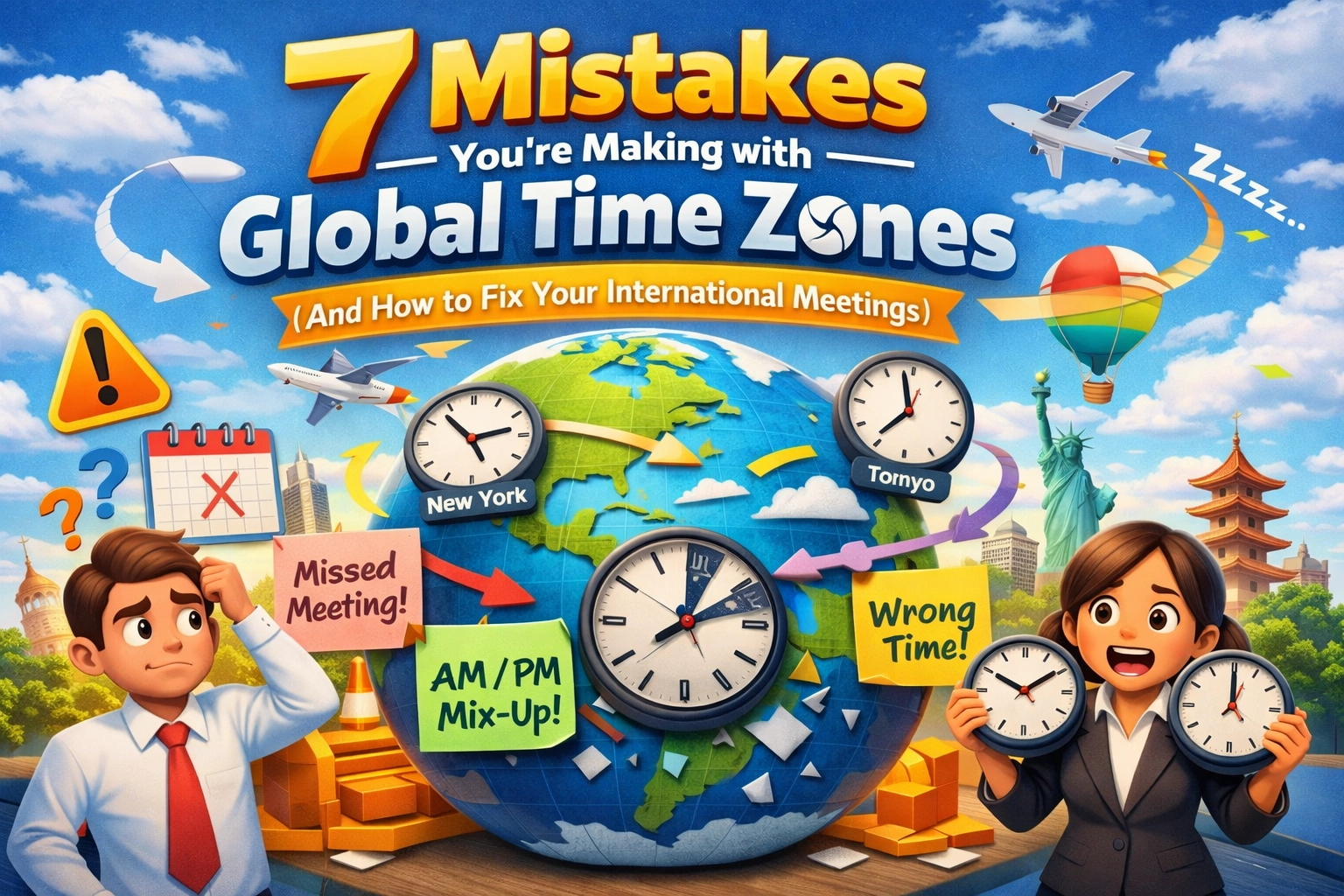

Global business never sleeps, but your schedule shouldn't be a nightmare. You’re navigating a world where a three-minute lag in decision-making can cost millions, yet you’re still tripping over the basic arithmetic of a UTC offset. Whether you are coordinating a product launch from a sleek high-rise in Istanbul or syncing with a dev team in Seoul, the clock is either your greatest ally or your most relentless adversary.
Most professionals treat time zones as a minor inconvenience. They are wrong. It is a logistical labyrinth that requires clinical precision. If you’ve ever sat alone in a Zoom room wondering why your counterpart in Vienna hasn't joined, you’ve felt the sting of a time zone blunder.
You will fix this. You will master the global clock. Here are the seven critical mistakes you are making right now and the high-level hacks to ensure your international meetings run with the efficiency of a Swiss chronometer.
1. The Deadly Abbreviation Assumption
You’re typing an email and you write "3 PM PST." You feel professional. You feel precise. You are actually being dangerous.
The mistake is assuming that Standard Time and Daylight Saving Time are interchangeable. PST (Pacific Standard Time) and PDT (Pacific Daylight Time) are an hour apart. In March, as the Northern Hemisphere prepares to "spring forward," using the wrong acronym isn't just a typo, it’s a one-hour delay that kills your productivity.
The Fix: Use the generic "PT" if you must, but better yet, use the UTC offset. Instead of relying on abbreviations that change twice a year, refer to the offset. If you are checking what time is it on the East Coast right now, you need to know if they are currently UTC-5 or UTC-4.

2. Ignoring the "Spring Forward" Desync
March is the most dangerous month for global logistics. Why? Because the world does not change its clocks in unison.
The United States typically shifts to Daylight Saving Time weeks before the United Kingdom and Europe. If you have a recurring meeting between New York and London, that "standard" 5-hour gap suddenly shrinks to 4 hours for a chaotic fourteen-day window. You will miss meetings. You will frustrate your partners.
The Fix: Audit your calendar every March and October. Do not trust your recurring invites to handle the logic for you. Use a dedicated meeting scheduler to visualize the overlap during these transition weeks.
3. The "My Time vs. Your Time" Ambiguity
"Let’s hop on a call at 9:00." This sentence is the equivalent of logistical suicide. Which 9:00? Yours? Mine? The headquarters in Pennsylvania?
When you fail to anchor a meeting to a specific, undisputed reference point, you invite chaos. You end up in an endless "ping-pong" of emails trying to clarify the meridian.
The Fix: Adopt UTC (Coordinated Universal Time) as your internal team standard. It never changes for DST. It is the North Star of global navigation. Alternatively, always list at least two time zones in your invitation. For example: "9:00 AM EST / 2:00 PM GMT." This provides immediate context and removes the mental load from your recipient.
4. Overlooking Cultural Time Norms
You’ve calculated the offset perfectly. You know what time is it in Istanbul right now. You schedule a meeting for 2:00 PM local time. You think you’re set.
But you forgot that in Istanbul, business culture often revolves around late lunches and evening socializing. Or perhaps you scheduled a 9:00 AM call for a team in Spain, ignoring the fact that the "9-to-5" doesn't really kick into high gear until 10:00 AM.
The Fix: Research the "Golden Windows" for each hub.
- Istanbul (UTC+3): Strong preference for afternoon meetings; avoid the Friday prayer window if working with traditional firms.
- Vienna (UTC+1): Punctuality is a religion. If you are one minute late, you are ten minutes late. Check Vienna's current time before every dial-in.
- Seoul (UTC+9): Early morning starts are common, but respect the "Hoesik" (after-work dinner) culture where late-night pings are frowned upon unless urgent. See KST details for more.

5. Calculating in Your Head (The Human Error Factor)
You’re a high-performer. You’re good with numbers. You think, "Okay, Vegas is 3 hours behind New York, so…"
Stop. Human error is the leading cause of missed international flights and botched Zoom calls. Even the best of us get the direction of the offset wrong when we're tired or stressed. You think you're adding hours when you should be subtracting.
The Fix: Trust the tools. Use a world clock converter for every single invitation. If you are frequently coordinating with the West Coast, keep a tab open for what time is it in Las Vegas right now. Digital tools don't have brain fog; you do.
6. The Jet Lag Logistical Collapse
You land in a new city, your phone updates automatically, and you think you’re ready to lead. But your circadian rhythm is still back in Mountain Time. You schedule a high-stakes pitch for what feels like 2:00 PM but is actually your biological 3:00 AM.
Your cognitive performance will be at its nadir. You will miss nuances. You will lose the deal.
The Fix: Use the "First 24" Rule. Upon arrival in a major hub like London or Tokyo, do not schedule "active" meetings (negotiations, pitches) for the first 24 hours. Stick to "passive" tasks (emails, research). Use Mountain Time references to track your biological clock vs. the local reality.

7. Failing to Confirm in the Local Tongue
When you send a calendar invite, the software handles the conversion. But when you send a follow-up text or Slack message, you often revert to your own local time. This creates a "Source of Truth" conflict. The calendar says one thing, your message says another.
The Fix: The Double-Entry Protocol. Always state the time in both your zone and theirs in the confirmation message. "Looking forward to our chat at 10 AM my time (which is 6 PM your time in Vienna)." This small habit saves hours of frustration.
The Global Hub Deep-Dive: Timing Your Calls Perfectly
To truly master the world, you need to understand the rhythm of the major international business hubs. Here is how you should handle the "Big Three" regions:
The EMEA Power Play (Europe, Middle East, Africa)
Centering your operations in places like Vienna or Istanbul places you in the "sweet spot" of global trade. You can talk to Seoul in the morning and New York in the evening.
- Best Time for Global Calls: 1:00 PM – 3:00 PM CET. This allows you to catch the tail end of the Asian workday and the start of the North American morning.
- Pro Tip: Always verify if your partner is in a region that observes Standard Time year-round. Many countries in Africa and the Middle East do not shift.
The APAC Sprint (Asia-Pacific)
Working with KST (Korea Standard Time) or JST (Japan Standard Time) requires an "early bird" mentality if you are West-based.
- The Struggle: The 13–14 hour difference with the US East Coast.
- The Hack: Schedule "Handover Meetings" at 8:00 PM EST, which is 9:00 AM or 10:00 AM the following day in Seoul. This ensures the work continues while you sleep.

The Americas Hustle
From Las Vegas to Pennsylvania, the US spans four major time zones.
- The Trap: Assuming everyone on the "East Coast" is on the same page. Always check what time is it here to ensure your internal IP geolocation isn't tricking you.
- The Best Time: 11:00 AM EST is the "Universal Hour" for North America, where the entire continent from coast to coast is generally online and caffeinated.
Action Plan: Your 30-Second Pre-Meeting Checklist
Before you hit "Send" on that next international invite, run through this:
- Check the Offset: Is it UTC+2 or UTC+3? Don't guess.
- Verify DST: Is today the day the clocks changed in London but not New York?
- Identify the Golden Window: Is this time during their lunch or after they’ve picked up their kids from school?
- Reference a Hub: Use a reliable source like What Time Is It Blog to confirm the exact second in their city.
- Confirm Twice: State both time zones in the body of the invite.
The world is getting smaller, but the gaps between our clocks remain as wide as ever. By eliminating these seven mistakes, you aren't just managing a calendar: you are mastering the logistics of global influence.
Precision is your brand. Don't let a time zone ruin it. Period.