
You are standing at the center of a logistical hurricane. Your team isn't just in the next building; they are scattered across 100 global hubs, from the neon-slick streets of Tokyo to the espresso-scented cafes of Milan. When you manage a footprint this large, the standard 9-to-5 mindset isn't just outdated, it’s a liability.
To lead effectively, you will transition from a "sync-first" manager to a Global Time Architect. You will stop guessing and start calculating with clinical precision. This guide is your blueprint for dominating the clock, ensuring that no matter where your team sits, the work never stops.
The Brutal Reality of the 24-Hour Cycle
Coordinating 100 hubs means you are playing a game of permanent overlap. There is no "perfect time." While you are finishing your morning coffee in New York (UTC-5), your counterparts in Istanbul (UTC+3) are already winding down their afternoon. If you need to know exactly what time is it in Istanbul right now, you cannot rely on memory. You will use live digital offsets to prevent the "oops, I woke you up" email.
Mastering Global Time Zones requires acknowledging the "Triad of Friction":
- The Americas (UTC-10 to UTC-3)
- EMEA (UTC+0 to UTC+4)
- APAC (UTC+7 to UTC+12)
You will find that the most difficult bridge is the one between the US West Coast and Southeast Asia. For example, knowing what time is it in California right now is vital for your tech leads, but when they need to call Singapore, someone is going to lose sleep. Period.

Stop Searching for the "Best Time for Global Calls"
The "best time" is a myth that leads to burnout. If you find a slot that works for everyone, it usually means someone in London is staying up until 11:00 PM while someone in Sydney is waking up at 4:00 AM.
You will implement Time Zone Rotation.
Instead of forcing one region to suffer, you will rotate the "pain" of the meeting slot. Week one: US-friendly. Week two: EMEA-friendly. Week three: APAC-friendly. This creates equitable inconvenience, a core tenet of global leadership that builds long-term team resilience.
The Power of Core Hours
You will define Core Collaboration Windows. These are 2-3 hour blocks where the maximum number of hubs overlap.
- NYC & London: 9:00 AM – 12:00 PM EST.
- London & Dubai: 8:00 AM – 11:00 AM GMT.
- Tokyo & Sydney: 9:00 AM – 5:00 PM (Easy mode).
Outside of these windows, you will mandate Asynchronous Communication. If it doesn't require a live debate, it belongs in a shared document or a recorded video brief.
Leveraging a High-Performance Meeting Scheduler
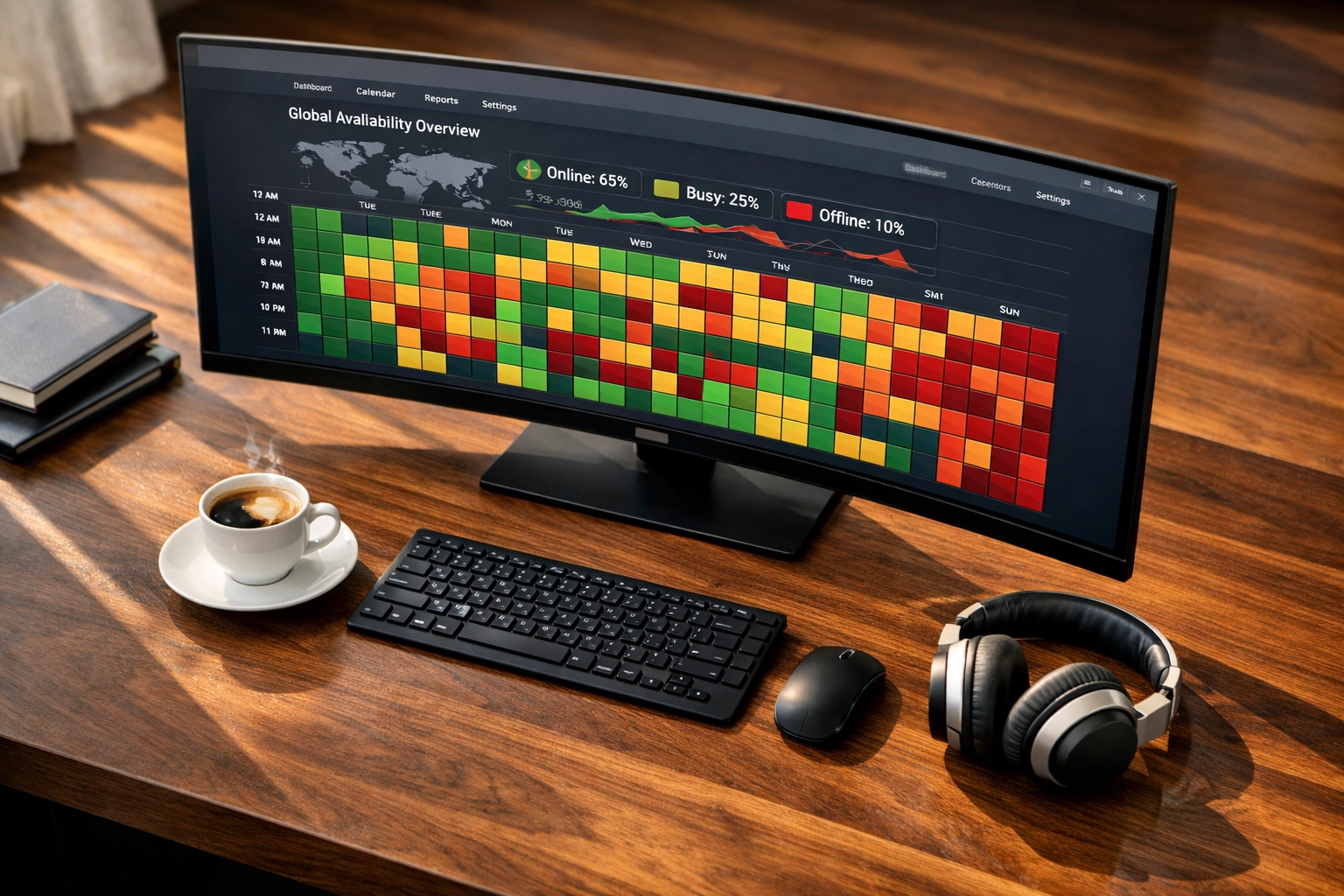
Manual calculations are for amateurs. To manage 100 hubs, you will deploy a professional Meeting Scheduler tool. You need a visual grid that color-codes "Working Hours," "Golden Hours," and "Sleep Zones" across your entire network.
You will prioritize tools that integrate directly with your calendar and automatically adjust for Daylight Saving Time (DST). Remember: DST transitions don't happen simultaneously worldwide. Europe might shift weeks before the US, and hubs in Hawaii or Arizona don't shift at all. Checking what time is it in Hawaii right now will remind you that they remain on HST (UTC-10) year-round.
Cultural Time Norms: Beyond the Clock
Logistics are only half the battle. To lead 100 hubs, you must navigate Cultural Chronemics. How a culture perceives time will dictate your meeting success.
- Linear-Active Cultures (Germany, Switzerland, USA): Time is money. Meetings start at 09:00:00. If you are two minutes late, you are disrespectful. You will provide tight agendas and stick to them.
- Multi-Active Cultures (Italy, Brazil, UAE): Relationships take priority over the clock. A meeting might start late because a previous conversation was important. You will build "buffer time" into these schedules.
- Reactive Cultures (Japan, China, Korea): Time is used for reflection and harmony. Silence in a meeting isn't "dead air": it’s processing time. You will learn to wait.
When you check what time is it in Texas right now to call a Houston-based energy firm, expect a different "pace" than a call to a frantic startup hub in Berlin. Context is everything.
Travel and Jet Lag Advice for the Global Elite
If you are the one flying between these 100 hubs, you will face the physical toll of rapid time zone shifting. To maintain your edge, you will adopt the Pro-Traveler Protocol:
- The 48-Hour Pre-Adjustment: Two days before you fly from London to Singapore, begin shifting your sleep schedule by 1-2 hours toward your destination time.
- Hydration Precision: You will consume 500ml of water for every three hours in the air. Avoid the "celebration drink" in business class; alcohol at altitude is a jet lag catalyst.
- Strategic Light Exposure: Upon landing, seek natural sunlight immediately. It is the fastest way to reset your circadian rhythm. If you arrive at night, use blue-light blocking glasses until you hit the pillow.
- The "No-Nap" Rule: Regardless of how exhausted you feel, you will stay awake until at least 9:00 PM local time on your first day.

The Asynchronous Revolution: Documentation is Your Savior
With 100 hubs, you cannot afford to have 100 people in every meeting. You will adopt a "Record by Default" policy.
- Transcript Gold: Every call is recorded and transcribed.
- The 5-Minute Summary: Every hour-long meeting must produce a 5-bullet summary of decisions and action items.
- The Searchable Archive: Use a centralized hub (like your company Wiki) to categorize these recordings by region and project.
This allows your team in Mumbai to wake up and see exactly what was decided in Chicago while they were sleeping. It removes the "information bottleneck" and empowers your global hubs to move at their own pace.

Strategic "Time-Shifting" for Maximum Productivity
You will learn to use the global clock as a competitive advantage. This is known as "Follow-the-Sun" Development.
- Phase 1: Your team in Eastern Europe writes the code while the US sleeps.
- Phase 2: Your team in New York reviews and tests the code during their morning.
- Phase 3: Your team in California deploys the code in their afternoon.
- Result: You have achieved a 24-hour production cycle without a single person working overtime.
This is the ultimate "hack" for the modern enterprise. You aren't just managing time zones; you are harvesting time.
Final Instructions for the Global Leader
Mastering 100 global hubs is not about working harder; it is about working smarter within the constraints of a rotating planet.
- Trust the data. Use live clocks and sitemaps like our major international cities guide to stay oriented.
- Prioritize clarity. In a world of varied accents and time zones, a clear written summary beats a fuzzy Zoom call every time.
- Protect your sleep. You cannot lead a global empire if your brain is foggy from 3:00 AM calls. Set boundaries and stick to them.
You are now equipped to handle the complexity of a 100-hub network. Go forth and synchronize your world. The clock is ticking, but now, it’s working for you.