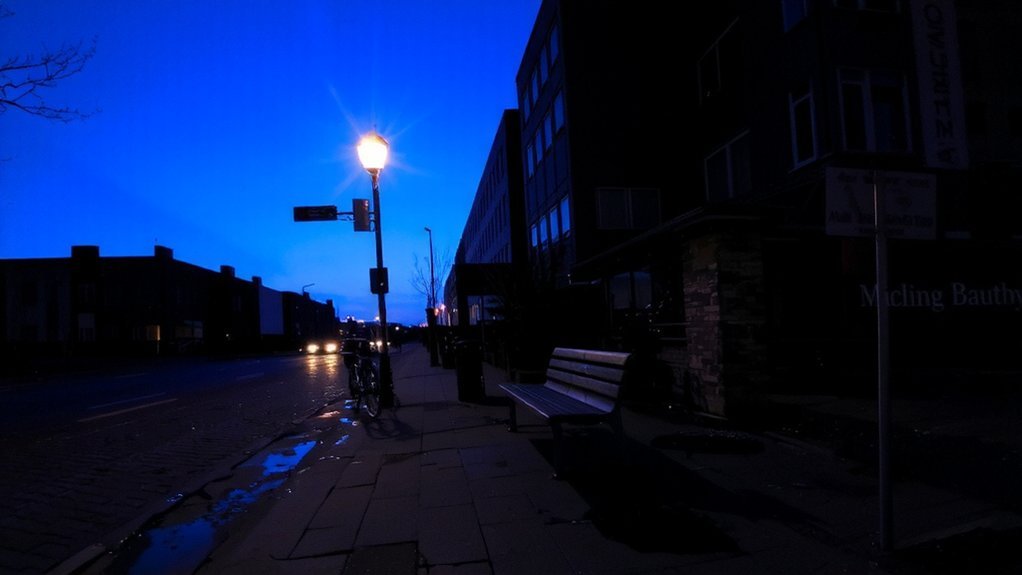

You wait for the sky to soften, for streetlights to glow, for that quiet moment when the day finally lets go—yet “dark” never seems to happen at the same time twice, does it? You notice how winter shadows rush in, how summer evenings linger, how clouds, city lights, and even the moon change your sense of night. If you’ve ever wondered when darkness truly begins, you’re closer to the answer than you think…
Key Takeaways
- “Dark” usually means when you can no longer read easily outside and stars become clearly visible, not exactly the moment of sunset.
- After sunset, civil, nautical, and astronomical twilight progress; true dark for stargazing usually starts around astronomical dusk.
- Depending on location and season, full darkness typically occurs 60–90 minutes after sunset at mid‑latitudes.
- Higher latitudes have longer twilight and sometimes no true night; near the equator, twilight is short and darkness arrives faster.
- Use local sunrise/sunset and twilight tables or apps for your coordinates to know when civil, nautical, and astronomical dusk occur.
Understanding What We Mean by “Dark
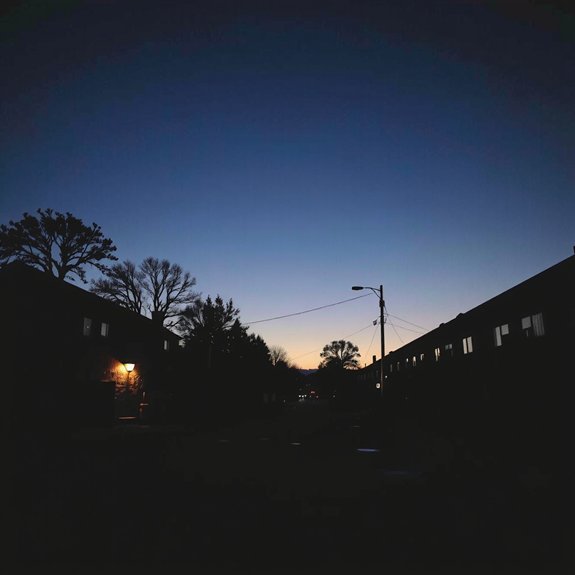
When you say it’s “getting dark,” what’re you really noticing—the vanishing of color, the first stars waking up, the moment the sky finally turns from deep blue to velvet black? You’re sensing perceived darkness, not a single scientific switch being flipped.
Your eyes struggle with fine detail, streetlights flicker on, a child says, “It’s night now,” and you nod, even though the Sun still sits just a little below the horizon.
You also live inside cultural definitions of dark, whether you realize it or not. Laws tell you when headlights are required, rules set when you can hunt or fish, neighborhoods decide when porch lights should glow.
Civil, Nautical, and Astronomical Dusk Explained
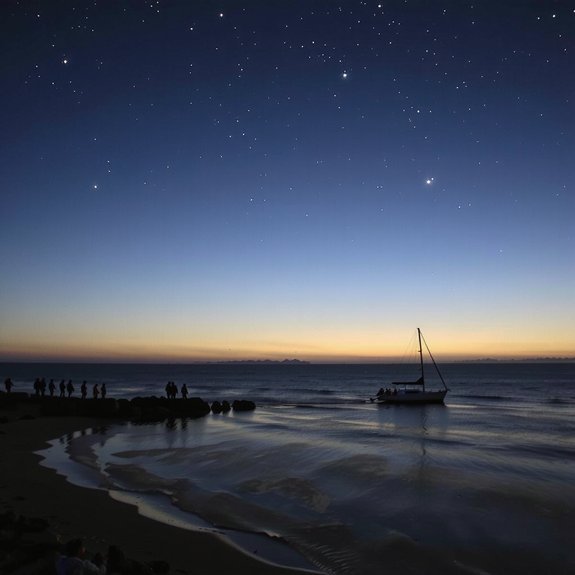
You’ve already noticed how your own eyes and habits decide what “dark” feels like, but the sky also keeps its own careful schedule, marked by three stages of dusk that astronomers track by the angle of the Sun below the horizon.
At civil dusk, when the Sun slips 6° below, you can still read a book outside, recognize faces, finish a walk without a flashlight, though you feel daylight’s presence fading fast.
Nautical dusk comes next, the Sun at 12° down, the horizon soft but still traceable, bright stars pricking through as if someone slowly dimmed a cosmic rheostat.
Sailors once trusted this moment; you can trust it too, as a cue to pause and breathe.
How Latitude, Season, and Terrain Change Darkness Times
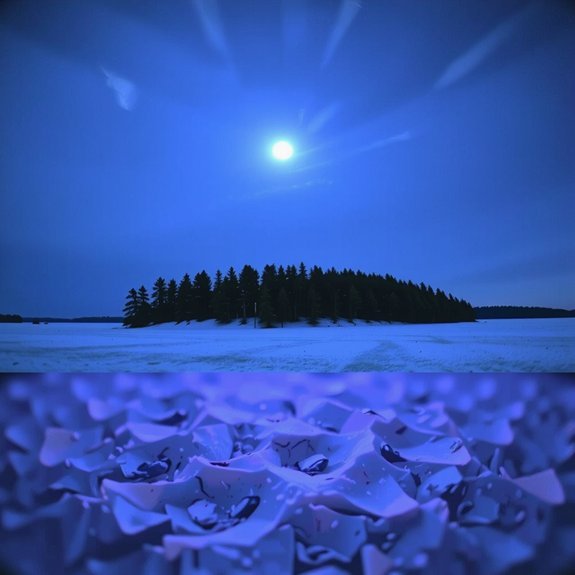
Although the Sun follows the same grand path for all of us, the way darkness arrives in your life depends a lot on where you stand, what time of year it is, and even what’s sitting on your horizon.
Near the equator, you feel evening fall quickly, because the Sun dives straight down and civil twilight fades in twenty or thirty minutes, like a light dimmer snapped fast.
Closer to the equator, twilight is a swift exhale, daylight dimming almost before you can notice.
Move toward the poles and the story stretches—twilight lingers for hours, and polar daylength can erase true night for weeks, leaving only a soft, glowing not-quite-dark.
In winter, that same tilt brings long, enveloping nights, inviting reflection and quiet.
Then there’s terrain obstruction: a mountain, a row of tall trees, even city towers can steal the last rays early, pulling darkness over you while a friend across town still sees gold on the clouds.
Notice the difference, let gratitude deepen.
Using Sunrise, Sunset, and Twilight Tables for Your Location
How do you turn all this talk of sunset and twilight into something you can actually use in your daily life—planning a walk, a commute, or a quiet moment under the stars?
Start with a sunrise, sunset, and twilight table for your ZIP code, then notice how each column quietly answers a different need: civil twilight for when streetlights glow and colors still linger, nautical for when the horizon softens, astronomical for when the sky finally feels deep and star-filled.
Because these tables fold in atmospheric refraction, your exact coordinates, and timezone accuracy, you’re not guessing—you’re trusting data.
In Iowa, for example, a 4:54 pm sunset mightn’t mean true darkness until 70–90 minutes later, and by the end of January, “dark” can arrive nearly an hour later than on New Year’s Day.
Use apps or tools with API integration to keep shifting thresholds visible and truly grounding.
Practical Tips for Planning Evening Activities and Skywatching
When does evening really begin for you—the moment the sun slips below the horizon, or the quieter minute when the first stars finally appear and streetlights take over the work of the day?
Start by choosing your goal: relaxed walk, family games, or deep-sky awe, then match it to civil, nautical, or astronomical twilight instead of just “sunset.” Look up tonight’s times in a dependable app, set alerts a few minutes early, and give yourself gentle margins so you arrive calm, not rushed.
Build a simple Safety checklist—layers, flashlight, charged phone, water, and a way home in the dark.
Practice Moon planning too: circle full and new moons on your calendar, notice how bright nights feel busy while moonless ones feel almost sacred.
Scout your viewing spot before dusk, note trees, buildings, and city glow, then let the growing darkness invite you into stillness, presence, and quiet gratitude.
Common Myths and Misconceptions About When It Gets Dark
As you start noticing when the light truly fades each evening, you may realize that “dark at sunset” is more of a habit in your mind than a real moment in the sky, because the world often stays washed in soft color and lingering glow long after the Sun slips below the horizon.
It’s easy to feel thrown off by the clock change of Daylight Saving Time or to mix up twilight, dusk, and full darkness, yet your senses—how the air cools, how colors drain from buildings, how stars slowly appear—can guide you with more honesty than the numbers on a screen.
Let yourself question what you’ve always assumed about nightfall, and you’ll begin to notice a richer pattern of light and shadow that brings more presence, gratitude, and calm into the simple act of watching day turn to night.
Dark at Sunset” Myth
Despite what many people casually say, it doesn’t actually get dark the instant the Sun slips below the horizon—“dark at sunset” is a comforting shortcut, not a scientific truth.
Think about the phrase origins you’ve heard in songs or seen in media portrayal of cozy porch scenes—the sky goes orange, someone says, “It’s dark,” yet you can still read a sign, watch clouds glowing, feel color lingering. After sunset, you move through civil, nautical, then astronomical twilight, as the Sun sinks from just below the horizon to about 18 degrees down. Depending on season, latitude, and weather, that journey can last minutes or more than an hour, inviting you to notice subtle shades, shifting stars, and your own patient presence with gratitude and authenticity.
Daylight Saving Time Confusion
How often have you felt like Daylight Saving Time suddenly “steals” your evenings or magically makes it stay light later, as if someone reached up and dragged the Sun across the sky by hand?
You’re not crazy for noticing the jump, but DST only moves the numbers on your clock, not the Sun itself, so the very same sunset simply appears as 8:30 instead of 7:30. Those sharp steps you see on sunrise and sunset graphs come from this man‑made choice, rooted in old policy origins about saving fuel and shaping work hours.
When you remember that, you can notice the sky with more calm, protect your sleep from sudden shifts, and stay mindful of real health impacts. Let that simple truth guide tonight.
Misreading Twilight and Dusk
You’ve already seen how a simple change on the clock can fool you about evening light, and there’s another quiet trick at work: we often misread what the sky itself is saying. You think darkness arrives at sunset, yet the sun still lingers below the horizon, lighting the air while your eyes slowly adjust.
Civil, nautical, astronomical—each twilight has its own flavor of blue, its own invitation to pause and notice. Because of human adaptation, your vision keeps stretching to use the fading glow, so you underestimate how late true night begins.
Camera metering would call it dim long before you do, registering shadows where you still see detail. At higher latitudes, twilight can feel endless, a soft refusal to let the day go.
Frequently Asked Questions
How Does Artificial City Lighting Affect Our Perception of When It Gets Dark?
You feel darkness arrive later than it truly does, because artificial city lighting creates a Perceptual Delay, stretching twilight into a bright, busy blur.
Streetlamps wash the horizon with Skyglow Adaptation, so your eyes adjust to glare instead of stars, to storefronts instead of constellations.
Notice how your body still softens when the air cools, how quiet corners invite presence, gratitude, and authentic rest—trust that subtle shift within you tonight.
What Time Is Safest for Walking or Jogging Outside After Sunset?
You’re usually safest walking or jogging about 30–60 minutes after sunset, while civil twilight still gives soft light and people remain outside, creating traffic, noise, and witnesses.
Check local crime statistics and choose well‑lit routes, steady footpaths, and familiar neighborhoods.
Tell someone your plan, carry a light, and trust your body’s signals—your safety, presence, and gratitude for movement matter more than any pace or personal record on this earth tonight.
How Do Animals and Insects Respond to Changing Darkness Times Throughout the Year?
Animals and insects shift with the seasons just as you do: as darkness times change, they adjust migration cues, breeding rhythms, and daily feeding patterns.
You can imagine birds lifting off at earlier dusks, fireflies flashing later in warm, slow nights, urban raccoons learning new streetlight shadows.
When you notice these changes with real presence and gratitude, you strengthen your own sense of timing, belonging, and quiet authenticity each day.
Can Smartphone Night-Mode Settings Help Our Eyes Adjust More Easily to Darkness?
Yes—night-mode can feel like slipping from a blazing stadium into a quiet candlelit chapel, helping your eyes adjust more gently to darkness.
By lowering blue light and pairing it with Adaptive brightness, you reduce glare, strain, and Melatonin suppression, so your body’s signals stay clearer.
Still, don’t trust it completely—dim the screen, add real darkness, and give yourself tech‑free minutes to arrive, with presence and gratitude, and deeper, easier sleep.
How Does Air Pollution or Haze Change How Quickly It Appears Dark?
Polluted air usually makes it seem darker faster because aerosol scattering blocks and redirects sunlight, softening colors and hiding distant shapes.
You might notice twilight feels shorter, yet sometimes haze stretches twilight duration, leaving a dull, gray glow that lingers.
Use these moments as quiet signals—pause, breathe deeply, honor your limits, step inside with gratitude and renewed presence.
Let the fading sky remind you to choose rest, curiosity, and authenticity.
Conclusion
When you ask, “What time is it dark?”, you’re really asking when the day finally exhales, when streetlights flicker on and the sky trades blue for deep velvet. Now you know how civil, nautical, and astronomical dusk unfold, how seasons and places tilt the clock, how charts and apps become quiet guides. So step outside, linger on the porch, let the shadows gather, and meet the night with curiosity, presence, and simple gratitude.


