

Like sailors once steering by the North Star, you move through each day guided by the small glowing numbers on your screens, trusting they tell you what moment you’re in—and sometimes, without noticing, letting them rule your mood, your pace, your sense of enough. But what if “What time is it now?” isn’t as simple as your phone suggests, and learning how time really works could quiet some of that constant rush?
Key Takeaways
- “What time is it now?” depends on your location’s time zone and any current Daylight Saving Time rules.
- Coordinated Universal Time (UTC) is the global reference; local clocks are set as offsets from UTC (for example, UTC−5).
- Use a trusted world clock site or your phone/computer, which syncs via NTP/GPS to atomic-clock–based UTC, for accurate current time.
- When checking time for another city, use a time-zone converter or multi-city planner to account for offset and DST differences.
- For precise applications, rely on ISO 8601 UTC timestamps (e.g., 2025-12-31T14:23:05Z) instead of ambiguous local times.
Understanding Local Time and Time Zones
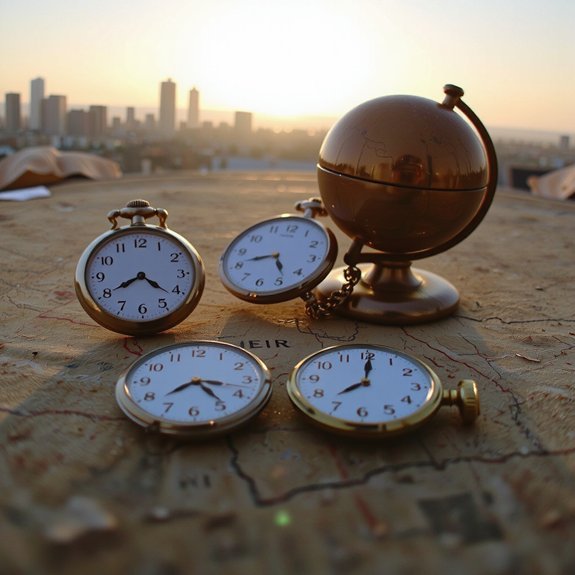
Even though the clock on your wall seems simple, the time it shows is part of a quiet global system that keeps billions of people moving in step.
When you read that clock, you’re using local time—the civil time your town agrees on, written into laws, shaped by political borders, and carried in daily habits like school bells, bus schedules, and dinner hours.
You live inside a time zone, an offset from a shared reference, so if you’re in Eastern Standard Time you’re five hours behind that reference, while someone in Tokyo may be many hours ahead.
As the sun’s light slides across the sky, lines of longitude suggest neat zones, yet cultural perceptions bend them, pulling a country together or splitting it apart.
Then Daylight Saving Time nudges everything forward or back, asking you to reset your clock, your sleep, and your sense of presence and gratitude.
Coordinated Universal Time (UTC) and Global Synchronization
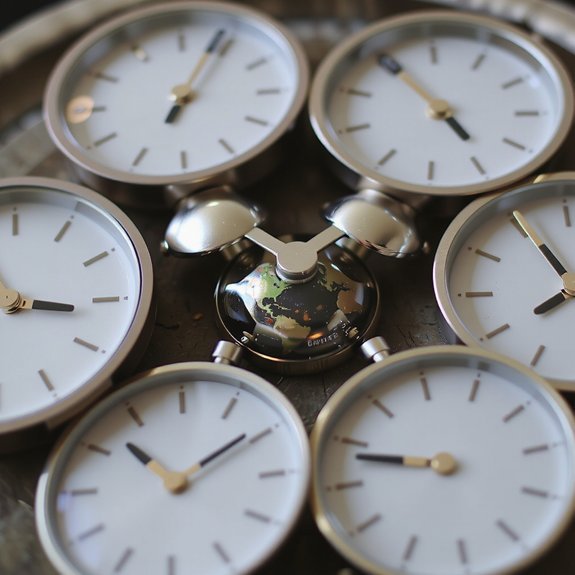
When you zoom out from the familiar rhythm of your own time zone, another layer of timekeeping comes into view—a single, steady heartbeat called Coordinated Universal Time, or UTC, that the whole planet quietly leans on. You meet it every time you schedule a call across oceans, track a flight, or watch a rocket launch, even if you don’t notice its presence. Through UTC adoption, your local zone plugs into a single civil synchronization system, so traders in London, coders in Nairobi, and farmers in Kansas can share one trusted “now,” precise, fair, and quietly shared.
| Aspect | How it touches your life |
|---|---|
| UTC(BIPM) clocks | Anchor the master timeline you rarely see |
| Leap seconds | Keep clocks aligned with Earth’s gentle wobble |
| Time‑zone offsets | Turn UTC into local hours you actually use |
| NTP / PTP | Steady your devices, servers, and cloud tools |
| GPS timing | Guides power grids, markets, and navigation |
Daylight Saving Time: Why and How Clocks Change
Although the sun still rises and sets on its own quiet schedule, we choose, twice a year, to grab the clock and slide it forward or back, trying to pull a little more daylight into the hours we’re awake. You step into this tradition without always seeing its historical origins—early leaders hoped extra evening light would save candles, later, electricity—yet you still feel its tug every March and November.
In many places you “spring forward” at 2:00 AM, losing an hour as 1:59 blinks straight to 3:00, then “fall back” in November, when 2:00 repeats and the night suddenly stretches. Near the equator, or in states like Arizona and Hawaii, people skip the switch, choosing steady clocks over shifting ones.
Still, you can’t ignore the health effects—tired eyes, fuzzy focus, higher accident risk—so you prepare gently, protect your sleep, and notice how your body answers the moving hands.
Checking the Exact Time: Devices, Standards, and Accuracy
As you start paying closer attention to the exact moment you’re in, it helps to know that there are official time standards—built on whisper‑quiet atomic clocks, tuned to the cesium beat—that anchor every second you see on a watch, phone, or laptop.
You can let that reassure you rather than overwhelm you: your phone syncing over the network, your computer checking trusted servers, your GPS quietly correcting itself in the background
all work together so you rarely drift more than a blink away from true UTC time. Now you get to use that invisible precision with real presence—tightening your clock settings, choosing better time sources, and turning “about now” into a clear, grounded “right now” that supports your plans, your focus, and your sense of gratitude for each passing second.
Official Time Standards
How do we pin down a single, exact moment in a world where everything seems to be rushing past you?
You start by trusting the quiet guardians of time—Metrology Institutions that watch cesium atoms tick, again and again, 9,192,631,770 tiny quantum transitions defining one steady second.
Their cesium fountain clocks drift less than a millionth of a billionth, giving you a foundation that feels almost timeless.
From those labs, the world builds Coordinated Universal Time, blending hundreds of atomic clocks into one shared heartbeat, then shaping Legal Timekeeping so contracts, train schedules, and daily rituals rest on the same invisible grid.
When you pause, breathe, and notice that alignment, even a single second can feel full of presence and gratitude, and quiet, steady, inner authenticity.
Syncing Phones and Computers
When you wake your screen, those numbers already match distant atomic clocks, carried over cables and air with quiet care.
You rarely notice, yet syncing has Privacy Concerns, Battery Impact, and huge emotional weight—you trust meetings, memories, and shared moments to these ticking circuits.
Improving Everyday Time Accuracy
Often you just glance at a screen, trust the numbers, and move on—but if you care about being exactly on time, it helps to know what those numbers are really tied to.
Behind your phone’s clock sits UTC, a worldwide chorus of atomic clocks, holding each second steady to almost unimaginable precision. When you check GPS time, you’re touching satellites whose onboard standards stay aligned within billionths of a second, giving your receiver microsecond‑level truth.
At home, you can improve everyday accuracy—let your devices sync to trusted NTP servers, avoid sketchy network settings, reboot routers that lag.
For old‑school wall clocks, mind clock placement and temperature compensation, keeping them away from sunlight, drafts, and vibration, treating timekeeping like a quiet daily practice in presence.
Online Tools for World Clocks, Timers, and Converters
When you open a world clock site that syncs to atomic time and shows both UTC and your local hour, you’re not just checking numbers on a screen—you’re feeling your small but real presence inside a planet of ticking cities and shared midnights.
As you explore precise online timers and stopwatches for your runs, your cooking, or your deep-focus work—milliseconds flashing past, alarms chiming softly—you start to sense how each moment can carry more attention, more authenticity, even a touch of gratitude.
Then, when you use time zone converters and meeting planners that quietly track daylight saving shifts and global offsets, let them remind you of a simple truth: you can work with time rather than fight it, so pause, breathe, and choose the tools that help your days feel more clear, more connected, and more your own.
Best Online World Clocks
How do you stay present with people scattered across time zones, without feeling like you’re forever counting hours on your fingers? You start by choosing world clocks that give you confidence, not confusion—clean widget aesthetics, honest pricing models, and accuracy you can trust.
Time.is streams atomic‑synced time for millions of places, its live widgets quietly updating like a steady heartbeat on your screen. Timeanddate.com wraps clocks with sun and moon details, so a meeting in Tokyo becomes more than numbers, it’s a sense of morning light or deep night sky. WorldTimeServer.com adds clear city lists and DST rules, helping you confirm, not guess.
Use these tools daily, and notice how coordination slowly becomes connection. Let them hold the minutes while you hold the moment.
Precision Timers and Stopwatches
Why does a single second feel so different depending on what you’re doing—racing to finish a set of sprints, waiting for water to boil, or watching a lab experiment tick toward a result?
Online precision timers and stopwatches help you meet those moments with presence, not panic, giving you millisecond accuracy you can trust.
Tools like Time.is and timeanddate sync with atomic clocks, then let you shape each interval to fit your purpose:
- Track sprints with clear lap and split times, watching improvement stack like bricks.
- Time lab steps, letting reliable Button Debounce prevent shaky clicks from ruining data.
- Run full‑screen countdowns during talks, keeping your delivery calm and authentic.
- Log exact ISO 8601 timestamps, while smart Lap Algorithms reveal patterns you’d otherwise miss.
Time Zone Conversion Tools
Across the globe, where sunrise in Tokyo shares the same moment as midnight in New York, time zone conversion tools quietly keep that single instant from turning into confusion and missed connections. You lean on sites like Time.is or timeanddate, trusting their atomic clocks, their UTC readouts, their quiet promise that seven million places can breathe in sync.
| Tool feature | How it serves you |
|---|---|
| Multi‑city planners | Reveal shared hours for Tokyo, London, New York, Cleveland |
| DST rules | Track shifts like March 9 and November 2, 2025 |
| Timers and widgets | Embed countdowns, word clocks, analog faces |
| Language support | Invite presence across scripts, accents, cultures |
As you embed APIs or use API integrations, pause, notice privacy implications, and choose with calm, grounded care for yourself today.
Practical Tips for Scheduling Across Different Time Zones
Even though the world spins through dozens of time zones, you can turn scheduling into a calm, almost graceful practice instead of a daily puzzle.
Start by grounding everything in UTC, then let your tools translate, using simple calendar templates and gentle meeting etiquette to signal care for everyone’s rest and focus.
Anchor your plans in UTC, then let thoughtful tools and etiquette honor everyone’s time and rest
When you plan, imagine people actually sitting at their desks, city lights outside, coffee cooling beside their keyboard.
- Block out core hours in each region, then check overlaps with a time-zone converter, noticing when 9:00 AM in New York becomes 11:00 PM in Tokyo.
- For cross-ocean calls, always propose two slots—one kind to the Americas, another to EMEA or APAC.
- In invites, show both organizer and local times, like “15:00 EST / 20:00 GMT,” so no one hesitates.
- When EST shifts to UTC−5, pause, recalculate, and protect everyone’s evening with presence, gratitude, and steady shared attention.
Frequently Asked Questions
How Do Time Zones Affect International Travel Itineraries and Jet Lag Recovery?
Time zones stretch and compress your days, so they shift flight plans, layovers, and your internal clock, shaping both your itinerary and your jet lag recovery.
You manage this with careful Schedule Optimization—choosing eastbound flights that land at night, planning gentle first days, protecting key meetings.
You support your body with Sleep Strategies: light snacks, water, short walks, sunlight, and intentional naps, honoring your limits with presence and gratitude daily.
How Is Time Kept and Displayed on Spacecraft or the International Space Station?
You keep time in space by anchoring everything to Coordinated Universal Time, so astronauts on the ISS follow UTC like a quiet heartbeat behind every task. Onboard chronometers track this standard, while display interfaces show digital clocks, timelines, and alarms for experiments, sleep, and communication.
You learn to trust those steady numbers, feel your body drift from Earth’s day–night cycle, and practice gratitude for each shared moment of coordinated presence.
What Historical Events Led to the Creation of Standardized Time Zones?
You trace standardized time zones back to the 19th century, when exploding railway networks demanded precise Railway Scheduling across distant cities, and Telegraph Synchronization let clocks click together across continents.
You picture crowded stations, mismatched town times, confused travelers, and you feel why leaders met at the 1884 International Meridian Conference.
Remember this: humans solved chaos by agreeing on shared time, and you can bring presence, and gratitude to days.
How Do Cultures With Lunar or Traditional Calendars Think About Daily Clock Time?
You treat clock time like a helpful tool, not a master, because in many lunar or traditional cultures daily hours bend around Ritual Time and the moon’s pulse, like dancers following a drum.
You notice work, meals, and rest guided by Lunar Scheduling, festivals, and prayer, so you ask, “What’s this moment for?” instead of “What time is it?”, and you anchor your presence in gratitude, community, and authentic routines.
How Does Timekeeping Work at the North and South Poles?
You follow an agreed clock, not the sky, because at the poles the Sun may circle for months or vanish in long night, so Sunlight Cycles can’t guide you.
Research stations choose a Base Timekeeping standard—often the time zone of their supply country—so people can eat, work, and rest together, feel daily structure, and keep a gentle sense of presence, gratitude, and authenticity in an endless-seeming day that still moves.
Conclusion
You’re not just checking the clock anymore—you’re steering a tiny starship through hours, zones, and seasons, choosing exactly when and how you’ll arrive. When you anchor plans in UTC, translate times with care, and trust precise tools, you turn chaos into clarity, panic into presence. So pause, breathe, feel the quiet tick of this moment, then schedule boldly, show up fully, and let your sense of time reflect your deepest authenticity, and honor each second.


