
If you’ve ever stared at your microwave clock in early March after the resetting of clocks, half-awake and mildly annoyed, you already know why Daylight Saving 2026 still gets searched like a yearly weather report. Daylight saving time (DST) is the system where most of the United States moves clocks forward by one hour in spring, then back in fall, shifting daylight later in the day and stealing (or gifting) an hour of sleep in the process.
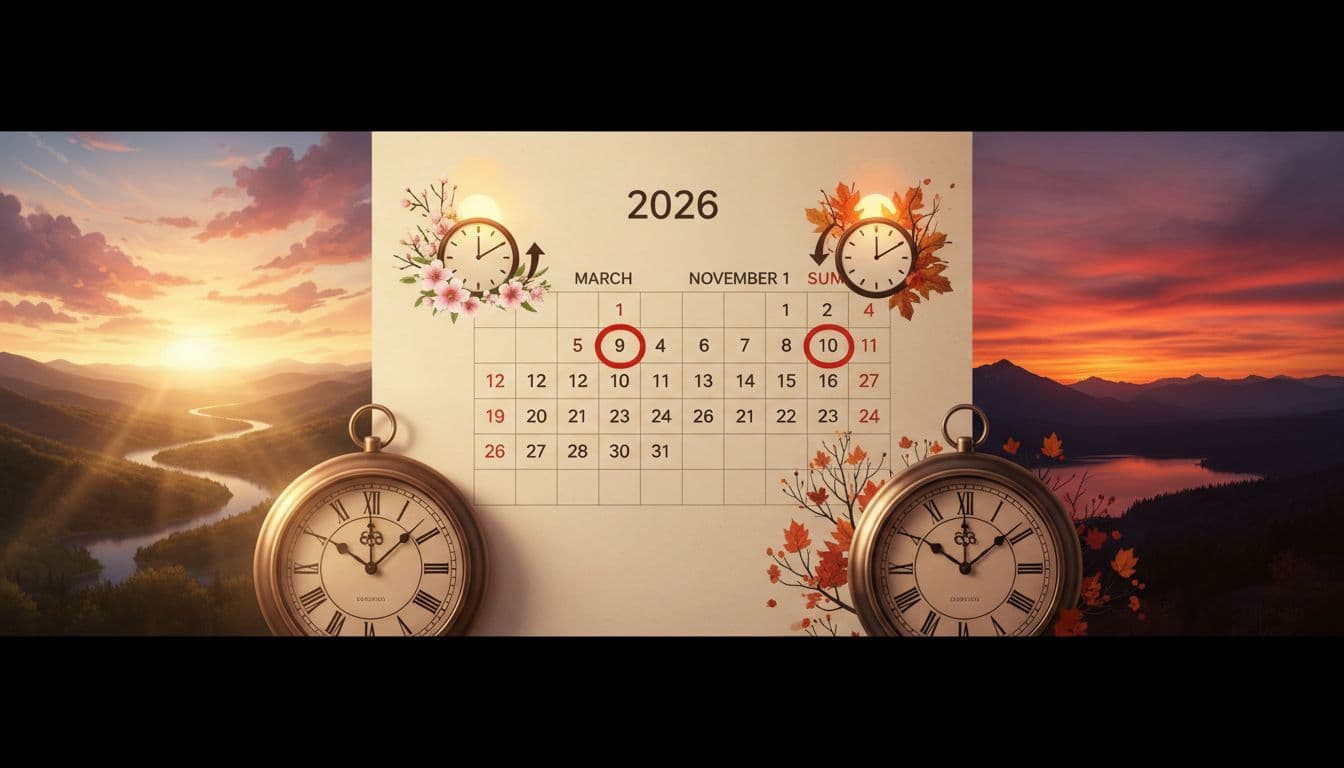
In the U.S., DST starts on Sunday March 8 2026 at 2 a.m. (you jump to 3 a.m.), and it ends on Sunday, November 1 2026 at 2 a.m. (you repeat 1 a.m.). Most states follow this schedule under federal law, but Hawaii and most of Arizona don’t change clocks.
This post lays out the exact 2026 dates, who changes and who doesn’t, and how to prep without feeling wrecked. We’ll also cover the usual trouble spots (sleep, tech glitches, travel timing), plus what’s known, and not known, about any law changes as of December 2025 (spoiler, the rules haven’t changed yet).
Daylight saving 2026 dates and times (United States)
The time change doesn’t arrive with fireworks, it slips in while most of us are asleep, quietly rearranging your morning coffee, your commute, and the way the sky looks at dinner. If you want the clean, no-drama plan for daylight saving 2026, it comes down to two Sundays and one very specific moment: 2 a.m. local time.
Here’s the quick, at-a-glance version you can skim now and trust later:
- Spring forward: Sunday, March 8, 2026 at 2:00 a.m. local time (clocks jump ahead to 3 a.m.)
- Fall back: Sunday, November 1, 2026 at 2:00 a.m. local time (clocks drop back to 1 a.m.)
If you ever want to verify your city’s exact changeover, this Daylight Saving Time 2026 in the United States listing from timeanddate.com is a handy reference.
When do we spring forward on March 8 2026?
In most of the United States, you spring forward on Sunday, March 8, 2026 at 2 a.m. local time. At that moment, the clock jumps from 1:59 a.m. to 3:00 a.m. like someone flipped past a page in your night.
That means:
- Clocks forward one hour, so the hour between 2:00 and 2:59 a.m. doesn’t happen.
- You lose an hour of sleep (or at least you lose an hour on the clock).
- Mornings look darker for a bit, because sunrise shifts later by the clock even though your body still wants to wake up on its old schedule.
It can feel like the day starts under a dimmer switch for the first week or two. The tradeoff is the part most people notice later: more natural daylight in the evening, right when errands, walks, and after-work life actually happen.
When do we fall back on November 1 2026?
You fall back on Sunday, November 1, 2026 at 2 a.m. local time. This one is the time change with a rewind button. At 2 a.m., the clock drops back to 1 a.m., and that 1 o’clock hour happens twice.
In plain terms:
- Clocks move back one hour, returning to standard time.
- You gain an hour of sleep (or an extra hour on the couch, no judgment).
- It gets dark earlier in the evening, which is why November can suddenly feel like someone moved sunset up on the calendar.
If you’ve ever looked outside at what feels like 4:45 p.m. and thought, “This doesn’t make sense,” that’s the fall change doing its thing.
Why the dates change every year (and the rule behind them)
The reason DST feels like it “moves around” is that it’s tied to a simple calendar rule, not a fixed date. In the U.S., the current schedule (used since 2007) is:
- Start: the second Sunday in March
- End: the first Sunday in November
So in 2026, that lands on March 8 and November 1.
This longer DST window traces back to a federal update from the Energy Policy Act of 2005 era, which expanded daylight saving by several weeks. If you want the straight, non-legal explanation, timeanddate.com summarizes the shift and what changed in the US DST change in the Energy Policy Act of 2005.
Who follows daylight saving time in 2026, and who does not
For daylight saving 2026, the simplest real-life question is the one that saves you from missed calls and late airport pickups: Do I need to change my clocks? In most of the United States, yes, you’ll move forward on March 8 and back on November 1, but a few places keep time steady. Outside the U.S., it gets even trickier because nearby countries may follow the same rhythm, or none at all, and Europe often shifts on different Sundays.
US areas that do not change clocks (Hawaii and most of Arizona)
Hawaii and most of Arizona (except the Navajo Nation) along with US territories do not observe daylight saving time, thanks to exemptions under the Uniform Time Act, which is overseen by the Department of Transportation. Clocks stay on the same schedule all year. Sunrise and sunset still drift with the seasons, but your clock does not do the seasonal jump.
Practically, that means these areas can feel like they “move” on the map twice a year, even though it’s everyone else doing the moving.
Here’s the part that matters in daily life: if you have family, work, or travel plans in these places, meeting times can shift relative to where you are.
- In spring, when your area “springs forward,” they do not, so the time difference can widen.
- In fall, when you “fall back,” that difference can tighten again.
If you want a plain overview of the U.S. rules and exceptions, this reference on daylight saving time in the United States can help you sanity-check what your devices should do.
Canada, Mexico, and the Caribbean: what travelers should double check
Many parts of Canada line up with the U.S. schedule, which means if you’re traveling between major cities near the border, the time change often feels “in sync.” Still, Canada has multiple time zones and local exceptions, so don’t assume. Confirm your exact destination, especially if you’re crossing provinces or heading to smaller towns. A reliable starting point is Daylight Saving Time 2026 in Canada.
For Mexico, the headline is simple: most of the country does not observe DST, but some areas do, which can surprise you if you’re booking flights near the border or scheduling a remote meeting with a resort, tour operator, or colleague. This page, Daylight Saving Time 2026 in Mexico, is a useful city-by-city reality check.
For the Caribbean, it’s a mixed bag. Some places keep one time year-round, others follow a pattern closer to North America, and some vary by territory. Before a flight, cruise departure, or a “quick” video call, confirm the local time for your exact port or city, not just the country name.
Europe and the rest of the world: why your meeting time might change twice
If you work with people in Europe, the time difference can feel like it’s on a sliding track for a couple weeks each year. Many European countries switch on different dates than the U.S., often later in March and earlier in fall.
For 2026, a good reference window for Europe is March 29 to October 25. That gap between U.S. and Europe switch dates is where confusion lives. Your 9 a.m. meeting can become 10 a.m. (or the reverse) for a week or two, even if nobody “changed anything” on the calendar.
The fix is simple and a little boring, but it works: confirm the time zone in the invite, and double check the local start time the week your country changes clocks. That one small habit prevents the “Wait, are you an hour late or am I?” moment.
How to prepare for the time change in 2026 (sleep, school, work, and driving)
The spring switch in Daylight Saving 2026 is a quiet magic trick. The clock steals an hour, your body argues the math, and Monday shows up like it has opinions. The fix is not heroics or weird hacks. It’s a week of small nudges that add up, plus a few checks that prevent late arrivals, missed buses, and foggy commutes.
Below is the most practical prep, built for real homes, real jobs, and real mornings.
A simple 7 day plan to make spring forward easier
Think of this like easing a car onto the highway instead of flooring it from a stop. You’re training your circadian rhythm with tiny, boring steps, which is exactly why it works.
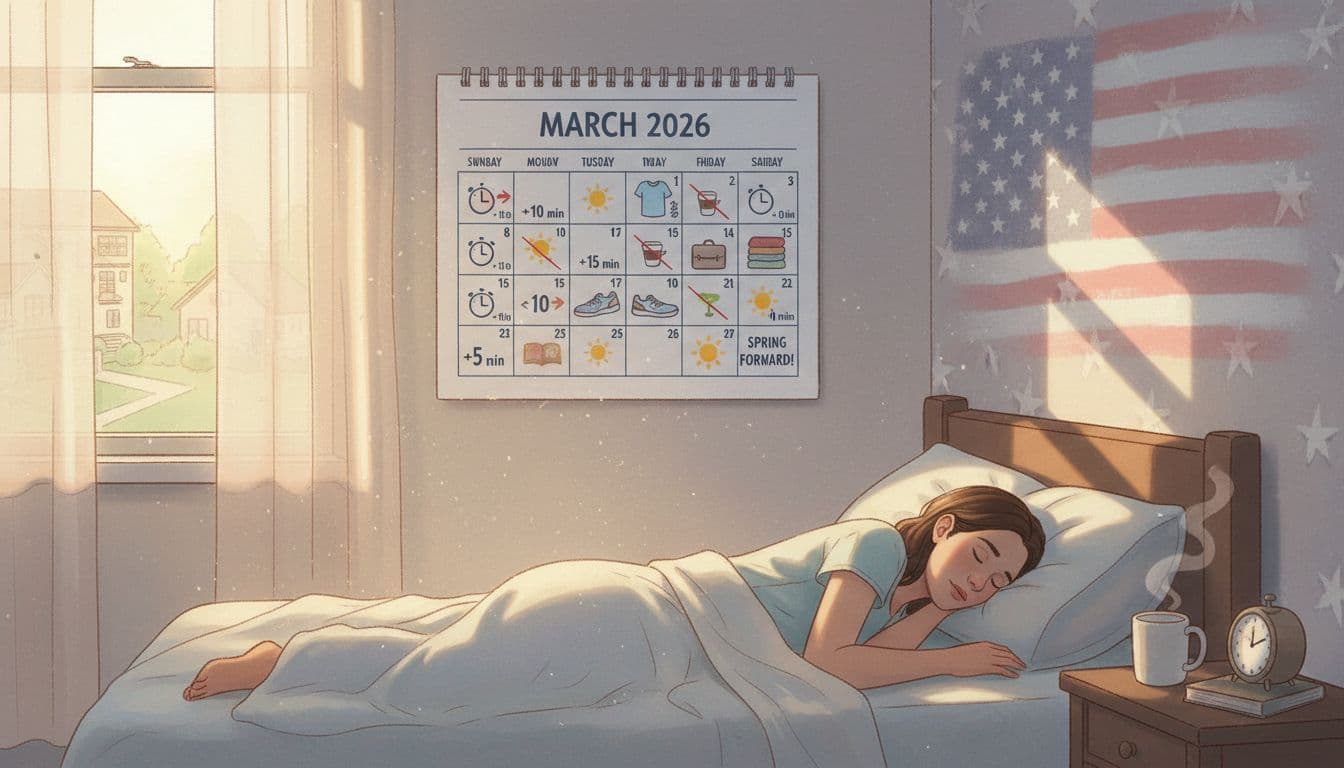
Use this checklist starting 7 days before the switch (or start today and do what you can):
- Move bedtime and wake time earlier by 10 to 15 minutes each day. Keep it gentle. The goal is progress, not perfection.
- Get morning light within the first hour you wake up. Step outside, open curtains, take the dog out, drink coffee by a bright window. Morning light is your body’s strongest “time cue.” The Cleveland Clinic’s general tips on adjusting can help you build a simple routine: Daylight Saving Time: 4 Tips to Help Your Body Adjust.
- Cut off caffeine earlier than usual. If you normally drink it late afternoon, pull it back by an hour or two for this week. You’re trying to make sleep come easier.
- Dim the last hour. Lower lights, quieter TV, less scrolling. You’re telling your brain, “Night is here.”
- Set out clothes and bags earlier. Do it at dinner, not at bedtime. You want fewer choices and fewer mistakes when you’re groggy.
- Plan simpler meals for Sunday and Monday. Leftovers count. So do sandwiches. Decision fatigue is real.
- If you can, make Monday lighter. Book fewer early meetings, avoid a high-stakes presentation, or shift a hard workout to later in the week. Even small changes help.
If you’re prepping for the fall back change too, keep the same structure, just reverse the direction. Shift bedtime and wake time later by 10 to 15 minutes for several days; this eases you into the extra hour of sleep, and keep morning light consistent so you don’t feel jet-lagged in your own house.
How to handle the time change for kids, teens, and early school start times
Kids often take the spring change personally. They were already running on the edge, and now the clock asks them to wake up “one hour earlier” (to their bodies) for school. Teens can get hit even harder because their natural sleep rhythm tends to run later, so early bells can feel like a pre-dawn alarm.
A few adjustments keep the week after spring forward from turning into a daily negotiation:
- Start the wind-down earlier than you think. Aim for calmer activities 30 to 60 minutes before bed, even if bedtime only shifts a little at first.
- Hold the line on consistency. Try not to let bedtime swing wildly between school nights and weekends. Big swings make Monday cruel.
- Build a calmer morning routine. Pick the simplest breakfast, pre-fill water bottles, and keep the “Where is your shoe?” hunt out of the script.
Coordination matters too, because the time change doesn’t just hit your house, it hits the whole chain of handoffs.
- Confirm bus pickup times and before-school care hours the week of the switch.
- Tell caregivers your updated plan (grandparents, sitters, shared custody, anyone doing drop-off).
- Set a backup alarm for the first school day after the change, just in case a device fails or a setting surprises you.
Parents.com has a solid, practical overview for children’s routines if you want more ideas: 5 Ways to Ease Your Child’s Transition Into Daylight Saving Time.
Driving and workplace safety tips for the week after the switch
Sleepiness is not dramatic. It’s just expensive. It makes you miss small cues, drift in thought, and take longer to react, which matters on highways and in workplaces where timing and attention keep things safe.
Keep it simple for the week after spring forward:
- Give yourself extra commute time. Rushing stacks stress on top of fatigue.
- Use a bright start. Turn on more light in the morning, open the blinds, step outside for a minute before driving.
- Take breaks on longer drives. If you feel your focus slipping, stop. Walk for two minutes, drink water, reset.
- Skip risky tasks when you’re overtired. If your job includes ladders, heavy equipment, sharp tools, or complex work, do the most demanding tasks when you’re most alert (often later in the morning).
- Be careful with “second drink” caffeine. A late-day boost can backfire by pushing bedtime later, and you end up tired again tomorrow.
You don’t need to be afraid of the week after the switch. You just need to treat it like a week with slightly worse weather. Adjust. Slow down. Pay attention.
The night before: what to set, what to check, and what not to forget
The night before the time change is when tiny misses cause big chaos. Phones usually update on their own, yes, but “usually” is how people end up sprinting through a parking lot.
Do a quick sweep before bed:
- Confirm your phone time updated (or will update). Then double check alarms. Set a backup alarm if you have an early start.
- Check calendar events for the next day, especially anything tied to travel, remote meetings, or childcare handoffs.
- Update the clocks people forget:
- Oven and microwave clocks
- Car clocks
- Wall clocks
- Watches (especially older ones)
- Review smart home routines (thermostat schedules, lights, coffee maker timers, “wake up” scenes). These can be off by an hour even when your phone is right.
- Set out clothes, lunch, bags, keys before you sit down to relax. Morning-you will be grateful.
Common daylight saving 2026 problems (and quick fixes)
Daylight Saving 2026 has a funny talent for making smart people feel briefly cursed. Your phone looks right, the stove looks wrong, your car insists it’s an hour earlier, and someone on a meeting invite swears you’re late. The good news is most DST problems fall into a few repeat categories, and the fixes are fast once you know where to look.
Why your phone updated but your car clock did not
Your phone usually updates because it pulls time from your carrier, Wi-Fi, and GPS, then applies the DST rule automatically. Your car clock is a different story. Many vehicles still rely on a manual clock, an in-dash setting like “Auto time” that can be off, or a connection that only syncs when certain conditions are met (Bluetooth paired, navigation receiving GPS, ignition on long enough).
Common culprits include older head units, infotainment systems that do not handle the switch from standard time cleanly, or a Bluetooth setup that mirrors your phone for calls and music but doesn’t pass time settings.
Quick fix checklist (do this in order so you don’t chase ghosts):
- Restart the head unit (turn the car off, open the driver door, wait a minute, start again).
- In time settings, toggle Auto time off, then on (also check a separate DST toggle if it exists).
- If your car uses navigation time, confirm GPS time sync is enabled.
- Unpair and re-pair Bluetooth, then check the clock again after a short drive.
- If it still won’t stick, switch to manual time and move on with your life (you can revisit updates later).
If you want a real-world example of how finicky in-car DST can be across models, threads like this one show the same pattern repeating year after year: Daylight Time Savings not updating.
Calendar and meeting issues: avoiding the “wrong time” call
The sneaky problem is not the clock change itself, it’s the time zone label. A meeting set as “9:00 a.m.” without the right zone can shift when daylight time kicks in, especially for teams spread across states or countries.
A few habits prevent the classic “Why are you not on yet?” moment:
- Confirm the time zone in the invite (ET, CT, MT, PT), not just the city name.
- For key meetings the Monday after the switch, resend the invite or post a confirmation message with the time zone.
- If you manage cross-border calls, keep a simple world clock view open. Google Calendar also lets you show and schedule across zones: Use Google Calendar in different time zones.
Travel week tips: flights, hotel wake up calls, and rental cars
Travel during daylight saving 2026 can feel like stacking two puzzles on the same table: time zones plus DST. Flights are typically listed in local airport time, which is great until you forget which “local” you are reading at midnight in a hotel bed.
Three rules keep it clean:
- Check the departure airport time zone when you look at boarding times, not your home time.
- Set alarms based on where you’ll wake up, not where you started the trip.
- For hotel wake-up calls, confirm the time with the front desk and say, “That’s 6:30 a.m. local time here, right?”
Rental cars add one more twist: the car clock may be wrong even if your phone is right. Fix it before you leave the lot.
Shift work and hourly pay: what to ask your manager
DST hits shift work where it hurts: the clock. In spring, the “lost hour” can mean a scheduled overnight shift looks shorter on paper. In fall, the “extra hour” can mean you work an additional hour that needs to be tracked correctly.
Before your daylight saving 2026 shift week, ask directly about the time change:
- How is time tracked that night (clock-in system, manual correction, payroll adjustment)?
- How are breaks handled when the hour repeats or disappears?
- What triggers overtime on that shift, especially if you normally sit near the threshold?
You’re not being difficult. You’re making sure your time, and your pay, match reality.
Is daylight saving time changing in 2026? What we know as of December 2025
Most years, the DST rumor mill spins up like it’s spring-loaded. Someone swears Congress “finally fixed it,” your group chat runs with it, and then March arrives and your oven clock is still wrong. As of December 2025, there’s no confirmed nationwide change to the rules for daylight saving 2026, so planning is simple: expect the usual spring forward on March 8, 2026, and fall back on November 1, 2026.
Why the 2026 schedule is the same as recent years
The U.S. DST calendar is running on the same track it has used since 2007, a system originally inspired by World War I efforts for energy conservation: DST starts the second Sunday in March and ends the first Sunday in November. That’s why daylight saving 2026 lands where you’d expect, even if it feels like the dates “float” year to year.
As of late 2025 reporting, there’s no enacted federal change or federal law that rewrites the 2026 schedule. Talk and proposals like the Sunshine Protection Act come and go, but until a law actually passes and takes effect, your best move is to plan around the known dates and let your devices do what they usually do.
If you want a quick, dependable place to verify the official-style schedule, this Daylight Saving Time 2026 in the United States listing is a clean reference.
Still, laws can change fast when politics and public pressure line up. So keep a simple watchlist:
- Official government updates (federal and your state)
- Trusted local news that covers state legislation and ballot measures
- Your employer or school district (they often flag calendar impacts early)
If a real change happens, it won’t be subtle. It’ll show up everywhere.
If the rules ever change, what would likely happen (in plain terms)
When people say “end daylight saving,” they usually mean one of three outcomes. Each is simple on paper, but the daylight tradeoffs are real, especially when contrasting the winter solstice with peak summer light.
- Option 1: End the clock changes (pick one time year-round). No more spring forward or fall back. Your body gets consistency, but lawmakers would still have to choose which time we keep.
- Option 2: Stay on standard time year-round. In winter, it feels familiar. In summer, mornings get brighter earlier, and evenings get darker earlier by the clock.
- Option 3: Stay on permanent daylight saving time. In summer, it also feels familiar. In winter, evenings stay lighter later, but mornings get darker longer, which can matter for early commutes and school starts.
Plenty of states have pushed ideas in this direction over the years, with mixed momentum and lots of fine print. If you want a grounded snapshot of that ongoing state-level pressure, this overview from The Hill is helpful: Daylight saving time legislation and states pushing changes.
For now, though, the practical answer is the boring one (and boring is good for planning): daylight saving 2026 follows the standard U.S. schedule unless an official update says otherwise.
Conclusion
Daylight Saving 2026 arrives like a quiet stagehand, adjusting the lights while the audience sleeps. In the United States, the two moments that matter are Sunday, March 8, 2026 at 2 a.m. local time (spring forward to 3 a.m.), and Sunday, November 1, 2026 at 2 a.m. local time (fall back to 1 a.m.).
Most places follow that script, but exceptions (Hawaii and most of Arizona) can throw off calls, pickups, and travel days, so check your exact destination before you assume anything. If you’re flying, crossing borders, or working with Europe, confirm local times, then confirm them again.
Make the shift easier with a simple plan: nudge sleep by 10 to 15 minutes for a few nights, get morning light, and keep caffeine earlier. Then do the unglamorous part that saves you: verify alarms, calendar time zones, and the stubborn clocks in your car, oven, and smart home.
Add the dates to your calendar now, and do a quick device check the day before each time change.