
You probably don’t realize how much your plans already dance around the sky’s timing—yet every walk, errand, and quiet moment on the porch depends on when those first drops fall. When you ask, “What time is it supposed to rain?” you’re really asking, “Do I have space for what matters today?” Learn how to read the forecast, watch the radar, and trust your instincts just enough to choose well.
Key Takeaways
- Check an hourly forecast app for your exact location; use the hour-by-hour view to see predicted rain start and stop times.
- Use radar with a 5–10 minute loop to watch approaching echoes and refine the rain arrival time within the next 15–60 minutes.
- Treat Probability of Precipitation (PoP) as a time window: values above 60% suggest likely rain sometime during that block, not a guaranteed exact minute.
- Compare multiple sources (hourly forecast, radar, rapid-refresh models) and recheck closer to your planned activity, since timing can shift by an hour or more.
- Add a 10–20 minute buffer around any predicted start/stop time, and watch for short 15–60 minute dry gaps to fit quick outdoor tasks.
Understanding How Rain Is Forecast
How do forecasters actually know when those first drops will darken the sidewalk or drum against your window?
They start by giving you Probability of Precipitation, or PoP, which tells you the chance that measurable rain will touch your exact spot during a set time, like a quiet promise hidden inside numbers.
Behind that simple percent, powerful tools work together—Doppler radar watching echoes move closer, short‑term nowcasts tracking every shift, satellite interpretation revealing clouds building with quiet intent.
High‑resolution models such as HRRR and NAMnest simulate fronts and storms, yet model uncertainty remains, so ensembles compare many solutions to show timing confidence.
You can picture a tight cluster as a firm yes, a wide spread as a humble maybe.
Finally, surface reports, weather balloons, and radar velocity reveal temperature profiles, helping forecasters decide whether you’ll feel cold sleet on your face or gentle, steady rain later that day.
Using Hourly Forecasts to Pinpoint Timing
When you zoom in from the broad daily forecast to the hour‑by‑hour view, the weather suddenly feels closer, almost within reach, and that’s where you can start to truly time the rain around your life.
You notice those little bars labeled 2 PM, 3 PM, 4 PM, and you read the precipitation probability — a 60% PoP at 3–4 PM tells you there’s a real chance you’ll hear drops on the window during that exact hour.
Next, check intensity: 0.10 in/hr suggests a soft, walk‑in‑it drizzle, while 0.50 in/hr hints at wipers on high, splashing gutters, plans on pause.
Pay attention to Timestamp Conventions and Data Latency, because a model run stamped “12Z” or “10:15 AM” might describe conditions a bit ahead of you.
Compare several hourly sources, look for agreement on start times, and then recheck close to leaving so you can move with calm, informed confidence.
Reading Radar to See When Rain Is Moving In
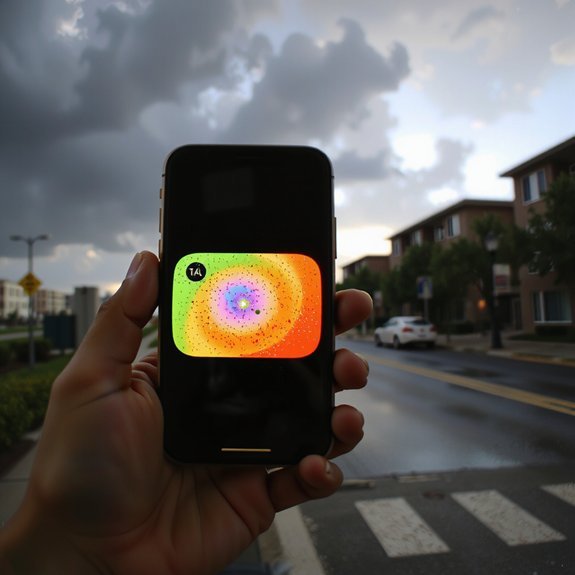
Some days, the surest way to feel ready is to watch the rain arrive before a single drop hits your skin, and that’s exactly what radar lets you do. Start with base reflectivity interpretation—the colors and dBZ numbers that show how hard it’s raining. As you loop the frames, notice if values climb from 10–20 dBZ to 30–40 dBZ or even past 45 dBZ; that deepening shade means thicker curtains of rain drawing closer.
| Scene on radar | How you might feel |
|---|---|
| Pale greens, far away | Breathing easy, finishing errands |
| Yellows sliding nearer | Zipping up, texting a quick heads‑up |
| Echoes right overhead | Smelling wet pavement, settling in |
Use motion arrows to gauge speed, divide distance by that speed, then check elevation sweeps, composite reflectivity, and radial velocity—layers of evidence guiding your timing.
Microclimates and Why Your Rain Time May Vary
Even when the app promises rain at 3:15 sharp, your street, your porch, your favorite walking path can tell a different story—because tiny, hidden microclimates are quietly rewriting the script above your head. You might watch a downpour drench the next neighborhood while your sidewalk stays dry, simply because local temperature, humidity, and Vegetation cover shift the balance of what the sky decides to release.
Hills, ridges, and small valleys bend the wind and lift the air, so an upslope cabin gets soaked an hour earlier while a leeward cul-de-sac waits under bright, uneasy sun. In cities, dark roofs and pavement store extra heat, building rising plumes that can spark afternoon storms long before the nearby fields feel a drop.
Along coasts and lakes, gentle breezes collide like slow-motion fronts, nudging showers inland at different times. Soil moisture quietly steers timing too, holding heat, feeding rising air upward.
Getting Rain Alerts From Weather Apps and Websites
As you turn to weather apps and websites, you’re really learning to listen for rain in a new way—through quiet buzzes on your phone, small banners on your screen, and emails that arrive just before the first drops touch the sidewalk.
You’ll set up rain notifications that use your exact location, tune thresholds so you’re warned only when the odds or intensity truly matter to you, and choose timing options that range from “storm in a few minutes” to “likely showers in the next couple of hours.”
Let this be a calm, practical ritual—check your settings, adjust alert frequency, and notice how a well‑timed notification can bring a sense of presence, preparedness, and even gratitude when the sky finally opens.
Setting Up Rain Notifications
Catching the first hint of rain before it reaches your window isn’t magic—it’s a small habit of preparation that turns your phone into a quiet lookout on the horizon. Open your weather app, enable notifications.
| Feature | Why it matters | What you do |
|---|---|---|
| Precise location | Focuses on your true neighborhood | Allow location “Always” or similar |
| Severe alerts | Warn about floods and dangerous rain | Turn on NWS/NOAA options in the app |
| Wearable alerts | Tap your wrist when skies shift | Connect the app to your watch or band |
| Radar nowcasts | Catch approaching showers quickly | Keep background updates allowed |
Finally, review your privacy settings with intention, accept a bit of background tracking, and let each buzz remind you that you’re ready for rain instead of caught by surprise.
Choosing Alert Timing Options
How do you want the rain to fit into your day—slipping in as a quiet surprise, or arriving right on schedule because you chose when to be told it was coming?
Start by matching alerts to your personal routines—immediate push when radar spots showers, or gentle heads‑up 5, 10, 30, even 60 minutes before the first drops.
For bigger planning, lean on hourly or daily summaries, then breathe.
Set thresholds that fit your comfort: maybe only when PoP hits 30%, or when rain strengthens past a light 0.1 in/hr patter into a steady 0.5 in/hr drum.
Choose precise locations and quiet hours as an act of alert etiquette, protecting others’ sleep, your focus, and your phone’s battery.
Let thoughtful choices turn forecasts into calm.
Planning Your Day Around Expected Rain Windows
When you know roughly when showers will start and stop, you can shape your day with intention—running errands in the crisp, dry air before clouds thicken, then settling into something cozy and unhurried as the first drops tap against the windows.
You’ll time your walks, workouts, and commutes around those expected rain windows, using the forecast not as a limit but as a partner that helps you move through the day with more presence and less stress.
Think of each dry break as a small gift of clear sky and light, an opening you can claim for what matters most—fresh air with a friend, a quiet moment on a bench, or a simple, grateful walk home.
Timing Your Outdoor Plans
Suddenly find yourself eyeing the sky and wondering if those dark clouds will crash your picnic, your run, or that long-promised backyard project? Start by checking the hour‑by‑hour forecast for meal timing and transport coordination, then match your plans to the most generous dry slice, treating the rain chances like a friendly but firm schedule. Use low probabilities to lock in flexible walks or reading on the porch, keep moderate odds for errands and backup indoor options, and reserve high‑risk hours for rest, reflection, or simple presence at home, holding your energy—rather than the weather—responsible for the day’s meaning. You’re not dodging storms, you’re directing the story.
| Time window | Plan | Signal type |
|---|---|---|
| 0–3 | Tasks | Radar nowcast |
| 3–6 | Errands | Hourly forecast |
| 6–12 | Gatherings | Model consensus |
Maximizing Dry Weather Windows
Ever notice that the best dry moments can slip past while you’re still “thinking about” going outside? When the sky looks unsettled, open your radar app, watch the 5–10 minute updates, and look for 15–60 minute gaps between bright storm cells—those are your golden windows for errands, yard work, or quick Material Storage checks.
Pair that with hourly PoP, favoring slots at 20% or lower, and treating values above 60% as your cue to shift plans or focus on indoor Drainage Preparation.
Trust rapid‑refresh models for the next 18 hours, add a 10–20 minute buffer on both sides of any rain signal, then choose tasks that fit comfortably inside each window, not pressed against it, so you move with calm purpose, not rushed regret.
When the Forecast Changes: Adjusting to Shifting Rain Times
Even the most reliable forecast can shift under your feet, and learning to move with those changes turns a “ruined” afternoon into a flexible, almost peaceful kind of dance with the sky.
Let shifting forecasts guide you, turning disrupted plans into a calmer, more curious dance with the weather
You start with expectation management, then you add quiet contingency planning—backup locations, backup times, backup moods.
See a 60% PoP from 3–6 PM? Treat it as a window, not a promise, and hold your plans with an open hand.
- Watch radar every 5–10 minutes, noticing echoes sliding closer like distant gray curtains.
- Use nowcasts to nudge start times forward or back by an hour, not by a single anxious minute.
- Glance at ensembles, imagining a band of possible onsets instead of one fragile line.
- Set phone alerts, then let them carry some of the worry for you.
- When rain arrives early or late, pause, feel the air shift, and choose presence over frustration and quiet gratitude.
Frequently Asked Questions
Can Rain Forecasts Predict Exactly When a Storm Will Start and Stop?
No, you can’t rely on forecasts to time a storm’s exact first and last raindrops, because model uncertainty and nowcasting challenges always blur the edges.
Still, you can watch the sky—darkening clouds, a rising wind, that charged hush before the first splash—and feel more prepared than powerless.
Let radar loops guide you, then add your own presence, curiosity, and gratitude for the weather’s wild authenticity in each sudden shift outside.
How Do Mountains or Tall Buildings Affect the Time Rain Reaches Me?
Mountains and tall buildings can delay or speed up when rain reaches you, because they’ll reshape the wind and force moist air to rise.
With mountains, orographic lift makes clouds grow on the uphill side, so the windward timing of showers may hit earlier there, while valleys on the other side might wait longer in a brief, surprising calm.
Notice those shapes around you, and let their influence teach patience.
Why Do Different Weather Apps Give Different Rain Times for the Same Day?
About 70% of rain forecasts miss the exact minute, and you feel that gap when two apps disagree.
They use different radar feeds and sensors, then apply unique algorithms and model differences, so each predicts the storm’s path in its own way.
Add data latency—old observations arriving late—and their timelines split.
Trust trends, notice the sky, and let uncertainty deepen your presence and gratitude in moments of waiting, watching, breathing.
Can My Smartwatch’s Barometer Help Me Guess When It Will Start Raining?
Yes, your smartwatch’s barometer can help you guess, but it’s more a gentle hint than a clock.
Watch for steady pressure drops paired with darkening clouds, rising wind, that earthy smell before rain.
Use Calibration Tips in the app, then practice simple Data Interpretation—note pressure trends, compare them with what actually happens, keep a tiny weather journal, and you’ll grow quietly skilled, patient, and observant over the changing sky above.
How Far in Advance Can Meteorologists Reliably Predict Rain Timing for My Area?
You can usually trust specific rain timing about 1–2 days ahead, with broader yes-or-no guidance out to roughly a week, depending on your region.
That Prediction Horizon shifts with Model Resolution—higher detail lets you see storms like sharp brushstrokes instead of blurry smudges.
Conclusion
Now you can watch the sky and the screen together, noticing dark clouds on the horizon, tiny green blobs on radar, and those shifting hourly chances of rain, then choose your next step with calm confidence. You read the PoPs, you add a time buffer, you honor your own plans and limits. When you ask, “What time is it supposed to rain?” you’re really asking how to live today—so listen carefully, then move forward with presence and gratitude.


