
You probably don’t know your clock lies about darkness. You think sunset means dark. Wrong. At the equator dusk slams shut; in Stockholm it lingers like a bad meeting. Winter cheats you early. Summer toys with you late. Civil, nautical, astronomical—three flavors of “not night yet.” Time zones gaslight you. Hills, snow, city glare—more tricks. Want the real time you lose the light—and why it matters for tonight?
Key Takeaways
- Darkness time varies by latitude and season: equator has ~12-hour days year-round; high latitudes get lingering summer light or polar night.
- Sunset isn’t full dark; civil, nautical, and astronomical twilight extend darkness onset until the Sun is 18° below the horizon.
- Clock time can mislead due to time zones and Daylight Saving; local solar time often differs from the posted sunset.
- Terrain and light pollution change perceived darkness—valleys and wilderness darken fast; cities and clouds keep skies bright longer.
- For exact local times, check Timeanddate or Weather Underground for sunset and twilight, and validate predictions against your sky.
How Latitude Shapes Sunset and Darkness
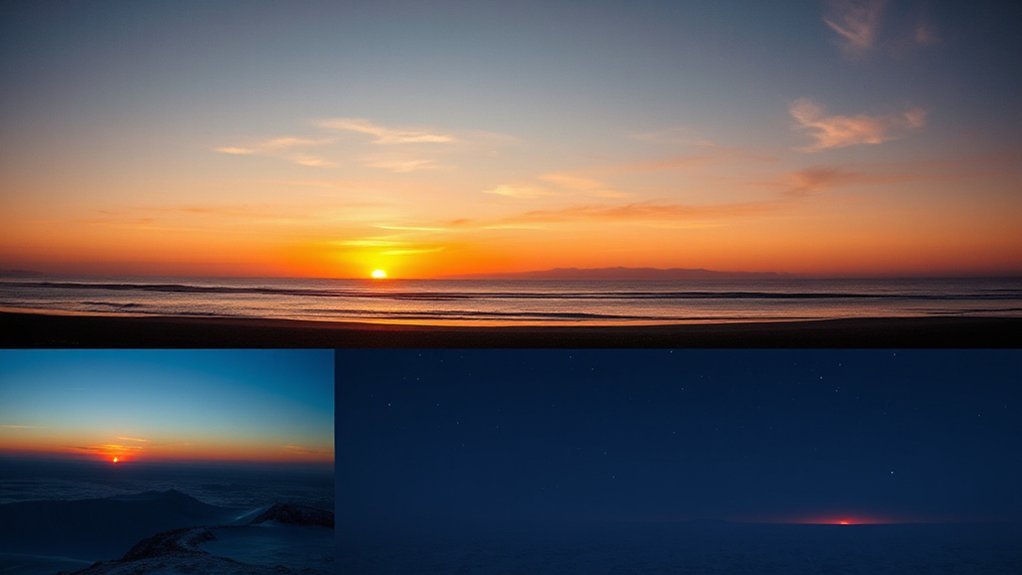
While you might think sunset is a clock thing, latitude rigs the game. You stand on Earth, not a spreadsheet. Near the equator, the sun dives fast. Bam, night. Up north, it drags its feet, scraping the horizon like a stubborn mule. Twilight stretches, then stretches more. You feel every minute. That angle matters. Low arc, long glow. High arc, quick cut. Simple. And it messes with you. Sleep, plans, mood. So you adapt or you lose. You build smarter—shade, courtyards, bright paint, thick walls—real Architectural Adaptations, not buzzwords. You time meals and markets. You throw Cultural Festivals at the sky, daring it to blink. You measure. You brag. You chase that last light down streets, cliffs, rooftops. Admit it. Latitude owns you today.
Seasons and the Changing Length of Evenings
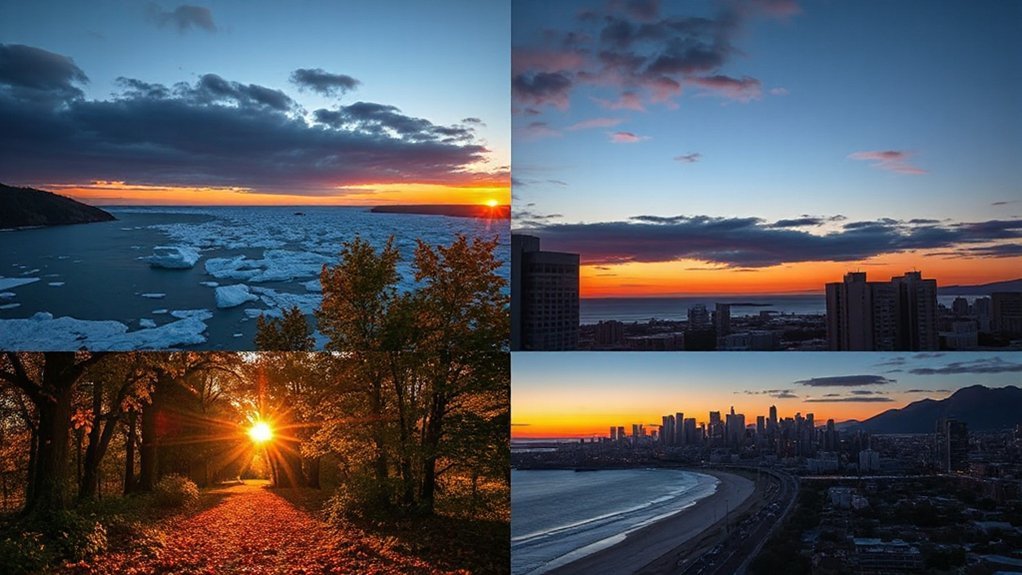
You chase summer’s lingering twilight—streets still glowing at 9 p.m.—because you refuse to go inside. Then winter hits hard and you blink and it’s night, like the sun ditched you before homework even starts. On the equinox light finally plays fair, a clean split, so what will you do with the balance—waste it or own it?
Summer’s Lingering Twilight
Because Earth leans like a show‑off, summer evenings refuse to shut up. You watch the sky stall, then stall again, soaking streets in syrupy blue. Shadows stretch, brag, linger. Time lies. You nod, but you stay. That’s porch culture, loud and stubborn, iced glass sweating while neighbors gossip like cicadas. You make evening rituals: a slow walk, a grill hiss, a last lap around the block you swear is final. Stars tease, then hide. The sun won’t exit. You want sleep? Too bad. The horizon says wait. So you wait, and talk, and dare the light to quit. Kids chase echoes. Sprinklers clap. Bikes flicker by. And still the glow holds, grinning, saying not yet, not now, not for you. Give in to dusk.
Winter’s Early Nightfall
As the planet leans back, the day doesn’t fade—it bails, fast, smug, gone by late afternoon. You blink, and boom, night steals the block. Shadows boss you around. Commutes turn sketchy, and safety concerns aren’t optional; you watch your back, you plan your route, you move. Stores glow like lures. You chase warmth, then check the bill. Heating costs punch, hard. So you choose: extra layers or extra zeros. And that sunset? It’s not romantic. It’s a curfew. You hurry dinner. You skip the park. You argue with the clock and lose. But you’re not helpless. Flip routines. Grab brighter gear, set timers, own the street. Make dark blink first, not you.
| Mood | Reality |
|---|---|
| Short walks | Streetlights by 4:30 |
| Big coat | Heating costs spike |
Equinox Balance of Light
Enough of winter’s sucker punch. You want balance, not shadows chewing the clock. The equinox smacks the seesaw flat. Day meets night, eye to eye, no flinching. You step outside and feel the light cut clean. Not mercy. Precision. Sunset stops sprinting south and catches its breath. Finally.
Time Zones and Daylight Saving: Why Clocks Mislead
Though you swear the clock tells truth, it lies to your face. You chase numbers, not the Sun. Noon slides later because your zone got stitched to a capital far east. Blame political boundaries, not the horizon. Your neighbor across a river eats dinner in daylight while you squint at dusk. Fair? Please. Then comes Daylight Saving, the grand prank. We jump an hour, then pretend we’re smarter. You lose sleep, gain glare, and call it progress. The health impacts are real—groggy mornings, crashes, stress. Kids wait in dark streets. Farmers roll eyes. Pilots mutter. You? You keep asking why sunset shifted. Simple. Clocks move. The Earth doesn’t. So stop trusting digits. Watch the sky. Set your life there. Start tonight. Prove the clock.
Civil, Nautical, and Astronomical Twilight Explained
You think sunset ends the show—wrong; twilight hits in three phases, set by the Sun slipping about 6, 12, and 18 degrees below the horizon. Civil means you read street signs, nautical means you steer by a clean horizon, astronomical means the Milky Way punches you in the eyes while the Sun sulks far below. Prove it—look up, try a task, admit it fast: can you see faces, only outlines, or nothing but stars; if you can’t, you picked the wrong phase.
Sun Angles and Phases
While the sky plays coy, the Sun’s angle runs the show. You track degrees, not vibes. Zero at sunset. Then down it dives. At 6 degrees below, you’re in civil twilight; shapes hold, horizon still clean. Push to 12 degrees, nautical twilight; the sea line lurks, and darkness flexes. Drop to 18 degrees, astronomical twilight; the night finally stops arguing. Angles matter. Don’t guess. Watch the arc like a drill sergeant. Latitude twists the timeline, seasons shove, elevation laughs. Your panel orientation? It’s the same geometry game. Tilt wrong, lose power. Tilt right, own the clock. Shadow geometry hammers it home—longer angles, longer reach, brutal and honest. You want dark sooner? Blame the tilt, the track, the math, not the mood. Own it now.
Practical Visibility Thresholds
Angles call the shots; the next question is what your eyes can actually see. Admit it. You don’t care about degrees. You care about faces, curbs, and threats. In civil twilight, your Visual Acuity still hangs on. Contrast Sensitivity? Barely smug. Then it slips. Nautical hits and shapes melt. Stars pop. Streets sulk. You squint. You guess. Astronomical arrives and color dies; the world whispers, hide. Your clock lies. Your pupils beg. Do you move smart or brag dumb? Choose. Light wins. Or you do. Decide right now.
| Phase | What you see | You do |
|---|---|---|
| Daylight | Details sharp | Go normally, safely |
| Civil | Street signs readable | Walk fast |
| Nautical | Horizon faint shapes | Slow down |
| Astronomical | Stars dominate colorless | Use light |
| Night | Detail lost points | Stop, light |
Equator to Poles: Global Patterns and Extremes
Because the planet tilts, sunset plays favorites. Near the equator, you get ruthless consistency. Bam. Day drops off a cliff, year-round, almost twelve and twelve. You blink, it’s night. No mercy.
March north or south and the rules change. Fast. Spring stretches evenings. Fall steals them. High latitudes go extreme. White nights taunt you. Polar night swallows weeks. You want drama? You get it. The clock looks drunk because Earth leans.
And the sky flexes. Aurora distribution tracks magnetic ovals, not your schedule, so twilight can glow green while your breath turns to knives. Meanwhile, permafrost dynamics whisper underfoot—sun angle controls thaw, thaw controls life. You thought sunset was simple. Cute. It’s a moving target, a seasonal fistfight you can’t ignore. Not this far.
City vs. Wilderness: Terrain, Light Pollution, and Perceived Darkness
You think the drama ends at latitude? Think again. Cities cheat the night. Streetlamps pour wattage into the clouds, and the clouds punch back. That hazy dome? Sky glow. It steals stars, flattens contrast, stretches dusk like gum. Shadows vanish. Your eyes never get the memo.
Now hike out. Wilderness doesn’t coddle you. The ridge eats the sun fast. One step and light crashes. Terrain decides, not a clock. Valleys hold twilight, peaks cut it clean. Snow cranks ground reflectivity, bouncing the last rays like a mirror. Desert rock swallows them whole. Same sunset, different punchline.
You want drama? Stand where glass towers blaze, then move to a dark canyon. Tell me it’s the same night. Go on. I dare you. Prove me wrong.
Planning by Purpose: Photography, Running, Fasting, and Stargazing
While the sun drops on its own schedule, your plan decides what that means. Chase golden hour shots, or miss them and blame clouds. Photographers, you map shadows, beg reflections, guard highlights. Runners, you hit dusk for cool air and empty paths, then wear lights because cars don’t care. Fasters, you break with intention, not guesswork. Stargazers, you wait past civil, then nautical, because patience wins.
| Pulse | Picture | Promise |
|---|---|---|
| Heart hammers | Sky explodes | You move |
| Silence swells | Stars ignite | You listen |
Now the rules. Community etiquette matters. Don’t blind hikers, spook wildlife, or crowd the view. Share space. Speak soft. Pack out pride. Emergency prep isn’t drama. It’s headlamp batteries, a charged phone, a route texted, a Plan B. You’re not reckless. You’re ready.
Best Tools and Apps to Predict Tonight’s Fade to Black
When does the sky actually quit? You want answers, not vibes. Grab reliable tools. Try Weather Underground for precise sunset, civil, nautical, astronomical. Or Timeanddate when you need brutal detail. Need maps? Photographers Ephemeris nails shadows and golden hour. Hate dead zones? Choose apps with Offline Functionality so your hike doesn’t become a guess. Battery dies, data lies, you still win.
Demand honesty. Read Privacy Policies like a hawk. If an app tracks you more than the sun, ditch it. Set alerts. Push, not pray. Use widgets so times glare at you. Cross‑check two sources and stop arguing with the horizon. Test tonight. Compare posted dusk to real darkness on your street. Trust the app that earns it. Delete the rest. Do it now.