
Your phone lies; an atomic clock doesn’t. You think seconds are simple? Prove it. In a lab, cesium atoms flip like metronomes so steady they shame pendulums, quartz, your precious smartwatch. Lasers grill atoms. Microwaves argue. Gravity even tweaks time—yeah, your height matters. GPS lives or dies on this. Finance too. You want power over time, not folklore—so here’s how the atoms fight back.
Key Takeaways
- Atomic clocks use atomic energy transitions (e.g., cesium-133 hyperfine) to define the second as exactly 9,192,631,770 cycles.
- They achieve exceptional stability via microwave or optical interrogation with laser cooling, minimizing Doppler, Zeeman, Stark, and blackbody shifts.
- Optical lattice and single-ion clocks operate at optical frequencies, surpassing cesium clocks in precision and long-term stability.
- Stability is quantified using Allan deviation and Ramsey fringes, with systematic corrections validated by cross-comparisons and redundancy.
- Atomic time underpins GPS, finance, and networks; distribution via UTC, NTP/PTP, and authenticated fiber ensures synchronized, trusted time.
From Pendulums to Atoms: A Brief History of Precision Timekeeping
Although you think your phone’s clock is magic, timekeeping got here by sweat, gears, and stubborn minds. You aren’t floating on precision by accident. You stand on monks with water clocks, then Galileo staring at swinging lamps, then Huygens trapping a pendulum in brass. Tick with purpose. Miss, and ships crash. Enter marine chronometers—hardcore boxes that told sailors where they were, or weren’t. You like GPS? Thank those sea beasts. And thank clockmaking guilds, fierce little unions guarding secrets like dragons. They fought, they sued, they crowed. Progress still shoved through. Springs got tighter. Escapements got cleaner. Quartz arrived and laughed at wobble. You flinch at drift now. Good. Demand better. Atomic clocks raised the bar again. History’s message? Don’t trust guesses. Earn time.
Inside the Atom: How Cesium Transitions Define the Second
How do we nail time to the wall without it wriggling free? We bully an atom. Cesium‑133 to be exact. Its electrons and nucleus lock into a tidy duel. Call it hyperfine splitting. One tiny magnetic tug from nuclear spin, one from the electron. Two levels. A jump between them sings one microwave note. You blast it. The atom answers. That frequency doesn’t drift, you say. It dictates the second. Count 9,192,631,770 cycles, bang, one tick. Not a wish. A rule. You don’t ask a pendulum. You command a quantum. Cesium obeys because physics doesn’t care about your schedule. It cares about energy gaps. Flip the spin state, snag the signal, march the seconds. Precise. Relentless. Almost rude. Good. Keep up. Right now, always.
Measuring and Minimizing Error: Stability, Accuracy, and Systematic Shifts
You measure short‑term stability with tools like Allan deviation and Ramsey fringes, and you stare down the jitter like it’s taunting you. You smash systematic shifts—Zeeman, Stark, Doppler, blackbody—using shielding, thermal control, laser tuning, smart geometry. Measure, fix, repeat—because if you can’t crush noise and shifts, your “precision” is a joke.
Short-Term Stability Metrics
Why chase short‑term stability? Because seconds matter and your clock either holds its nerve or it lies. You test it hard. You track fractional frequency with Allan deviation across averaging time τ. If the curve drops fast, you win. If it stalls, you fix noise, not later, now. You parse phase noise close to carrier. You watch time deviation to see jitter punch holes in your data stream. Don’t guess. Use benchmark datasets and smash them against your trace. Then use visualization techniques—log–log plots, noise slope overlays, residuals—to spot flicker, white FM, random walk, the usual villains. Compare overlapping Allan to Hadamard when drift lurks. Short windows, brutal honesty. You measure. You average. You reject outliers. You demand quiet. No excuses. Stability speaks now.
Systematic Shift Mitigation
Even when the clock is quiet, it lies—systematic shifts whisper in the decimals. You hunt them. You cage them. Temperature first. Heat fakes time, so you shroud the cavity, map gradients, slam doors on drift. Magnetic fields next. Shield hard. Probe soft. Calibrate, then calibrate again. Motion cheats too. Cool the atoms. Trap them tight. Interrogate short, compare long. And when you doubt, you measure the doubt.
You don’t trust a single box. Redundancy Planning saves you when one diva screeches off key. Cross‑compare clocks, swap references, expose liars. Predictive Maintenance isn’t cute, it’s survival. Trend offsets daily, flag jumps, replace parts before they dream of failing. Document everything. Challenge every digit. If it moves, you nail it. If it stalls, you shake it.
From Microwave to Optical: The Rise of Optical Lattice and Ion Clocks
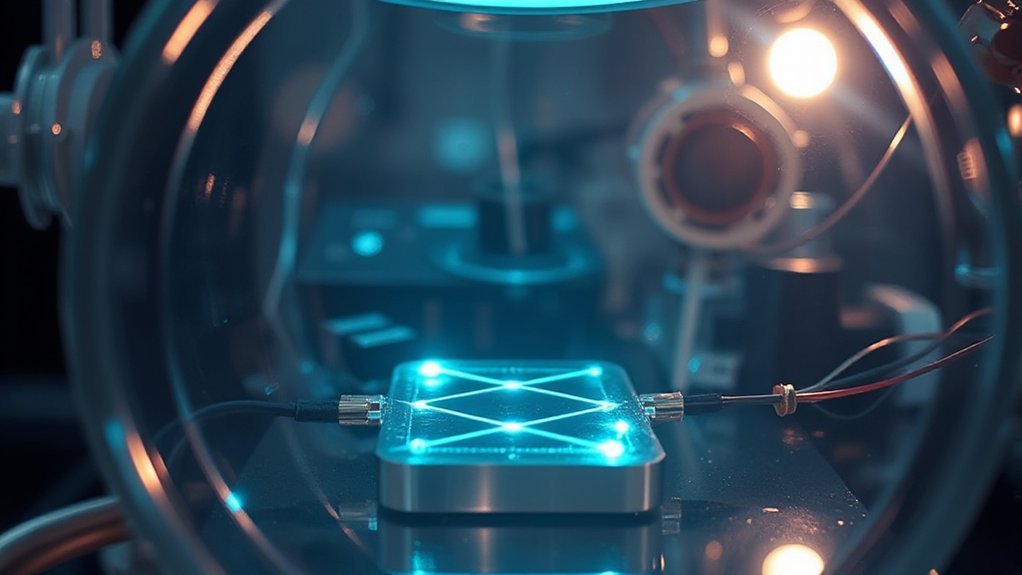
While microwave clocks brag about ticking with cesium, optical clocks roll their eyes and count light waves instead. You want speed and ruthlessness? Go optical. You lock atoms with laser cooling, slam motion to near zero, then beat time with petahertz teeth. Lattice clocks pin thousands of strontium like bugs, averaging noise to dust. Ion clocks go monastic: one ion, zero mercy, absurd purity. You think that’s overkill? Precision hates chill.
Here’s at‑a‑glance smackdown.
| Clock type | Killer move |
|---|---|
| Optical lattice (Sr, Yb) | Many atoms, tight lattice, laser cooling crushes jitter |
| Single‑ion (Al+, Yb+) | One ion, pristine line, brutal isolation |
Next step you should demand: quantum entanglement to squeeze even harder.
Why It Matters: GPS, Networks, Finance, and Fundamental Physics
Because seconds rule everything around you. Miss a beat and GPS stops being a map and becomes a rumor. Your phone gets lost. Planes drift. Autonomous navigation throws a tantrum. You think that’s fine? Cool. Enjoy traffic cones forever.
Markets? Same deal. If clocks slip, trades misfire, prices smear, and your portfolio eats pavement. HFT synchronization isn’t a luxury. It’s oxygen. Milliseconds pick winners. Microseconds bury losers. You want fair? Keep time brutal.
Networks breathe timing too. Packets line up or crash. Cloud melts, streams stutter, and your game lags into rage. Not cute.
Physics? Timing slices reality. Compare atomic ticks and you test relativity in the wild, sniff dark matter, and hunt tiny drifts that rewrite textbooks. You want truth? Start counting. Now.
Distributing Perfect Time: NTP, PTP, GNSS, and Emerging Time Services
If your clock is perfect but you can’t share it, it’s a trophy. You need reach. NTP spreads seconds to masses, cheap and sloppy but everywhere. PTP fights for microseconds on wired networks, tight, bossy, and unforgiving. GNSS rains time from space; you love it until jammers sneeze and everything staggers. So you blend. Holdover, fiber, satellites, even new terrestrial time broadcasts. You demand Authentication Protocols, or spoofers will feed you lies. You follow Regulatory Frameworks, or auditors will eat you alive. Test. Monitor. Alarm. No excuses. You stamp logs, trades, control loops, and lab runs with truth, not wishful thinking. Want trust? Prove it. Trace to UTC. Show the chain. Lose drift. Kill latency. Share time like you mean it. Right now today.